Julian owns a fruit stall selling fruit juice. The tables below give information related to Julian's stall.
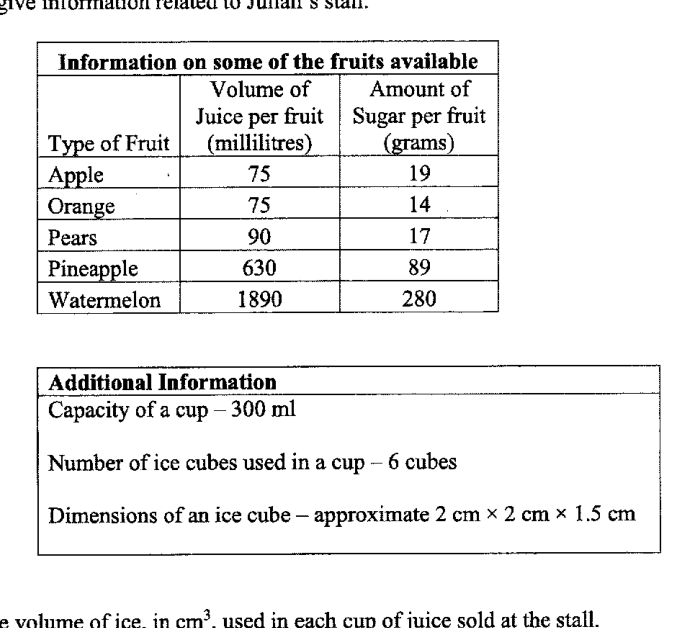
- (a)
Calculate the volume of ice, in cm³, used in each cup of juice sold at the stall.
Answer ... cm³
- (b)
Estimate the amount of sugar content, in grams, in 1 cup of apple juice with ice.
Answer ... g
- (c)
As part of the fight against diabetes, it is recommended that the amount of sugar intake for each Singaporean should be less than 10 teaspoons a day (1 teaspoon of sugar = 5 grams of sugar).
A study also shows that a typical Singaporean will consume multiple sources of food products that contain sugar within a single day.
Julian plans to introduce a new recipe of mixed fruit juice.
Determine if Julian's new recipe will be considered as suitable for Singaporeans who wishes to stay healthy and avoid diabetes.
Justify the decision with calculations.
It won't just hand you the answer — it asks where you're stuck.How the checker works
Worked solution
10(a)
1. Calculate the total volume of ice used in one cup.
Volume of one ice cube
Volume of 6 ice cubes
10(b)
1. Find the volume of apple juice in one cup after allowing for the ice.
From part (a), volume of ice in one cup .
Volume of apple juice
2. Use direct proportion to estimate the sugar content in $264\text{ ml}$ of apple juice.
For apple juice, contains of sugar.
Sugar in
10(c)
1. Find the volume of mixed fruit juice in the cup and the equal volume from each fruit.
From part (a), volume of ice in one cup .
Volume of juice in one cup
Since equal amounts of juice are used from each of the 3 fruits,
of juice is used from each fruit.
2. Identify the compulsory fruit and choose the lowest-sugar possible recipe for a fair health test.
The fruit with the highest sugar content per fruit is watermelon, since it has of sugar per fruit.
To minimise sugar content while satisfying the recipe condition, choose the two fruits with the lowest sugar per ml:
So consider watermelon, pineapple and orange.
3. Calculate the sugar content contributed by each of the 3 fruits using direct proportion.
Sugar from of watermelon juice:
Sugar from of pineapple juice:
Sugar from of orange juice:
4. Find the total sugar content in one cup and convert it to teaspoons.
Total sugar in one cup
Since teaspoon of sugar ,
teaspoons of sugar.
5. Make and justify the health decision using the daily recommendation and the context of other sugar sources.
The recommended daily sugar intake is less than
One cup of the least sugary possible mixed fruit juice already contains about
This leaves only
of sugar, or about
teaspoons, for all other food products in the day.
Since a typical Singaporean consumes sugar from multiple sources in a day, this drink is too close to the daily limit.
The least sugary possible recipe using watermelon, pineapple and orange contains about of sugar, or teaspoons, in one cup. Since this is already close to the recommended daily limit of teaspoons and a typical Singaporean consumes sugar from other food products too, Julian's new recipe is not suitable for Singaporeans wishing to stay healthy and avoid diabetes.
AI analysis — may contain mistakes.
Worked this one out on paper? Snap your steps and Gigle's AI math checker will circle the step where it went wrong.
More questions on this topic
- 1A cuboid has a volume of 250 cm^3, correct to the nearest cubic centimetre. The height of the cuboid is 8.4 cm, correct…
- 2Isaiah cuts open a cardboard cube along some of its edges to form the flat shape shown on the right, which has an area o…
- 3Alex and Felicia each have cats as pets. Alex buys cat food in cylindrical cans that are in diameter and …
- 4把一个长方体正好分割成两个完全相同正方体,若分割后的正方体的棱长为4cm,则分割后比分割前表面积增加了 ,总体积增加了 .
- 5The figure below is made up of 1-cm cubes. What is the volume of the figure? Ans : ___