The diagram shows the curve with parametric equations
The curve meets the axes at and .
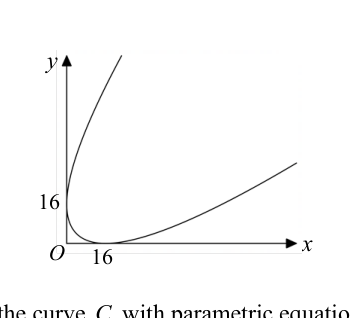
- (a)
Show that the line meets at the point where .
- (b)
The normal to at is denoted by .
Find the cartesian equation of . - (c)
The line meets again at the point where . Show that the area of the region bounded by , the lines , and the -axis is units.
- (d)
Show that the area (in units) of the region bounded by and can be given by
where , and the constants and are to be determined.
Hence find the value of this area.
It won't just hand you the answer — it asks where you're stuck.How the checker works
Worked solution
5(a)
1. Set up an equation for $t$ when $x = 16$ and solve it.
2. Identify which value of $t$ corresponds to point $P$.
When , . This gives the -intercept which is already given in the question.
Thus, the other intersection point where the line meets corresponds to (shown).
Shown
5(b)
1. Find the $y$-coordinate of the point $P$ where $t = -5$.
At ,
The coordinates of are .
2. Find the gradient of the curve $\frac{\mathrm{d}y}{\mathrm{d}x}$ at $P$ using parametric differentiation.
At ,
3. Determine the gradient of the normal and formulate its equation.
The gradient of the normal is .
Using the point-gradient equation :
5(c)
1. State or re-derive the Cartesian equation of the normal $l$ (required from part b).
Using the parametric equations and :
and .
At where , and .
The gradient of the normal is .
The coordinates of are and .
The equation of is:
.
2. Find the parameter $t$ at point $Q$ where the line $l$ intersects the curve $C$ again.
Substitute and into :
Multiply by 2 to eliminate the fraction:
Since the line meets at , is a known factor:
For point , .
3. Calculate the boundaries $x = b$ and the corresponding $y$-coordinate for point $Q$.
Substitute into the respective parametric equations:
4. Calculate the exact area of the region bounded by $l$, $x = 16$, $x = b$, and the $x$-axis.
The region is bounded above by the straight line , forming a trapezium with parallel vertical sides and . This can be evaluated via definite integration or the geometry area formula:
\frac{266240}{81}
5(d)
1. Set up the integral for the total bounded area using the geometry of the curves.
The line meets at when , and at when .
Between these points, reaches a minimum -value at , where and .
The region is bounded above by the line (for ) and the upper branch of (for ), and bounded below by the lower branch of (for ).
Thus, the total area bounded by and is:
2. Express the curve areas in terms of the parameter $t$.
From part (c), the area under is .
For , ranges from to as decreases from to . Using parametric integration:
For , ranges from to as increases from to :
3. Combine the integrals to find $c$, $d$ and $\mathrm{f}(t)$.
Substitute the parametric areas into the total area expression:
Comparing this with , we find:
Given and :
4. Evaluate the integral to find the required area.
Let .
Use the substitution and .
When , . When , .
Evaluate at upper limit :
Evaluate at lower limit ():
Subtract to find :
Finally, the total bounded area is:
, , ; Area
AI analysis — may contain mistakes.
Worked this one out on paper? Snap your steps and Gigle's AI math checker will circle the step where it went wrong.