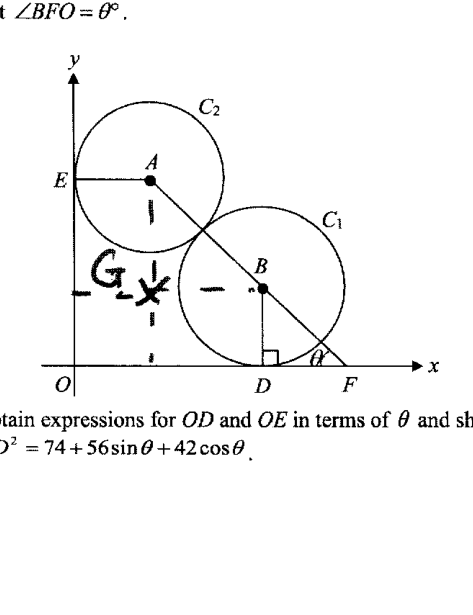
The figure shows two circles and which touch each other and lie in the -plane as shown below. has radius 4 units and touches the -axis at , has radius 3 units and touches the -axis at . The line , joining the centres of and , meets the -axis at such that .
- (i)
Obtain expressions for and in terms of and show that .
- (ii)
Express in the form where and .
- (iii)
Find the maximum value of and the value of at which this occurs.
It won't just hand you the answer — it asks where you're stuck.How the checker works
Worked solution
10(i)
1. Determine the distance between the centres of the two circles.
Since the circles touch each other externally, the distance between their centres and is the sum of their radii:
2. Express the coordinates of $A$ and $B$ in terms of $OD$ and $OE$.
Circle touches the -axis at , so the -coordinate of is 3. Thus, .
Circle touches the -axis at , so the -coordinate of is 4. Thus, .
3. Use trigonometry to find expressions for $OD$ and $OE$.
The line makes an angle with the horizontal. By drawing a right-angled triangle with hypotenuse :
Horizontal distance between and is .
Therefore, .
Vertical distance between and is .
Therefore, .
4. Show the expression for $ED^2$ using Pythagoras' theorem.
In , .
Since :
(shown)
,
(shown)
10(ii)
1. Set up the R-formula equivalence for the trigonometric part of the expression
We need to express in the form .
Expanding gives .
Comparing coefficients:
2. Calculate the value of R
3. Calculate the value of alpha and write the final expression
(to 1 d.p.)
Therefore, .
10(iii)
1. Find the values of $R$ and $\alpha$ from part (ii)
From part (ii), .
Comparing coefficients:
So, .
2. Find the maximum value of $ED$
For maximum , must be maximum.
The maximum value of is .
Max
Max
3. Find the value of $\theta$ at which the maximum occurs
The maximum occurs when .
(to 1 d.p.)
Maximum value of , at
AI analysis — may contain mistakes.
Worked this one out on paper? Snap your steps and Gigle's AI math checker will circle the step where it went wrong.