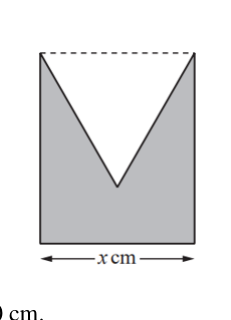
The diagram shows a shape made by cutting an equilateral triangle out of a rectangle of width cm. The perimeter of the shape is 20 cm.
- ((i))
Show that the area, cm, of the shape is given by
- ((ii))
Given that can vary, find the value of which produces the maximum area and calculate this maximum area. Give your answers to 2 significant figures.
It won't just hand you the answer — it asks where you're stuck.How the checker works
Worked solution
5((i))
1. Express the perimeter of the shape in terms of $x$ and the height of the rectangle, $y$, and solve for $y$.
Let the height of the rectangle be cm.
The perimeter consists of the bottom width (), the two vertical sides (), and the two inner sides of the equilateral triangle ().
Perimeter
Given the perimeter is 20 cm:
2. Find the area of the rectangle and the area of the equilateral triangle in terms of $x$.
Area of the rectangle
Area of the equilateral triangle
3. Subtract the triangle's area from the rectangle's area to obtain the final expression for $A$.
Area of the shape, = Area of rectangle - Area of triangle
(Shown)
Shown
5((ii))
1. Differentiate the area function with respect to $x$
2. Set the derivative to zero to find the stationary point
For maximum area,
3. Verify that the stationary point is a maximum
Since the second derivative is negative, the area is a maximum.
4. Calculate the maximum area and round both answers to 2 significant figures
Substitute into :
To 2 significant figures:
Maximum area
, Maximum area
AI analysis — may contain mistakes.
Worked this one out on paper? Snap your steps and Gigle's AI math checker will circle the step where it went wrong.
More questions on this topic
- 1The diagram shows a greenhouse built on a rectangular base. of polyethene is used to build the curved r…
- 2In the triangle , , and angle . If is increasing…
- 3A curve has the equation , where . The normal to the point on the cur…
- 4Find the gradient function of the curve . The curve touches the positive -axis at point . Fi…
- 5The normal to the curve at point crosses the -axis at point …