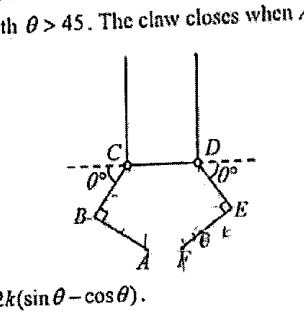
The claw of a claw machine is designed such that AB=BC=CD=DE=EF=k cmAB = BC = CD = DE = EF = k\text{ cm} with angle ABC=angle FED=90∘ABC = \text{angle } FED = 90^\circ. The two sides of the claw, ABCABC and FEDFED, hinge at CC and DD respectively at angle θ∘\theta^\circ with θ>45\theta > 45. The claw closes when AA and FF touches one another.

  1. (i)

    Show that AF=k−2k(sin⁡θ−cos⁡θ)AF = k - 2k(\sin\theta - \cos\theta).

  2. (ii)

    Express sin⁡θ−cos⁡θ\sin\theta - \cos\theta in the form Rsin⁡(θ−α)R\sin(\theta - \alpha), where R>0R > 0 and 0∘<α<90∘0^\circ < \alpha < 90^\circ.

  3. (iii)

    Hence, find the value of θ\theta when the claw closes.

Work through it with AI →

It won't just hand you the answer — it asks where you're stuck.How the checker works

Worked solution

6(i)

1. Determine the horizontal distance from C to B

Let the horizontal line through CC and DD be the reference line. The horizontal distance from CC to BB is kcos⁡θk \cos \theta.

2. Determine the horizontal distance from B to A

Since ∠ABC=90∘\angle ABC = 90^\circ, the angle ABAB makes with the horizontal is 90∘−θ90^\circ - \theta. The horizontal distance from BB to AA (moving rightwards) is kcos⁡(90∘−θ)=ksin⁡θk \cos(90^\circ - \theta) = k \sin \theta.

3. Calculate the total horizontal distance between A and F

The horizontal position of AA relative to CC is −kcos⁡θ+ksin⁡θ-k \cos \theta + k \sin \theta. By symmetry, the horizontal position of FF relative to DD is kcos⁡θ−ksin⁡θk \cos \theta - k \sin \theta. The distance CD=kCD = k. Thus, the distance AF=k−2(ksin⁡θ−kcos⁡θ)=k−2k(sin⁡θ−cos⁡θ)AF = k - 2(k \sin \theta - k \cos \theta) = k - 2k(\sin \theta - \cos \theta).

Answer

Shown

6(ii)

1. Expand $R\sin(\theta - \alpha)$ and equate coefficients

Rsin⁡(θ−α)=R(sin⁡θcos⁡α−cos⁡θsin⁡α)R\sin(\theta - \alpha) = R(\sin\theta\cos\alpha - \cos\theta\sin\alpha)
Comparing with sin⁡θ−cos⁡θ\sin\theta - \cos\theta:
Rcos⁡α=1R\cos\alpha = 1
Rsin⁡α=1R\sin\alpha = 1

2. Find the value of $R$

R=12+12=2R = \sqrt{1^2 + 1^2} = \sqrt{2}

3. Find the value of $\alpha$ and write the final expression

tan⁡α=11=1\tan\alpha = \frac{1}{1} = 1
Since 0∘<α<90∘0^\circ < \alpha < 90^\circ, α=45∘\alpha = 45^\circ
∴sin⁡θ−cos⁡θ=2sin⁡(θ−45∘)\therefore \sin\theta - \cos\theta = \sqrt{2}\sin(\theta - 45^\circ)

Answer

2sin⁡(θ−45∘)\sqrt{2}\sin(\theta - 45^\circ)

6(iii)

1. Set up the equation for when the claw closes

When the claw closes, AA and FF touch, so AF=0AF = 0.
k−2k(sin⁡θ−cos⁡θ)=0k - 2k(\sin\theta - \cos\theta) = 0
1−2(sin⁡θ−cos⁡θ)=01 - 2(\sin\theta - \cos\theta) = 0
sin⁡θ−cos⁡θ=12\sin\theta - \cos\theta = \frac{1}{2}

2. Substitute the R-formula expression from part (ii)

From part (ii), sin⁡θ−cos⁡θ=2sin⁡(θ−45∘)\sin\theta - \cos\theta = \sqrt{2}\sin(\theta - 45^\circ).
2sin⁡(θ−45∘)=12\sqrt{2}\sin(\theta - 45^\circ) = \frac{1}{2}
sin⁡(θ−45∘)=122=24\sin(\theta - 45^\circ) = \frac{1}{2\sqrt{2}} = \frac{\sqrt{2}}{4}

3. Solve for theta

Basic angle α=sin⁡−1(122)≈20.7048∘\alpha = \sin^{-1}\left(\frac{1}{2\sqrt{2}}\right) \approx 20.7048^\circ
Since θ>45∘\theta > 45^\circ, θ−45∘>0\theta - 45^\circ > 0.
θ−45∘=20.7048∘\theta - 45^\circ = 20.7048^\circ
θ=65.7048∘≈65.7∘\theta = 65.7048^\circ \approx 65.7^\circ

Answer

75∘75^\circ

AI analysis — may contain mistakes.

Worked this one out on paper? Snap your steps and Gigle's AI math checker will circle the step where it went wrong.

More questions on this topic

  1. 1Solve the equation 2cot⁡22x=1−5sin⁡2x2 \cot^2 2x = 1 - \frac{5}{\sin 2x} for −180∘≤x≤180∘-180^\circ \le x \le 180^\circ.
  2. 2已知sin⁡(α+π12)=55\sin (α+ \dfrac {π}{12} )= \dfrac { \sqrt {5}}{5},则sin⁡(π3−2α)=(    )\sin ( \dfrac {π}{3} -2α)= (\:\:\:\:) A. 45 \dfrac {4}{5}…
  3. 38.8.设△ABC\triangle ABC的内角AA,BB,CC所对的边分别为aa,bb,cc,若bcos⁡C+ccos⁡B=asin⁡Ab\cos C+c\cos B=a\sin A,则△ABC\triangle ABC的形状为…
  4. 4Prove that sin⁡3xsec⁡2x+sin⁡x=tan⁡xsec⁡x\sin^{3} x\sec^{2} x + \sin x = \tan x\sec x. Solve the equation sin⁡3xsec⁡2x+sin⁡x=5\sin^{3} x\sec^{2} x + \sin x = 5 for 0≤x≤360∘0 \le x \le 360^\circ…
  5. 5Given that cos⁡x=−45\cos x = -\frac{4}{5} and tan⁡x>0\tan x > 0, find sin⁡2x\sin 2x, cos⁡x2\cos \frac{x}{2}.