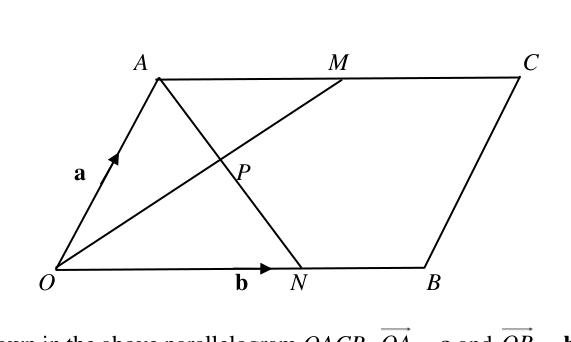
As shown in the above parallelogram OACBOACB, OA→=a\overrightarrow{OA} = \mathbf{a} and OB→=b\overrightarrow{OB} = \mathbf{b}. It is given that MM is the midpoint of ACAC and ON:NB=2:1ON : NB = 2 : 1. The point PP is the intersection of the line OMOM and ANAN.

  1. (i)

    By letting OP→=λOM→\overrightarrow{OP} = \lambda \overrightarrow{OM} and AP→=μAN→\overrightarrow{AP} = \mu \overrightarrow{AN}, find the value of λ\lambda and μ\mu and hence the position vector of PP in terms of a\mathbf{a} and b\mathbf{b}.

  2. (ii)

    Given that the point QQ lies on ANAN produced and is such that AN:NQ=2:1AN : NQ = 2 : 1, find the position vector of QQ and hence determine if QQ, BB and CC are collinear.

Work through it with AI →

It won't just hand you the answer — it asks where you're stuck.How the checker works

Worked solution

1(i)

1. Find an expression for $\overrightarrow{OP}$ in terms of $\lambda$, $\mathbf{a}$, and $\mathbf{b}$.

Given that MM is the midpoint of ACAC, and OACBOACB is a parallelogram:
AM→=12AC→=12OB→=12b\overrightarrow{AM} = \frac{1}{2}\overrightarrow{AC} = \frac{1}{2}\overrightarrow{OB} = \frac{1}{2}\mathbf{b}
OM→=OA→+AM→=a+12b\overrightarrow{OM} = \overrightarrow{OA} + \overrightarrow{AM} = \mathbf{a} + \frac{1}{2}\mathbf{b}
Since OP→=λOM→\overrightarrow{OP} = \lambda \overrightarrow{OM}, we have:
OP→=λ(a+12b)=λa+λ2b\overrightarrow{OP} = \lambda \left( \mathbf{a} + \frac{1}{2}\mathbf{b} \right) = \lambda \mathbf{a} + \frac{\lambda}{2}\mathbf{b}

2. Find a second expression for $\overrightarrow{OP}$ in terms of $\mu$, $\mathbf{a}$, and $\mathbf{b}$.

Given that ON:NB=2:1ON : NB = 2 : 1, we have ON→=23OB→=23b\overrightarrow{ON} = \frac{2}{3}\overrightarrow{OB} = \frac{2}{3}\mathbf{b}.
AN→=AO→+ON→=−a+23b\overrightarrow{AN} = \overrightarrow{AO} + \overrightarrow{ON} = -\mathbf{a} + \frac{2}{3}\mathbf{b}
Since AP→=μAN→\overrightarrow{AP} = \mu \overrightarrow{AN}, we have:
AP→=μ(−a+23b)\overrightarrow{AP} = \mu \left( -\mathbf{a} + \frac{2}{3}\mathbf{b} \right)
OP→=OA→+AP→=a+μ(−a+23b)=(1−μ)a+2μ3b\overrightarrow{OP} = \overrightarrow{OA} + \overrightarrow{AP} = \mathbf{a} + \mu \left( -\mathbf{a} + \frac{2}{3}\mathbf{b} \right) = (1 - \mu)\mathbf{a} + \frac{2\mu}{3}\mathbf{b}

3. Form simultaneous equations by equating the coefficients of $\mathbf{a}$ and $\mathbf{b}$.

Since vectors a\mathbf{a} and b\mathbf{b} are non-parallel, we can equate their respective coefficients from the two expressions for OP→\overrightarrow{OP}:
For a\mathbf{a}: λ=1−μ\lambda = 1 - \mu (Equation 1)
For b\mathbf{b}: λ2=2μ3\frac{\lambda}{2} = \frac{2\mu}{3} (Equation 2)

4. Solve the simultaneous equations to find the values of $\lambda$ and $\mu$.

From Equation 2, we have λ=4μ3\lambda = \frac{4\mu}{3}.
Substituting this into Equation 1 gives:
4μ3=1−μ\frac{4\mu}{3} = 1 - \mu
4μ3+μ=1\frac{4\mu}{3} + \mu = 1
7μ3=1  ⟹  μ=37\frac{7\mu}{3} = 1 \implies \mu = \frac{3}{7}
Substituting μ\mu back into the expression for λ\lambda:
λ=43(37)=47\lambda = \frac{4}{3}\left(\frac{3}{7}\right) = \frac{4}{7}

5. Substitute $\lambda$ or $\mu$ back into the vector equation to find the position vector of $P$.

Using the expression with λ\lambda:
OP→=(47)a+12(47)b=47a+27b\overrightarrow{OP} = \left(\frac{4}{7}\right)\mathbf{a} + \frac{1}{2}\left(\frac{4}{7}\right)\mathbf{b} = \frac{4}{7}\mathbf{a} + \frac{2}{7}\mathbf{b}

Answer

λ=47\lambda = \frac{4}{7}, μ=37\mu = \frac{3}{7}, OP→=47a+27b\overrightarrow{OP} = \frac{4}{7}\mathbf{a} + \frac{2}{7}\mathbf{b}

1(ii)

1. Find the position vector of $Q$.

From ON:NB=2:1ON : NB = 2 : 1, we have ON→=23b\overrightarrow{ON} = \frac{2}{3}\mathbf{b}.
Since QQ lies on ANAN produced and AN:NQ=2:1AN : NQ = 2 : 1, the point NN divides the line segment AQAQ internally in the ratio 2:12 : 1.
By the ratio theorem:
ON→=1OA→+2OQ→2+1\overrightarrow{ON} = \frac{1\overrightarrow{OA} + 2\overrightarrow{OQ}}{2+1}
23b=a+2OQ→3\frac{2}{3}\mathbf{b} = \frac{\mathbf{a} + 2\overrightarrow{OQ}}{3}
2b=a+2OQ→2\mathbf{b} = \mathbf{a} + 2\overrightarrow{OQ}
2OQ→=2b−a2\overrightarrow{OQ} = 2\mathbf{b} - \mathbf{a}
OQ→=b−12a\overrightarrow{OQ} = \mathbf{b} - \frac{1}{2}\mathbf{a}

2. Find displacement vectors $\overrightarrow{BQ}$ and $\overrightarrow{BC}$.

BQ→=OQ→−OB→=(b−12a)−b=−12a\overrightarrow{BQ} = \overrightarrow{OQ} - \overrightarrow{OB} = \left(\mathbf{b} - \frac{1}{2}\mathbf{a}\right) - \mathbf{b} = -\frac{1}{2}\mathbf{a}
From the parallelogram OACBOACB, OC→=OA→+OB→=a+b\overrightarrow{OC} = \overrightarrow{OA} + \overrightarrow{OB} = \mathbf{a} + \mathbf{b}.
BC→=OC→−OB→=(a+b)−b=a\overrightarrow{BC} = \overrightarrow{OC} - \overrightarrow{OB} = (\mathbf{a} + \mathbf{b}) - \mathbf{b} = \mathbf{a}

3. Determine if $Q$, $B$ and $C$ are collinear by finding a scalar relationship.

BC→=a=−2(−12a)=−2BQ→\overrightarrow{BC} = \mathbf{a} = -2\left(-\frac{1}{2}\mathbf{a}\right) = -2\overrightarrow{BQ}
Since BC→\overrightarrow{BC} is a scalar multiple of BQ→\overrightarrow{BQ}, the line segments BCBC and BQBQ are parallel.
Because point BB is common to both segments, QQ, BB and CC are collinear.

Answer

OQ→=b−12a\overrightarrow{OQ} = \mathbf{b} - \frac{1}{2}\mathbf{a}; Yes, points QQ, BB and CC are collinear.

AI analysis — may contain mistakes.

Worked this one out on paper? Snap your steps and Gigle's AI math checker will circle the step where it went wrong.

More questions on this topic

  1. 1A drilling company plans to install a straight pipeline ABAB through a mountain. Points (x,y,z)(x, y, z) are defined relative…
  2. 2A plane Π1\Pi_1 has equation x+y+z=3x + y + z = 3. A line passes through the points PP and QQ with position vectors i+j+2k\mathbf{i} + \mathbf{j} + 2\mathbf{k}…
  3. 3A home interior designer is looking to design a pull-down wardrobe lift. To test his concept, the designer built a small…
  4. 4The points AA and BB have coordinates (0,2,0)(0, 2, 0) and (1,0,2)(1, 0, 2) respectively, and the plane π1\pi_1 has equation r⋅(221)=4\mathbf{r} \cdot \begin{pmatrix} 2 \\ 2 \\ 1 \end{pmatrix} = 4…
  5. 5A temporary isolation centre is built to manage the increasing number of COVID-19 cases. The roof takes the shape of a t…