In the diagram, A, B, C and P lie on a circle. The line PQ is the tangent to the circle at P. The tangent meets CA produced at Q. The lines AC and PB intersect at D. AP bisects angle QPB.
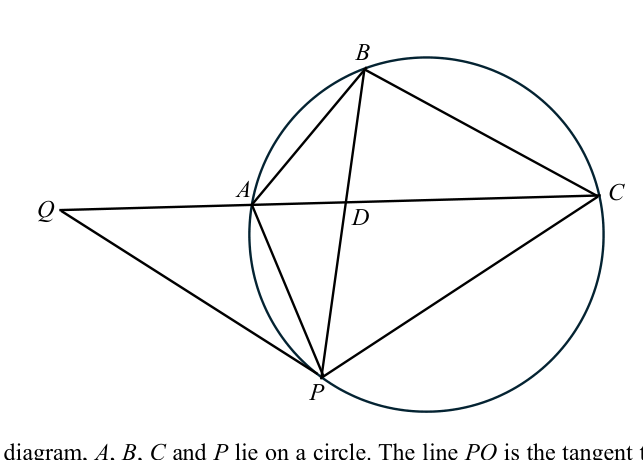
- (a)
Show that triangle ABP is isosceles.
- (b)
Prove that
- (i)
triangle ACP is similar to triangle APD,
- (ii)
.
- (i)
It won't just hand you the answer — it asks where you're stuck.How the checker works
Worked solution
5(a)
1. Use the angle bisector property to relate angles at P.
Since bisects , we have:
2. Apply the alternate segment theorem.
By the alternate segment theorem, the angle between the tangent and chord is equal to the angle in the alternate segment:
3. Conclude that the triangle is isosceles.
Therefore, .
Since two angles in triangle are equal, triangle is isosceles (with ).
Triangle is isosceles since .
5(b)(i)
1. Identify a common angle between the two triangles.
In and , is common to both triangles (i.e., ).
2. Use the alternate segment theorem and angle bisector property to find another pair of equal angles.
By the alternate segment theorem, .
Since bisects , .
Therefore, (which is ).
3. Conclude similarity using the AA criterion.
Since two pairs of corresponding angles are equal ( and ), is similar to (AA similarity).
Shown that is similar to .
5(b)(ii)
1. Use the similarity of triangles ACP and APD to establish a relationship between their sides.
Since is similar to (from part (b)(i)), the ratio of their corresponding sides is equal:
Cross-multiplying gives:
2. Substitute the result from part (a) to complete the proof.
From part (a), is isosceles with .
Substituting with into the equation yields:
Shown
AI analysis — may contain mistakes.
Worked this one out on paper? Snap your steps and Gigle's AI math checker will circle the step where it went wrong.
More questions on this topic
- 1The triangle ABC is such that its area is , the length of AB is …
- 2如果三角形的两条边分别为4和6,那么连结该三角形三边中点所得的周长可能是下列数据中的【 】 A. 6 B. 8 C. 10 D. 12
- 3In , , is a right angle, radians and is the…
- 4The diagram shows a quadrilateral whose vertices lie on the circumference of a circle. The point lies on the…
- 5The equation of a circle is . Find the radius of the circle and the coordinates of its ce…