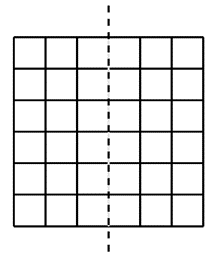
Kei draws a 6-by-6 grid. He colors 13 of the unit squares silver and the remaining squares gold. Kei then folds the grid in half vertically, forming pairs of overlapping unit squares. Let and equal the least and greatest possible number of gold-on-gold pairs, respectively. What is the value of ?A. 12B. 14C. 16D. 18E. 20
It won't just hand you the answer — it asks where you're stuck.How the checker works
Worked solution
1. 2025 AMC 8 官方解析
Answer (C): There are 13 silver squares and gold squares. When the grid is folded in half, there are 18 pairs of squares, each of which can be silver-on-silver, silver-on-gold, or gold-on-gold.
There cannot be 12 gold-on-gold pairs because that would require at least 24 gold squares. The figure below shows it is possible to have 11 gold-on-gold pairs, so the greatest possible number of gold-on-gold pairs is .
Similarly, the combined number of silver-on-silver pairs and silver-on-gold pairs is at most 13 because there are only 13 silver squares. This means the least possible number of gold-on-gold pairs is . The figure below shows this can also be achieved.
Therefore, the value of is .
C. 16
AI analysis — may contain mistakes.
Worked this one out on paper? Snap your steps and Gigle's AI math checker will circle the step where it went wrong.
More questions on this topic
- 1Ricardo has coins, some of which are pennies (-cent coins) and the rest of which are nickels (-cent coins).…
- 2已知首项为的数列的前项和为,且,数列满足…
- 3In a tournament there are six teams that play each other twice. A team earns points for a win, point for a draw,…
- 4已知行列的数表…
- 5The integers from 1 through 25 are arbitrarily separated into five groups of 5 numbers each. The median of each group is…