In the diagram, and are chords of a circle, with and . It is given that and intersect each other at at and , where varies.
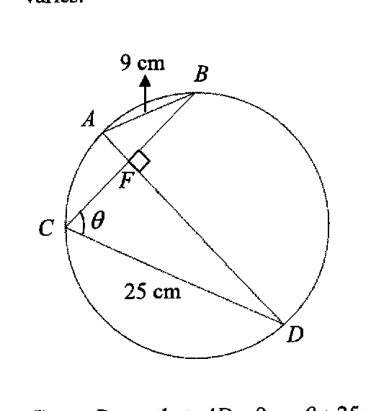
- (i)
Prove that .
- (ii)
Express in the form , where and .
- (iii)
Find the values of when .
- (iv)
Calculate the angle for which is the diameter of the circle.
It won't just hand you the answer — it asks where you're stuck.How the checker works
Worked solution
13(i)
1. Identify angles in the same segment
Angles in the same segment are equal, so .
2. Express AD as the sum of AF and FD using trigonometry in right-angled triangles
In right-angled , .
In right-angled , .
Therefore, .
Shown
13(ii)
1. Expand $R \cos(\theta - \alpha)$ and compare coefficients with $9 \cos \theta + 25 \sin \theta$
Comparing with :
2. Calculate the value of $R$
3. Calculate the value of $\alpha$ and write the final expression
or
13(iii)
1. Express $AD$ using the $R$-formula result from part (ii)
From part (ii), and .
So, .
2. Set up the equation for $AD = 26$ and find the basic angle
Basic angle
3. Solve for the possible values of $\theta$
13(iv)
1. Identify the condition for $AD$ to be the diameter
The diameter is the longest chord in a circle. Therefore, is the diameter when its length is at a maximum.
2. Find the angle $\theta$ that maximizes $AD$
From part (ii), .
For to be maximum, .
(to 1 d.p.)
AI analysis — may contain mistakes.
Worked this one out on paper? Snap your steps and Gigle's AI math checker will circle the step where it went wrong.