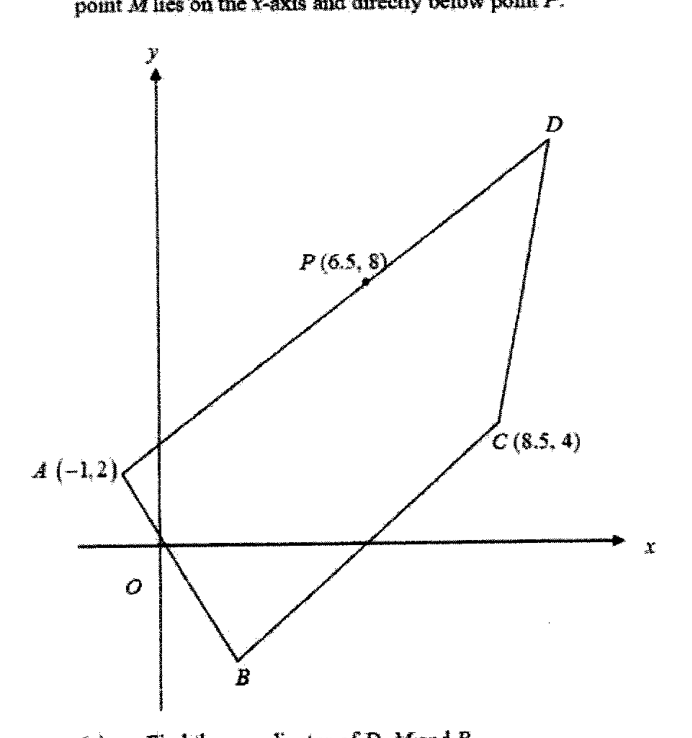
The diagram shows the quadrilateral ABCDABCD in which point AA is (−1,2)(-1, 2) and point CC is (8.5,4)(8.5, 4). The point P(6.5,8)P(6.5, 8) lies on ADAD such that AP:PD=3:2AP : PD = 3 : 2. The midpoint of BCBC, point MM lies on the xx-axis and directly below point PP.

  1. (a)

    Find the coordinates of DD, MM and BB.

  2. (b)

    Calculate the area of the quadrilateral ABCDABCD.

Work through it with AI →

It won't just hand you the answer — it asks where you're stuck.How the checker works

Worked solution

9(a)

1. Find the coordinates of $M$.

Since MM lies directly below P(6.5,8)P(6.5, 8), its xx-coordinate is 6.56.5.
Since MM lies on the xx-axis, its yy-coordinate is 00.
Therefore, M=(6.5,0)M = (6.5, 0).

2. Find the coordinates of $D$ using the given ratio $AP : PD = 3 : 2$.

The horizontal displacement from A(−1,2)A(-1, 2) to P(6.5,8)P(6.5, 8) is 6.5−(−1)=7.56.5 - (-1) = 7.5.
This corresponds to 3 parts of the ratio.
1 part of horizontal displacement =7.53=2.5= \frac{7.5}{3} = 2.5.
The horizontal displacement from PP to DD (2 parts) is 2×2.5=52 \times 2.5 = 5.
xx-coordinate of D=6.5+5=11.5D = 6.5 + 5 = 11.5.

The vertical displacement from AA to PP is 8−2=68 - 2 = 6.
1 part of vertical displacement =63=2= \frac{6}{3} = 2.
The vertical displacement from PP to DD (2 parts) is 2×2=42 \times 2 = 4.
yy-coordinate of D=8+4=12D = 8 + 4 = 12.

Therefore, D=(11.5,12)D = (11.5, 12).

3. Find the coordinates of $B$ using the midpoint formula.

Let the coordinates of BB be (x,y)(x, y).
Since M(6.5,0)M(6.5, 0) is the midpoint of BCBC and CC is (8.5,4)(8.5, 4):
x+8.52=6.5  ⟹  x+8.5=13  ⟹  x=4.5\frac{x + 8.5}{2} = 6.5 \implies x + 8.5 = 13 \implies x = 4.5
y+42=0  ⟹  y+4=0  ⟹  y=−4\frac{y + 4}{2} = 0 \implies y + 4 = 0 \implies y = -4

Therefore, B=(4.5,−4)B = (4.5, -4).

Answer

D(11.5,12)D(11.5, 12), M(6.5,0)M(6.5, 0), B(4.5,−4)B(4.5, -4)

9(b)

1. Find the coordinates of D and B from part (a)

Let D=(xD,yD)D = (x_D, y_D). Since AP:PD=3:2AP : PD = 3 : 2, PP divides ADAD in ratio 3:23:2.
2(−1)+3xD5=6.5  ⟹  −2+3xD=32.5  ⟹  3xD=34.5  ⟹  xD=11.5\frac{2(-1) + 3x_D}{5} = 6.5 \implies -2 + 3x_D = 32.5 \implies 3x_D = 34.5 \implies x_D = 11.5
2(2)+3yD5=8  ⟹  4+3yD=40  ⟹  3yD=36  ⟹  yD=12\frac{2(2) + 3y_D}{5} = 8 \implies 4 + 3y_D = 40 \implies 3y_D = 36 \implies y_D = 12
So D(11.5,12)D(11.5, 12).
MM is on the xx-axis directly below P(6.5,8)P(6.5, 8), so M(6.5,0)M(6.5, 0).
MM is the midpoint of BCBC, so xB+8.52=6.5  ⟹  xB=13−8.5=4.5\frac{x_B + 8.5}{2} = 6.5 \implies x_B = 13 - 8.5 = 4.5
yB+42=0  ⟹  yB=−4\frac{y_B + 4}{2} = 0 \implies y_B = -4
So B(4.5,−4)B(4.5, -4).

2. Apply the shoelace formula to find the area of quadrilateral ABCD

Vertices in anti-clockwise order: A(−1,2)A(-1, 2), B(4.5,−4)B(4.5, -4), C(8.5,4)C(8.5, 4), D(11.5,12)D(11.5, 12).
Area =12∣−14.58.511.5−12−44122∣= \frac{1}{2} \left| \begin{matrix} -1 & 4.5 & 8.5 & 11.5 & -1 \\ 2 & -4 & 4 & 12 & 2 \end{matrix} \right|
=12∣((−1)(−4)+(4.5)(4)+(8.5)(12)+(11.5)(2))−((2)(4.5)+(−4)(8.5)+(4)(11.5)+(12)(−1))∣= \frac{1}{2} | ((-1)(-4) + (4.5)(4) + (8.5)(12) + (11.5)(2)) - ((2)(4.5) + (-4)(8.5) + (4)(11.5) + (12)(-1)) |
=12∣(4+18+102+23)−(9−34+46−12)∣= \frac{1}{2} | (4 + 18 + 102 + 23) - (9 - 34 + 46 - 12) |
=12∣147−9∣= \frac{1}{2} | 147 - 9 |
=12(138)=69= \frac{1}{2} (138) = 69

Answer

102.5102.5 units2^2

AI analysis — may contain mistakes.

Worked this one out on paper? Snap your steps and Gigle's AI math checker will circle the step where it went wrong.

More questions on this topic

  1. 1In ΔABC\Delta ABC, AC=12 cmAC = 12\text{ cm}, ∠ABC\angle ABC is a right angle, ∠ACB=π6\angle ACB = \frac{\pi}{6} radians and MM is the…
  2. 2A circle with centre O passes through the points P(-1,7) and Q(0,8). State the relationship between the perpendicular bi…
  3. 3Two points A(−3,−6)A(-3, -6) and B(7,−6)B(7, -6) lie on a circle with centre GG. The equation of the tangent to the circle at the…
  4. 4A(1, 7) and B(9, 7) lie on a circle C1C_1 with centre P. The line 4y+3x=314y + 3x = 31 is a normal to the circle and passes th…
  5. 5ABCDABCD is a rectangle which fits inside a semicircle of radius 8 cm and centre OO. It is given that AB=xAB = x cm and BC=yBC = y…