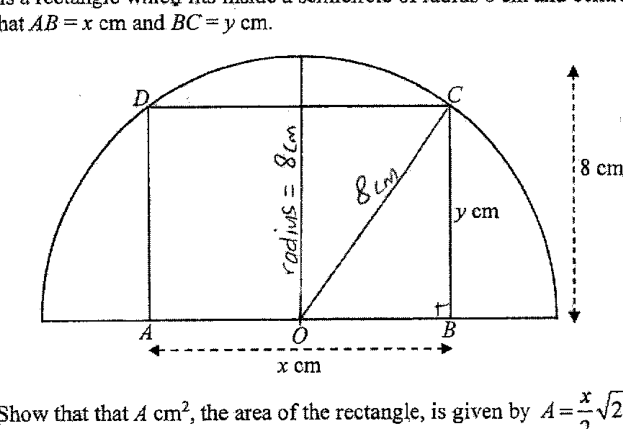
ABCDABCD is a rectangle which fits inside a semicircle of radius 8 cm and centre OO. It is given that AB=xAB = x cm and BC=yBC = y cm.

  1. (a)

    Show that AA cm2^2, the area of the rectangle, is given by A=x2256−x2A = \frac{x}{2}\sqrt{256 - x^2}.

  2. (b)

    Given that xx can vary, find the value of xx which gives a stationary value of AA.

  3. (c)

    By considering the sign of dAdx\frac{\text{d}A}{\text{d}x}, determine whether the stationary value of AA is maximum or minimum.

Work through it with AI →

It won't just hand you the answer — it asks where you're stuck.How the checker works

Worked solution

8(a)

1. Express the length of $OB$ in terms of $x$.

Since OO is the midpoint of ABAB, OB=x2OB = \frac{x}{2}.

2. Use Pythagoras' theorem in triangle $OBC$ to express $y$ in terms of $x$.

In △OBC\triangle OBC, ∠OBC=90∘\angle OBC = 90^\circ.
OB2+BC2=OC2OB^2 + BC^2 = OC^2
(x2)2+y2=82\left(\frac{x}{2}\right)^2 + y^2 = 8^2
y2=64−x24y^2 = 64 - \frac{x^2}{4}
y=64−x24y = \sqrt{64 - \frac{x^2}{4}}
y=256−x24y = \sqrt{\frac{256 - x^2}{4}}
y=256−x22y = \frac{\sqrt{256 - x^2}}{2}

3. Formulate the area of the rectangle $A$ in terms of $x$.

Area of rectangle, A=AB×BCA = AB \times BC
A=x×yA = x \times y
A=x(256−x22)A = x \left( \frac{\sqrt{256 - x^2}}{2} \right)
A=x2256−x2A = \frac{x}{2}\sqrt{256 - x^2} (Shown)

Answer

Shown

8(b)

1. Differentiate $A$ with respect to $x$ using the product rule and chain rule.

A=12x(256−x2)12A = \frac{1}{2}x(256 - x^2)^{\frac{1}{2}}

dAdx=12(256−x2)12+12x[12(256−x2)−12(−2x)]\frac{\text{d}A}{\text{d}x} = \frac{1}{2}(256 - x^2)^{\frac{1}{2}} + \frac{1}{2}x \left[ \frac{1}{2}(256 - x^2)^{-\frac{1}{2}}(-2x) \right]
dAdx=12(256−x2)12−x22(256−x2)12\frac{\text{d}A}{\text{d}x} = \frac{1}{2}(256 - x^2)^{\frac{1}{2}} - \frac{x^2}{2(256 - x^2)^{\frac{1}{2}}}

2. Set the derivative to zero to find the stationary value.

For a stationary value, dAdx=0\frac{\text{d}A}{\text{d}x} = 0:
12(256−x2)12−x22(256−x2)12=0\frac{1}{2}(256 - x^2)^{\frac{1}{2}} - \frac{x^2}{2(256 - x^2)^{\frac{1}{2}}} = 0
12(256−x2)12=x22(256−x2)12\frac{1}{2}(256 - x^2)^{\frac{1}{2}} = \frac{x^2}{2(256 - x^2)^{\frac{1}{2}}}

3. Solve the equation for $x$.

Multiply both sides by 2(256−x2)122(256 - x^2)^{\frac{1}{2}}:
256−x2=x2256 - x^2 = x^2
2x2=2562x^2 = 256
x2=128x^2 = 128
x=128=82x = \sqrt{128} = 8\sqrt{2} (since x>0x > 0 as it is a length)
x≈11.3x \approx 11.3

Answer

x=82x = 8\sqrt{2} (or 11.311.3)

8(c)

1. Evaluate the sign of the first derivative slightly before and after the stationary point

From part (b), the stationary value occurs at x=82≈11.31x = 8\sqrt{2} \approx 11.31.
Let us test values of xx slightly less than and slightly greater than 828\sqrt{2}.
dAdx=256−2x22256−x2\frac{\text{d}A}{\text{d}x} = \frac{256 - 2x^2}{2\sqrt{256 - x^2}}
When x=11x = 11, dAdx=256−2(11)22256−112=142135>0\frac{\text{d}A}{\text{d}x} = \frac{256 - 2(11)^2}{2\sqrt{256 - 11^2}} = \frac{14}{2\sqrt{135}} > 0
When x=11.5x = 11.5, dAdx=256−2(11.5)22256−11.52=−8.52123.75<0\frac{\text{d}A}{\text{d}x} = \frac{256 - 2(11.5)^2}{2\sqrt{256 - 11.5^2}} = \frac{-8.5}{2\sqrt{123.75}} < 0

2. Conclude the nature of the stationary point

Since dAdx\frac{\text{d}A}{\text{d}x} changes from positive to negative as xx increases through 828\sqrt{2}, the stationary value is a maximum.

Answer

Maximum

AI analysis — may contain mistakes.

Worked this one out on paper? Snap your steps and Gigle's AI math checker will circle the step where it went wrong.

More questions on this topic

  1. 1The diagram shows a greenhouse built on a rectangular base. 140 m2140\text{ m}^2 of polyethene is used to build the curved r…
  2. 2In the triangle ABCABC, AB=x cmAB = x\ \text{cm}, AC=3x cmAC = 3x\ \text{cm} and angle BAC=2π3BAC = \dfrac{2\pi}{3}. If xx is increasing…
  3. 3A curve has the equation y=2x−33x+4y = \frac{2x - 3}{3x + 4}, where x≠−43x \ne -\frac{4}{3}. The normal to the point PP on the cur…
  4. 4Find the gradient function of the curve y=2x2−ln⁡x+cy = 2x^2 - \ln x + c. The curve touches the positive xx-axis at point TT. Fi…
  5. 5The normal to the curve y=2tan⁡3x−1y = 2\tan 3x - 1 at point P(π3,−1)P\left(\frac{\pi}{3}, -1\right) crosses the yy-axis at point AA…