A particle moves in a straight line so that t seconds after passing a fixed point O, its velocity, v m/s, is given by , where k is a constant. The particle comes to instantaneous rest first at A and then at B.
- ((i))
Given that the acceleration is m/s at the point O, find the value of k.
- ((ii))
Find the distance between A and B.
- ((iii))
Calculate the total distance of the particle travelled in the first 6 seconds after passing O.
- ((iv))
Given that C is the point at which the particle has minimum velocity, determine with calculation whether C is nearer to O or to B.
It won't just hand you the answer — it asks where you're stuck.How the checker works
Worked solution
12((i))
1. Find the acceleration from the velocity expression and use that the particle is at O when $t=0$.
Given , the acceleration is
At point O, , and .
12((ii))
1. Use $k=-6$ and find the times when the particle is at rest.
From part (i), .
So
At instantaneous rest, :
Hence
2. Set up the displacement between A and B as the integral of velocity from $t=1$ to $t=5$.
The displacement from A to B is
3. Integrate the velocity expression and evaluate the displacement.
So
4. Convert displacement to distance by taking the magnitude.
The displacement from A to B is negative because the particle moves in the negative direction between and .
Therefore the distance between A and B is
12((iii))
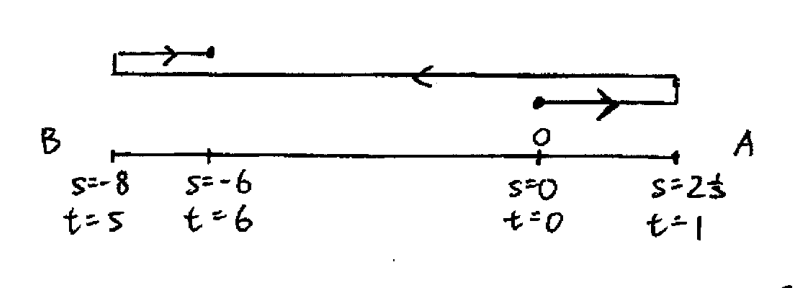
1. Identify the time intervals over which the direction of motion is constant.
From earlier parts, , so
The particle is instantaneously at rest when , so
Hence split the first 6 seconds into the intervals
2. Find the displacements over the required intervals.
The displacement from time to time is
An antiderivative is
Let
Then
3. Add the magnitudes of the displacements to obtain total distance.
Total distance travelled from to is
So
12((iv))
1. Find the time when the velocity is minimum.
Using from part (i),
Complete the square:
Hence the minimum velocity occurs when
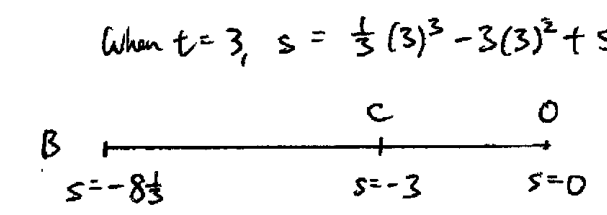
2. Find the position of C and compare its distance from O and B.
The displacement from to is
So m.
From earlier parts, is at and , so
Thus
Since
is nearer to .
is nearer to than to .
AI analysis — may contain mistakes.
Worked this one out on paper? Snap your steps and Gigle's AI math checker will circle the step where it went wrong.
More questions on this topic
- 1Hamid borrowed a sum of money for 3 years at an interest rate of 3.5% per annum simple interest to pay for his car. If t…
- 2By completing the square or otherwise, express in terms of given that . Answer x = ___ or ___…
- 3It is given that Obtain an expression for in the form…
- 4In the diagram, AB is a tangent to the circle with centre O, ∠CAB = 58° and CDE is a straight line. Find, stating your r…
- 5已知方程,用含的代数式表示为:___.