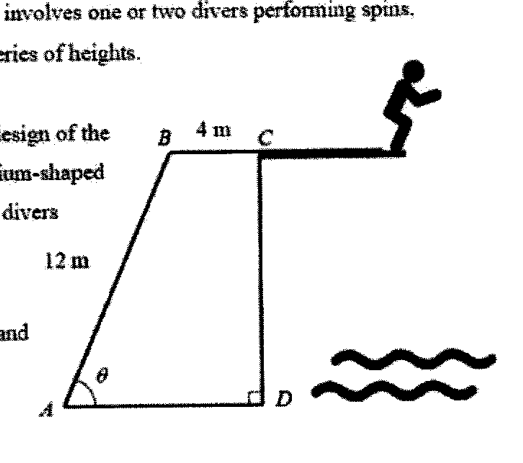
A competitive platform diving competition involves one or two divers performing spins, twists and somersaults into a pool from a series of heights. The diagram shows the cross-section of a design of the diving platform, which consists of a trapezium-shaped tower . is the stairway which the divers use to reach the platform. Given that , where can vary and , the length of and are and respectively.
- (a)
show that , the perimeter of , can be expressed in the form .
- (b)
express in the form of , where and .
- (c)
State the maximum value of , and the corresponding value of .
- (d)
Find the value of if . Explain why a platform with this value of is a poor design.
It won't just hand you the answer — it asks where you're stuck.How the checker works
Worked solution
6(a)
1. Find the lengths of CD and AD in terms of theta
Draw a horizontal line from to meet at . Then is the hypotenuse of right-angled triangle (or draw a vertical line from to at ).
Let be the foot of the perpendicular from to .
In , and .
and .
Since is a rectangle, and .
Thus, .
2. Express the perimeter L in terms of theta
6(b)
1. Determine the expression for $L$ from the context of part (a)
From the diagram, drawing a perpendicular from to gives a right-angled triangle with hypotenuse .
The vertical height is , so .
The horizontal distance is , so .
The perimeter .
2. Apply the R-formula to $12\cos\theta + 12\sin\theta$
Let .
Comparing coefficients:
3. State the final expression for $L$
6(c)
1. State the expression for $L$ from part (b)
From parts (a) and (b), .
2. Find the maximum value of $L$
The maximum value of is .
Maximum
3. Find the corresponding value of $\theta$
Maximum (or ),
AI analysis — may contain mistakes.
Worked this one out on paper? Snap your steps and Gigle's AI math checker will circle the step where it went wrong.