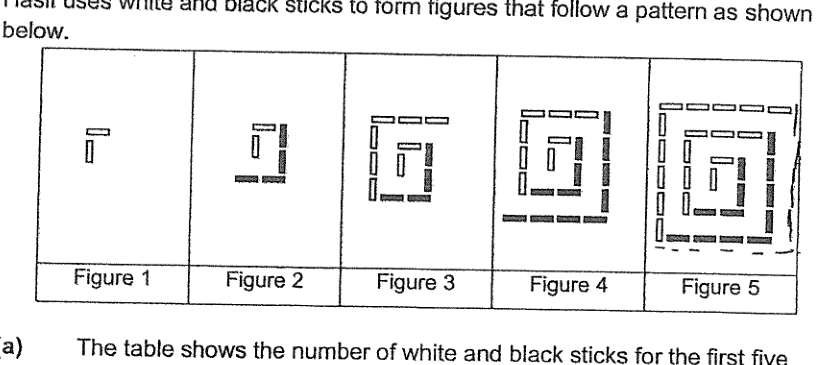
Hasif uses white and black sticks to form figures that follow a pattern as shown below. (Figures 1 to 5 are shown.)
- (a)
The table shows the number of white and black sticks for the first five figures. Complete the table for Figure 6.
- (b)
Which figure number has a total of 650 sticks?
Ans : (b)___
- (c)
How many white sticks did he use for Figure 15?
Ans : (c)___
It won't just hand you the answer — it asks where you're stuck.How the checker works
Worked solution
17(a)
1. Determine the number of white sticks for Figure 6
Observe the pattern for the number of white sticks:
- Figure 1: 2
- Figure 2: 2
- Figure 3: 8
- Figure 4: 8
- Figure 5: 18
The pattern repeats each value twice. The sequence of unique values is , which can be expressed as .
- For Figures 1 and 2:
- For Figures 3 and 4:
- For Figures 5 and 6:
Thus, the number of white sticks for Figure 6 is 18.
2. Determine the number of black sticks for Figure 6
Observe the pattern for the number of black sticks:
- Figure 1: 0
- Figure 2: 4
- Figure 3: 4
- Figure 4: 12
- Figure 5: 12
The pattern repeats each value twice starting from Figure 2. The sequence of unique non-zero values is , which can be expressed as , , , where the multipliers are triangular numbers .
Alternatively, we can find the total sticks first () and subtract white sticks:
- Total sticks for Figure 6:
- Black sticks for Figure 6: .
3. Determine the total number of sticks for Figure 6
Observe the pattern for the total number of sticks:
- Figure 1:
- Figure 2:
- Figure 3:
- Figure 4:
- Figure 5:
Following the pattern , for Figure 6:
Total sticks = .
(i) 18
(ii) 24
(iii) 42
17(b)
1. Identify the algebraic rule for the total number of sticks based on the table
Observe the total number of sticks for each figure:
- Figure 1:
- Figure 2:
- Figure 3:
- Figure 4:
- Figure 5:
In general, the total number of sticks for Figure is given by the formula:
2. Set up and solve the equation to find the figure number $n$ for 650 sticks
Set the formula equal to 650:
Since is a positive integer, we can find two consecutive numbers that multiply to 650. Let's estimate using square roots:
Check :
Thus, .
25
AI analysis — may contain mistakes.
Worked this one out on paper? Snap your steps and Gigle's AI math checker will circle the step where it went wrong.
More questions on this topic
- 1The figure below is made up of 2 squares, ABCD and DEFG. X is a point on GD and Y is a point on DE. BC = 7 cm, FE = 6 cm…
- 2Find the value of . Ans: ___
- 3In a camp, the number of children is of the number of adults. of the children are boys and t…
- 4A can of mushroom soup costs $3.20 and a bundle of 3 cans of mushroom soup costs $8. Diane wants to buy 20 cans of mus…
- 5A group of singers are arranged in 5 rows. There are 7 singers in the second row. Each row has more singers than the…