The diagram below shows the graph of . The curve cuts the axes at and . The asymptotes of the curve are and . Sketch, on separate diagrams, the graphs of indicating clearly the asymptotes, axial intercepts and the points corresponding to and where possible.
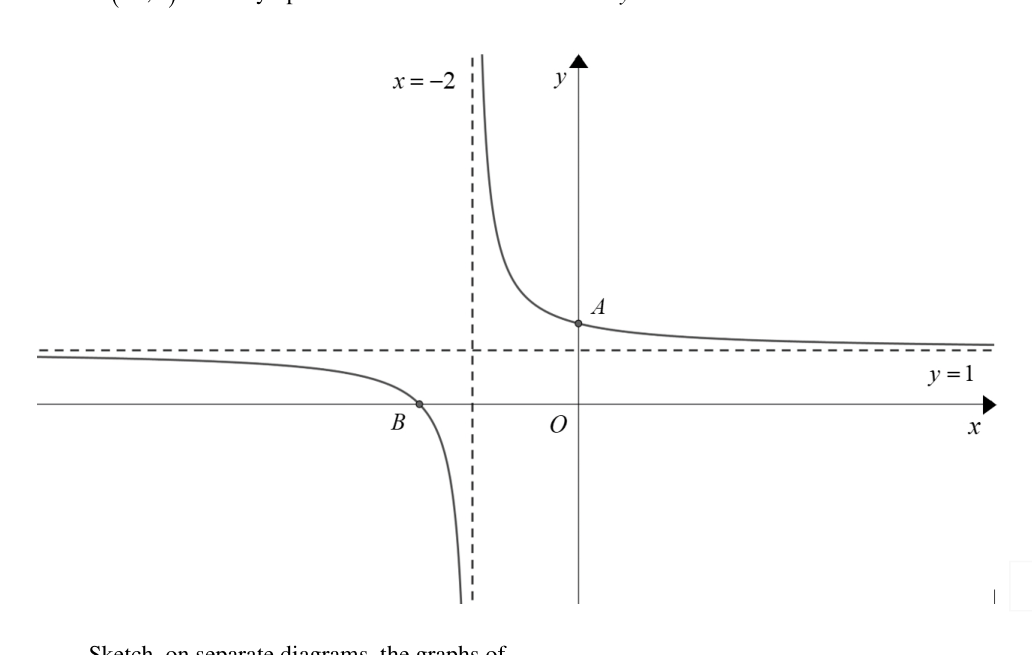
- (i)
,
- (ii)
,
- (iii)
,
It won't just hand you the answer — it asks where you're stuck.How the checker works
Worked solution
6(i)
1. Identify the geometric transformations that map $y = \mathrm{f}(x)$ to $y = -\mathrm{f}(1+x)$.
The transformation from to consists of two steps:
- A horizontal translation of unit to the left (mapping to ).
- A reflection about the -axis (mapping to ).
2. Find the new equations of the asymptotes.
Applying the transformations to the original asymptotes:
- Vertical asymptote : translating left by gives . The reflection in the -axis does not affect vertical lines.
New vertical asymptote: . - Horizontal asymptote : translation left by does not affect horizontal lines. Reflection in the -axis maps to .
New horizontal asymptote: .
3. Determine the new coordinates of the specific points $A$ and $B$.
Applying the transformations to the given points:
-
For point :
Translate left by :
Reflect in -axis:
So, maps to . -
For point :
Translate left by :
Reflect in -axis: since it lies on the -axis.
So, maps to the new -intercept .
A sketched graph containing two branches:
- Vertical asymptote at .
- Horizontal asymptote at .
- Left branch (): Lies above the horizontal asymptote, approaching from above as , crossing the -axis at , and going upwards towards positive infinity as it approaches .
- Right branch (): Lies below the horizontal asymptote, passing through , crossing the -axis between and , and going downwards towards negative infinity as it approaches . It approaches from below as .
6(ii)
1. Determine the new asymptotes for the reciprocal graph.
For :
- As , . Therefore, . The horizontal asymptote remains .
- The -intercept of is at (point ). As , . Thus, is the new vertical asymptote.
2. Determine the new axial intercepts and map points $A$ and $B$.
- The vertical asymptote of is . As , , so . This creates a new -intercept at .
- The -intercept is at . Thus, the new -intercept is at . This is the point corresponding to .
- Point corresponds to the newly formed vertical asymptote .
3. Determine the shape of the curve to complete the sketch.
- For : is positive and , so . The graph approaches as and goes to as .
- For : As , , so . The curve rises smoothly, crosses the -axis at , crosses the -axis at , and approaches from below as .
Sketch Description:
- Asymptotes: Vertical asymptote at , horizontal asymptote at .
- Axial intercepts: -intercept at , -intercept at .
- Points and : Point maps to the new -intercept . Point corresponds to the new vertical asymptote .
- Shape: Two continuous branches separated by . The left branch () lies above , approaching as and tending to as . The right branch () starts from at , crosses the axes at and , and approaches from below as .
6(iii)
1. Determine the asymptotes of $y = \mathrm{f}'(x)$ based on the behaviour of $y = \mathrm{f}(x)$.
Observe the limits of the gradient of :
- As , the graph of flattens out and approaches the horizontal asymptote . This means the gradient . Therefore, (the -axis) is a horizontal asymptote for .
- As , the tangent to the curve becomes increasingly steep towards the vertical, meaning . Therefore, is a vertical asymptote for .
2. Determine the shape, sign, and key points of the derivative graph.
- The original curve is strictly decreasing on both intervals and . Consequently, for all valid , meaning the entire graph of must lie below the -axis.
- Since , there are no -intercepts.
- The point corresponding to is at , giving a negative -intercept on the derivative graph.
- The point corresponding to is at , which will sit at some negative -value on the left branch.
- Since the exact functional equation is not given, we simply mark the -coordinates (as the -intercept) and on the graph to correspond to and .
A sketch of on a Cartesian plane with the following features:
- Asymptotes: Vertical asymptote at and horizontal asymptote at (the -axis).
- Shape: Two continuous branches, both strictly below the -axis (since ).
- Left Branch: Approaches from below as , decreases smoothly passing through a marked point at (corresponding to ), and tends to as .
- Right Branch: Approaches from as , increases smoothly cutting the -axis at a negative value (corresponding to at ), and approaches from below as .
(Note: The exact -coordinates for points and cannot be definitively calculated without assuming an explicit function, aligning with the caveat "where possible".)
AI analysis — may contain mistakes.
Worked this one out on paper? Snap your steps and Gigle's AI math checker will circle the step where it went wrong.
More questions on this topic
- 1将函数的图象保持纵坐标不变,先将横坐标缩短为原来的,再向右平移个单位长度后得到,则的解析式为…
- 2By expressing the equation of the curve in the form , where …
- 3A curve has the equation where . Sketch , stating the coordinates of any points o…
- 4The diagram shows the graphs of and . The graph of has t…
- 5The curve with equation is transformed to curve by a translation of …