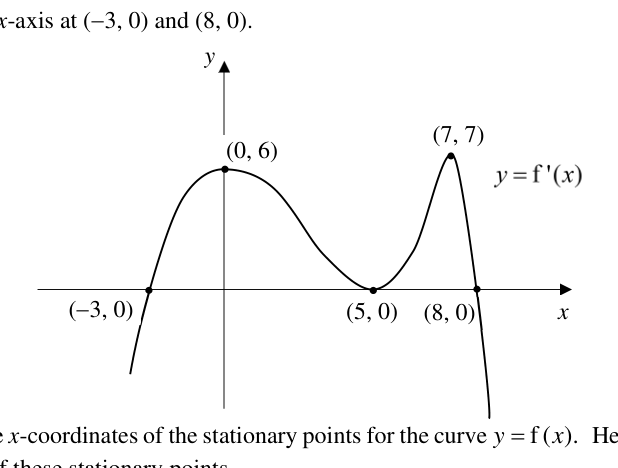
The diagram below shows the curve . It has turning points at , and and intersects the -axis at and .
- (i)
State the -coordinates of the stationary points for the curve . Hence determine the nature of these stationary points.
- (ii)
State the range of values of such that the curve is concave downwards.
- (iii)
A student claims that if the curve passes through the point , then for . Explain briefly whether the student is right to make such a claim.
It won't just hand you the answer — it asks where you're stuck.How the checker works
Worked solution
11(i)
1. State the $x$-coordinates of the stationary points by finding where $\text{f}'(x) = 0$.
Stationary points occur when , which corresponds to the -intercepts on the graph.
From the given graph, the -intercepts are , , and .
2. Determine the nature of the stationary point at $x = -3$.
Just before , the curve is below the -axis ().
Just after , the curve is above the -axis ().
Since the gradient changes from negative to positive, is a local minimum point.
3. Determine the nature of the stationary points at $x = 5$ and $x = 8$.
At , the curve touches the -axis and remains above it. Since on both sides, the gradient does not change sign, so is a stationary point of inflexion.
At , the curve crosses from above the -axis () to below the -axis (). Since the gradient changes from positive to negative, is a local maximum point.
Stationary points are at , , and .
- is a local minimum.
- is a stationary point of inflexion.
- is a local maximum.
11(ii)
1. Relate the concavity of $y = \text{f}(x)$ to the gradient of $y = \text{f}'(x)$
For the curve to be concave downwards, we require .
This means the gradient of the curve must be negative, which occurs when the graph of is strictly decreasing.
2. Identify the relevant intervals from the graph
From the given graph, is decreasing between the turning points and , and after the turning point .
Therefore, the required range of values is and .
and
11(iii)
1. Identify the sign of $\text{f}'(x)$ from the graph and deduce the behavior of $\text{f}(x)$ for $-3 < x < 5$.
From the given graph, the curve lies above the -axis for . This means in this interval, indicating that the function is strictly increasing.
2. Evaluate the student's claim based on the initial value at $x = -3$.
Given that the curve passes through , we have .
Since is strictly increasing for , it follows that for all in this interval.
Therefore, for , and the student is right.
Yes, the student is right.
AI analysis — may contain mistakes.
Worked this one out on paper? Snap your steps and Gigle's AI math checker will circle the step where it went wrong.
More questions on this topic
- 1A curve has the equation where . Sketch , stating the coordinates of any points o…
- 2The diagram shows the graphs of and . The graph of has t…
- 3The diagram shows the curve . The curve has a maximum point at and two asymptotes …
- 4The graph of has a maximum turning point at and passes through the origin. The lines …
- 5The diagram shows the graph of . The curve has a turning point at and the lines are asymp…