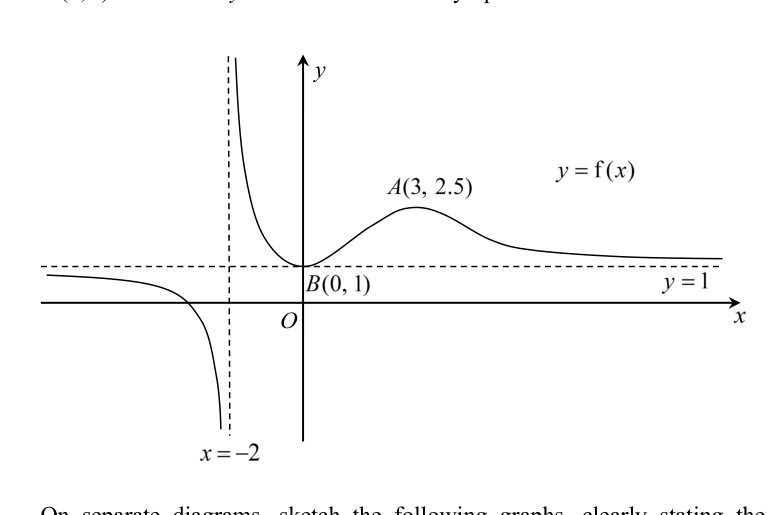
The diagram shows the curve , with turning points at and . The lines and are asymptotes of the curve.
- (a)
On separate diagrams, sketch the following graphs, clearly stating the equations of the asymptotes and the coordinates of the points corresponding to A and B where appropriate.
- (i)
- (ii)
- (i)
- (b)
The parametric equations of a curve are given by
.
The curve is reflected in the -axis. Find the exact coordinates of the point(s) where the reflected curve intersects the -axis.
It won't just hand you the answer — it asks where you're stuck.How the checker works
Worked solution
4(a)(i)
1. Identify the geometrical transformations applied to the original graph.
The equation represents a translation of the graph of by units in the positive -direction (to the right) and units in the positive -direction (upwards).
2. Find the coordinates of the new turning points.
Point
Point
3. Find the equations of the new asymptotes.
Vertical asymptote: (the -axis)
Horizontal asymptote:
A sketch of the curve with the same shape as , but shifted. The new turning points are and . The new asymptotes are (the -axis) and .
4(a)(ii)
1. Determine the asymptotes of y = f'(x)
The vertical asymptote of is unchanged, so is still a vertical asymptote of ; near it increases steeply to , so as .
Since is a horizontal asymptote of , the curve flattens as , so . Hence the horizontal asymptote of is (the -axis).
2. Convert turning points of f into x-intercepts of f'
At a turning point the gradient is zero, so at the -coordinates of and .
- -intercept .
- -intercept .
3. Use sign of the gradient on each interval to sketch f'
Read off the gradient of on each interval (B is a minimum, A is a maximum):
- : decreasing (below axis, from up to at ).
- : increasing (above axis, a positive hump).
- : decreasing towards , approaching .
Sketch a curve rising from near , crossing the axis at , peaking, crossing back at , then staying just below the -axis and tending to .
Sketch of with:
- Vertical asymptote (curve as ).
- Horizontal asymptote (curve as ).
- -intercepts at (from ) and (from ).
- for , for , for .
4(b)
1. Set $y = 0$ to find the value of the parameter $t$ at the $x$-axis intercept.
Since the domain restricts , we have .
2. Find the original $x$-coordinate, apply the reflection in the $y$-axis, and state the final exact coordinates.
Original -coordinate at :
When a curve is reflected in the -axis, its -coordinates remain unchanged and its -coordinates are negated.
Reflected -coordinate:
The exact coordinates of the point are .
AI analysis — may contain mistakes.
Worked this one out on paper? Snap your steps and Gigle's AI math checker will circle the step where it went wrong.
More questions on this topic
- 1将函数的图象保持纵坐标不变,先将横坐标缩短为原来的,再向右平移个单位长度后得到,则的解析式为…
- 2By expressing the equation of the curve in the form , where …
- 3A curve has the equation where . Sketch , stating the coordinates of any points o…
- 4The diagram shows the graphs of and . The graph of has t…
- 5The curve with equation is transformed to curve by a translation of …