The diagram shows five towns A, B, C, D and E. Towns B, C, D lie on a straight line. Town E is due east of Town D. It is given that , AC = 8 km and AD = 10 km.
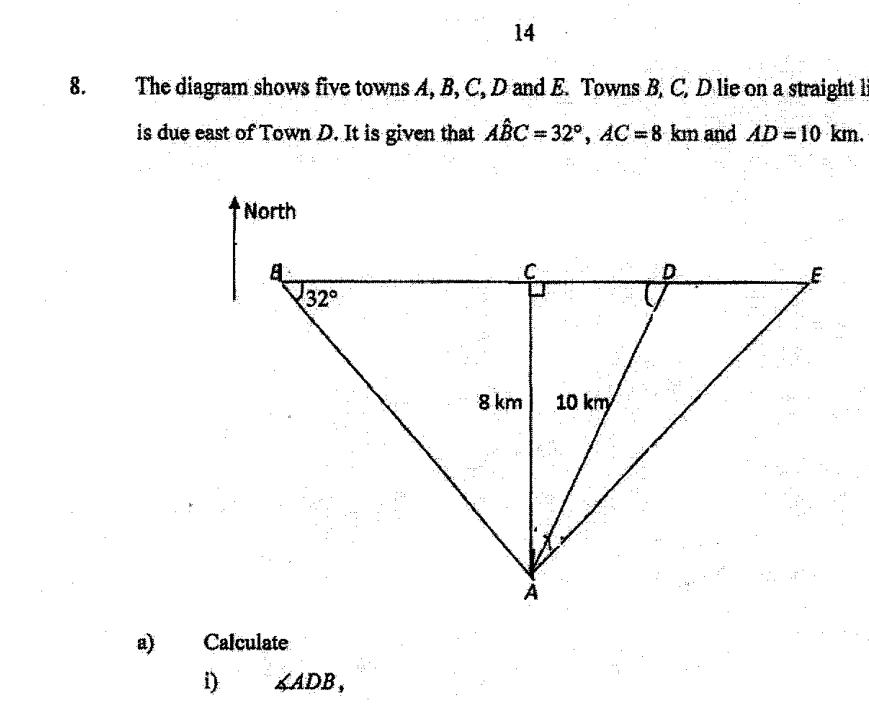
- (a)
Calculate
- (i)
.
- (ii)
the distance BD.
- (iii)
the value of .
- (iv)
the bearing of A from B.
- (i)
- (b)
Given that Town D is positioned such that it is equidistant from C and E. Calculate the distance AE.
- (c)
Hence or otherwise, calculate the bearing of E from A.
It won't just hand you the answer — it asks where you're stuck.How the checker works
Worked solution
8(a)(i)
1. Identify the equal angle and choose the correct right-angled triangle
Since lie on a straight line, is along the same line as .
So
2. Apply a trigonometric ratio in right-angled triangle $ACD$
In right-angled triangle ,
3. Calculate the angle
Therefore,
8(a)(ii)
1. Find $BC$ using the tangent ratio in right-angled triangle $ABC$
In right-angled triangle ,
2. Find $CD$ using Pythagoras' theorem in right-angled triangle $ACD$
In right-angled triangle ,
3. Add the collinear distances to find $BD$
Since , and lie on a straight line,
8(a)(iii)
1. Identify the angle $\angle ADE$ using the straight line $CDE$
Since and lie on a straight line,
2. Use the cosine relationship for supplementary angles and the right triangle $ACD$
In right-angled triangle ,
Hence
So
Therefore
8(a)(iv)
1. Convert the given angle from the east direction to a bearing from north
At , the line points due east. Since , the line is south of east.
Bearing of from :
8(b)
1. Use the equidistance condition to find the horizontal distance $CE$
From earlier, in right-angled triangle ,
Since is equidistant from and ,
Hence
2. Apply Pythagoras' theorem to find $AE$
Since , triangle is right-angled.
8(c)
1. Identify the right triangle and the horizontal and vertical distances from A to E
From earlier parts, . Since D is equidistant from C and E,
.
Hence
.
Also, , so from A to E, the eastward distance is and the northward distance is .
2. Use trigonometry to find the angle east of north
Let be the bearing angle of E from A, measured clockwise from north.
In the right-angled triangle,
3. Write the angle as a three-figure bearing
Bearings are written as three figures, measured clockwise from north.
Therefore the bearing of E from A is
Bearing of E from A
AI analysis — may contain mistakes.
Worked this one out on paper? Snap your steps and Gigle's AI math checker will circle the step where it went wrong.
More questions on this topic
- 1In the diagram, there are two right-angled triangles ΔABD and ΔCEB such that AD = 12 cm, BD = 15 cm and BE = 20 cm. Find…
- 2In triangle ABC, , and . Express as a fraction in its…
- 3The diagram shows the positions of a harbour, H, a lighthouse, L, and two buoys P and Q. HPQ is a straight line. The bea…
- 4A piece of wood which was 50 cm long, was in the shape of a uniform cylinder. A prism is cut out from the wood such that…
- 5The points A, B, C, D and E are shown in the diagram below such that ABC and AED are straight lines and BE = …