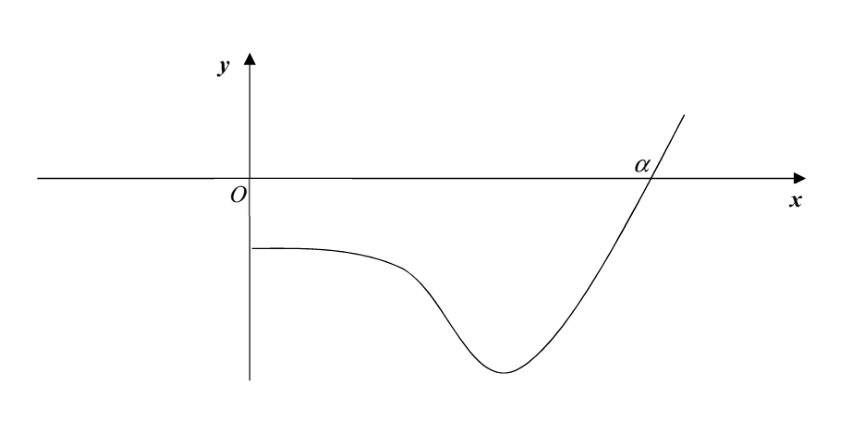
It is given that . The diagram shows the curve with equation for . The curve crosses the positive -axis at .
- (i)
Find the value of , giving your answer correct to 3 decimal places.
- (ii)
Show that for all real values of . What can be said about the six roots of the equation ?
- (iii)
It is given that , for all real values of .
Determine the -coordinates of all the stationary points of graph of and determine their nature.
- (iv)
For which values of is the graph of concave upwards?
It won't just hand you the answer — it asks where you're stuck.How the checker works
Worked solution
7(i)
1. Set the function to zero to find the positive $x$-intercept.
At the -axis, .
2. Solve the equation for $\alpha$ using a graphing calculator.
Since is the positive root, we use a graphing calculator to solve for :
Therefore, (correct to 3 decimal places).
7(ii)
1. Show that $\mathrm{f}(x) = \mathrm{f}(-x)$.
2. Use the symmetry of the graph to deduce the number of real roots.
Since , the graph of is an even function and is symmetrical about the -axis. This implies that if is a root, is also a root.
From the given graph, there is exactly one root for , which is .
Due to symmetry, there is exactly one root for , which is .
Thus, the equation has exactly two real roots, and .
3. Deduce the nature of the remaining roots.
Since is a polynomial of degree 6, the equation must have exactly 6 roots in total.
Because only 2 of these roots are real, the remaining 4 roots must be non-real complex numbers.
(Note: As the coefficients are real and the function is even, these 4 complex roots occur in conjugate pairs and in pairs).
- is shown by substitution.
- The roots occur in pairs of equal magnitude and opposite signs ().
- Exactly two of the roots are real ( and ).
- The remaining four roots are non-real complex numbers (occurring in conjugate pairs).
7(iii)
1. Establish the condition for the stationary points of $y = \mathrm{g}(x)$
Stationary points occur when .
Given , this implies we need to solve .
2. Find the $x$-coordinates of the stationary points using earlier results
From (i), solving using a graphing calculator yields the positive root .
From (ii), is an even function (), so there is a corresponding real negative root at .
Thus, the -coordinates of the stationary points are and .
3. Determine the nature of the stationary point at $x = \alpha$
From the given graph for , as increases through , the value of changes from negative to positive.
Since , the gradient of changes from negative to positive ().
By the first derivative test, has a local minimum at .
4. Determine the nature of the stationary point at $x = -\alpha$
By the symmetry of the graph (reflected across the -axis since it is an even function), as increases through , the value of changes from positive to negative.
Thus, the gradient of changes from positive to negative ().
By the first derivative test, has a local maximum at .
(local minimum), (local maximum)
7(iv)
1. State the condition for the graph of $y = \mathrm{g}(x)$ to be concave upwards.
For the graph of to be concave upwards, we require .
Given for all real , differentiating both sides gives .
Thus, we need to find the range of for which .
2. Find $\mathrm{f}'(x)$ and formulate the inequality.
Given ,
Set the derivative strictly greater than zero:
3. Solve the inequality to find the required values of $x$.
Find the roots of by letting :
Since for all real , we reject the negative value.
Thus, .
This gives .
The real roots of are , , and .
Testing intervals around these roots (or by sketching the curve/using a graphing calculator) shows that in the intervals and .
Therefore, the graph is concave upwards for:
AI analysis — may contain mistakes.
Worked this one out on paper? Snap your steps and Gigle's AI math checker will circle the step where it went wrong.
More questions on this topic
- 1[The volume of a cone of base radius and height is given by .] A manufacturer makes a…
- 2The sum of the first terms of a series is given by . Show that this series follows an arithmetic pr…
- 3A drilling company plans to install a straight pipeline through a mountain. Points are defined relative…
- 4[Cambridge/9709/2010] The diagram shows parts of the curves and and their points o…
- 5The sum of the first terms of a series is given by . Show that this series follows an arithmetic pr…