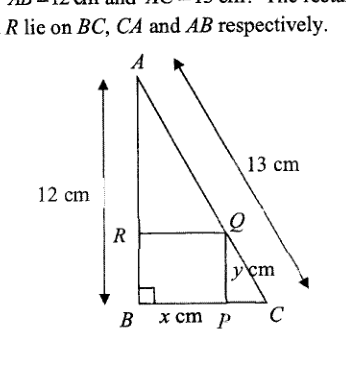
In ΔABC\Delta ABC, ∠ABC=90∘\angle ABC = 90^\circ, AB=12 cmAB = 12\text{ cm} and AC=13 cmAC = 13\text{ cm}. The rectangle BPQRBPQR is such that its vertices PP, QQ and RR lie on BCBC, CACA and ABAB respectively. It is given that BP=x cmBP = x\text{ cm} and PQ=y cmPQ = y\text{ cm}.

  1. (a)

    Show that y=60−12x5y = \frac{60 - 12x}{5}.

  2. (b)

    Show that the area, A cm2A\text{ cm}^2, of the rectangle BPQRBPQR is given by A=12x−12x25A = 12x - \frac{12x^2}{5}.

  3. (c)

    Given that xx can vary, find the stationary value of AA and determine its nature.

Work through it with AI →

It won't just hand you the answer — it asks where you're stuck.How the checker works

Worked solution

8(a)

1. Find the length of $BC$ using Pythagoras' theorem.

In ΔABC\Delta ABC, ∠ABC=90∘\angle ABC = 90^\circ.
BC=AC2−AB2BC = \sqrt{AC^2 - AB^2}
BC=132−122=169−144=25=5 cmBC = \sqrt{13^2 - 12^2} = \sqrt{169 - 144} = \sqrt{25} = 5\text{ cm}

2. Use similar triangles to establish the relationship between $x$ and $y$.

Since BPQRBPQR is a rectangle, PQ∥ABPQ \parallel AB.
Therefore, ΔCQP\Delta CQP is similar to ΔCAB\Delta CAB.
PQAB=CPCB\frac{PQ}{AB} = \frac{CP}{CB}
Given BP=xBP = x, CP=5−xCP = 5 - x.
y12=5−x5\frac{y}{12} = \frac{5 - x}{5}
y=12(5−x)5y = \frac{12(5 - x)}{5}
y=60−12x5 (shown)y = \frac{60 - 12x}{5} \text{ (shown)}

Answer

y=60−12x5y = \frac{60 - 12x}{5}

8(b)

1. Express the area of the rectangle in terms of $x$ and $y$

Area of rectangle BPQRBPQR, A=BP×PQ=x×yA = BP \times PQ = x \times y

2. Substitute the expression for $y$ from part (a) and simplify to obtain the given result

A=x(60−12x5)A = x \left( \frac{60 - 12x}{5} \right)
A=60x−12x25A = \frac{60x - 12x^2}{5}
A=12x−12x25A = 12x - \frac{12x^2}{5} (shown)

Answer

Shown

8(c)

1. Differentiate $A$ with respect to $x$.

A=12x−125x2A = 12x - \frac{12}{5}x^2

dAdx=12−245x\frac{dA}{dx} = 12 - \frac{24}{5}x

2. Find the value of $x$ at the stationary point.

For a stationary value, dAdx=0\frac{dA}{dx} = 0.

12−245x=012 - \frac{24}{5}x = 0

245x=12\frac{24}{5}x = 12

x=12×524=2.5x = 12 \times \frac{5}{24} = 2.5

3. Calculate the stationary value of $A$.

Substitute x=2.5x = 2.5 into AA:

A=12(2.5)−125(2.5)2A = 12(2.5) - \frac{12}{5}(2.5)^2

A=30−2.4(6.25)=30−15=15A = 30 - 2.4(6.25) = 30 - 15 = 15

4. Determine the nature of the stationary value using the second derivative test.

d2Adx2=−245=−4.8\frac{d^2A}{dx^2} = -\frac{24}{5} = -4.8

Since d2Adx2<0\frac{d^2A}{dx^2} < 0, the stationary value is a maximum.

Answer

Stationary value is 1515, and it is a maximum.

AI analysis — may contain mistakes.

Worked this one out on paper? Snap your steps and Gigle's AI math checker will circle the step where it went wrong.

More questions on this topic

  1. 1The triangle ABC is such that its area is 16+7102 cm2\dfrac{16 + 7\sqrt{10}}{2}\ \text{cm}^2, the length of AB is (32+5) cm(3\sqrt{2} + \sqrt{5})\ \text{cm}…
  2. 2如果三角形的两条边分别为4和6,那么连结该三角形三边中点所得的周长可能是下列数据中的【 】 A. 6 B. 8 C. 10 D. 12
  3. 3In ΔABC\Delta ABC, AC=12 cmAC = 12\text{ cm}, ∠ABC\angle ABC is a right angle, ∠ACB=π6\angle ACB = \frac{\pi}{6} radians and MM is the…
  4. 4The diagram shows a quadrilateral ABCDABCD whose vertices lie on the circumference of a circle. The point EE lies on the…
  5. 5The equation of a circle is x2+y2+8x−20y−53=0x^2 + y^2 + 8x - 20y - 53 = 0. Find the radius of the circle and the coordinates of its ce…