The triangle with vertices A (2, 5), B (−2, −3) and C (2, −2) is shown in the diagram below.
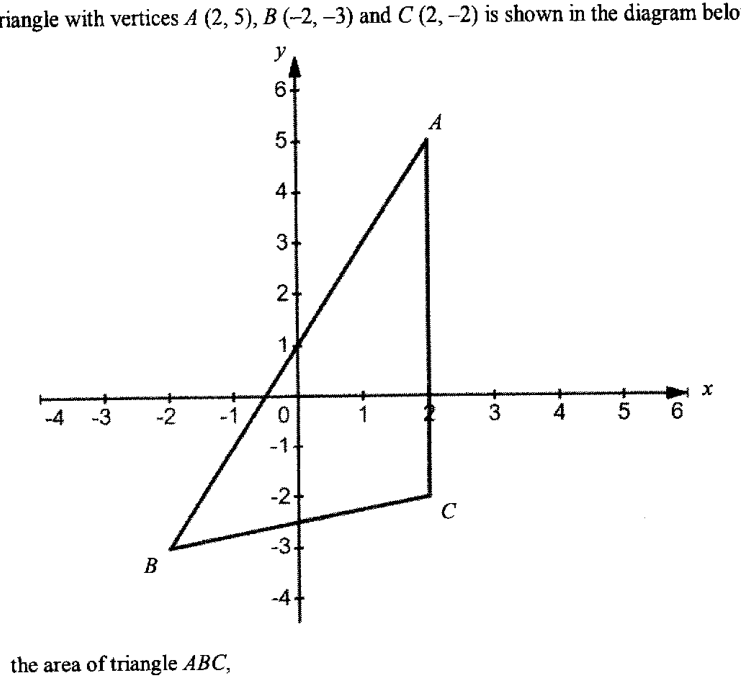
- (a)
Find
(a) the area of triangle ABC,
Answer ... unit^2
- (b)
the coordinates of point D such that ABCD is a parallelogram,
Answer (... , ...)
- (c)
the area of parallelogram ABCD,
Answer ... unit^2
- (d)
angle BAC,
Answer Angle BAC = ...
- (e)
the gradient of line AC,
Answer ...
- (f)
the cosine value of angle BCA in terms of p, where p = BC.
Answer ...
It won't just hand you the answer — it asks where you're stuck.How the checker works
Worked solution
24(a)
1. Identify a suitable base and perpendicular height from the coordinates
Since and have the same -coordinate, is vertical.
The perpendicular distance from to the vertical line is
2. Calculate the area of the triangle
24(b)
1. Find the translation from $B$ to $C$ and apply it to $A$ to locate $D$.
For parallelogram , .
to gives
So
24(c)
1. Use the triangle area from part (a) to find the area of the parallelogram
Area of parallelogram area of triangle
24(d)
1. Identify the relevant side lengths for angle $BAC$
Since and have the same -coordinate, is vertical.
The horizontal distance from to the line is
.
So, for angle , the opposite side is and the adjacent side is .
2. Use the tangent ratio to find angle $BAC$
24(e)
1. Determine the gradient of line $AC$ from the coordinates of $A$ and $C$
For and ,
Since division by zero is undefined, the gradient of is undefined.
undefined
24(f)
1. Identify the adjacent side and hypotenuse for angle $BCA$, then apply the cosine ratio
From the coordinates, and , so
.
Given , for angle ,
AI analysis — may contain mistakes.
Worked this one out on paper? Snap your steps and Gigle's AI math checker will circle the step where it went wrong.
More questions on this topic
- 1A cuboid has a volume of 250 cm^3, correct to the nearest cubic centimetre. The height of the cuboid is 8.4 cm, correct…
- 2The diagram (not drawn to scale) shows the speed-time graph of a vehicle. The vehicle starts from rest and accelerates u…
- 3The diagram below shows the speed-time graph of a bus journey. The bus accelerated from rest at 1.25 m/s^2 to a speed of…
- 4In the diagram, POR is a quadrant of a circle with radius 6 cm. OR and PQ are parallel. QR is an arc of a circle with ce…
- 5Four squares of side length , , , and units are arranged in increasing size order so that their left edges…