Diagram 1 shows an equilateral triangle with sides of length 1 unit. An inverted white equilateral triangle with sides of length unit is removed to form Diagram 2. Three inverted white equilateral triangles with sides of length unit is then removed from Diagram 2 to form Diagram 3. The process continues in this way.
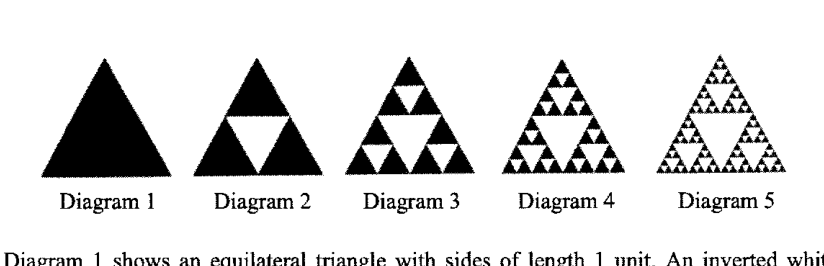
- (a)
Find an expression, in terms of , for the total number of black triangles in Diagram .
Answer ...
- (b)
Taking the area of Diagram 1 to be , find an expression, in terms of and , for the total area of black triangles in Diagram .
Answer ...
It won't just hand you the answer — it asks where you're stuck.How the checker works
Worked solution
19(a)
1. Identify the sequence for the number of black triangles in each diagram
Diagram 1: black triangle
Diagram 2: black triangles
Diagram 3: black triangles
Diagram 4: black triangles
Diagram 5: black triangles
The sequence is
2. Deduce the general formula for the $n$-th term
Notice that each term is a power of :
Diagram 1:
Diagram 2:
Diagram 3:
For Diagram , the power of is .
Number of black triangles
19(b)
1. Determine the area of black triangles in Diagram 2
Area of Diagram 1 =
In Diagram 2, an inverted triangle with side length is removed. The area of this removed triangle is of the original area.
Area of black triangles in Diagram 2 =
2. Generalise the pattern to Diagram $n$
In each subsequent diagram, the area of black triangles is of the previous diagram's area.
Area in Diagram 1 =
Area in Diagram 2 =
Area in Diagram 3 =
Area in Diagram =
AI analysis — may contain mistakes.
Worked this one out on paper? Snap your steps and Gigle's AI math checker will circle the step where it went wrong.
More questions on this topic
- 1The triangle ABC is such that its area is , the length of AB is …
- 2如果三角形的两条边分别为4和6,那么连结该三角形三边中点所得的周长可能是下列数据中的【 】 A. 6 B. 8 C. 10 D. 12
- 3In , , is a right angle, radians and is the…
- 4The diagram shows a quadrilateral whose vertices lie on the circumference of a circle. The point lies on the…
- 5The equation of a circle is . Find the radius of the circle and the coordinates of its ce…