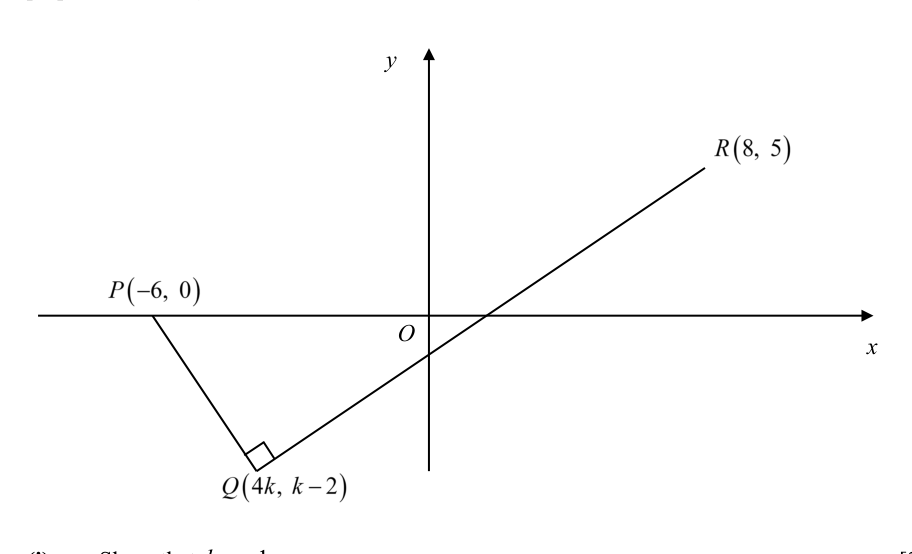
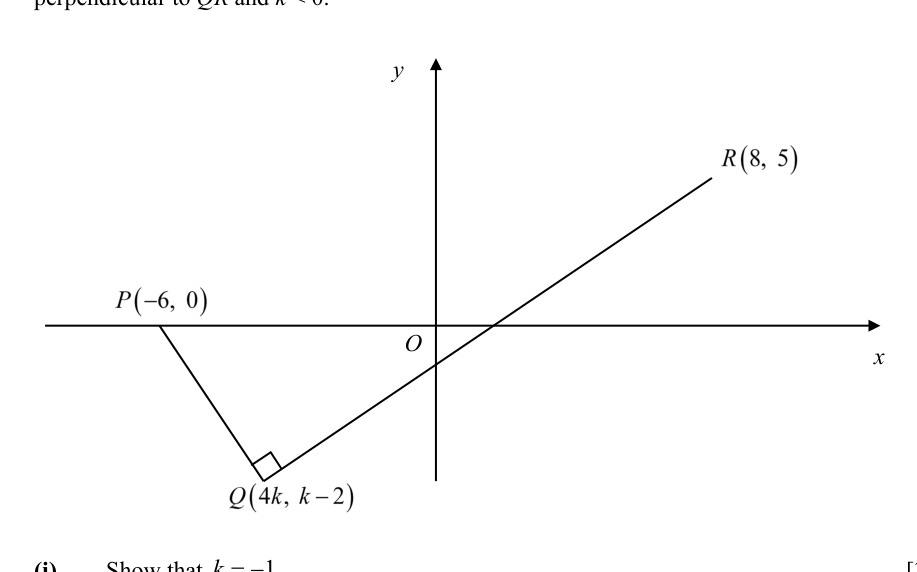
The diagram shows three points P(−6,0)P(-6, 0), Q(4k,k−2)Q(4k, k-2) and R(8,5)R(8, 5) where PQPQ is perpendicular to QRQR and $k < 0.

  1. (i)

    Show that k=−1k = -1.

  2. (ii)

    The perpendicular bisector of PRPR cuts the y-axis at SS. Find the coordinates of SS.

  3. (iii)

    Find the area of the quadrilateral PQRSPQRS.

Work through it with AI →

It won't just hand you the answer — it asks where you're stuck.How the checker works

Worked solution

13(i)

1. Find the gradients of the line segments $PQ$ and $QR$ in terms of $k$.

Gradient of PQPQ, mPQ=(k−2)−04k−(−6)=k−24k+6m_{PQ} = \frac{(k-2) - 0}{4k - (-6)} = \frac{k-2}{4k+6}

Gradient of QRQR, mQR=5−(k−2)8−4k=7−k8−4km_{QR} = \frac{5 - (k-2)}{8 - 4k} = \frac{7-k}{8-4k}

2. Apply the perpendicularity condition to form an equation in $k$.

Since PQ⊥QRPQ \perp QR, mPQ×mQR=−1m_{PQ} \times m_{QR} = -1.

(k−24k+6)(7−k8−4k)=−1\left(\frac{k-2}{4k+6}\right) \left(\frac{7-k}{8-4k}\right) = -1

(k−2)(7−k)=−(4k+6)(8−4k)(k-2)(7-k) = -(4k+6)(8-4k)

7k−k2−14+2k=−(32k−16k2+48−24k)7k - k^2 - 14 + 2k = -(32k - 16k^2 + 48 - 24k)

−k2+9k−14=16k2−8k−48-k^2 + 9k - 14 = 16k^2 - 8k - 48

3. Solve the resulting quadratic equation for $k$ and reject the invalid root.

17k2−17k−34=017k^2 - 17k - 34 = 0

k2−k−2=0k^2 - k - 2 = 0

(k−2)(k+1)=0(k-2)(k+1) = 0

k=2k = 2 or k=−1k = -1

Since it is given that k<0k < 0, we reject k=2k = 2.

Therefore, k=−1k = -1 (shown).

Answer

k=−1k = -1 (shown)

13(ii)

1. Find the coordinates of the midpoint of $PR$.

Midpoint of PR=(−6+82,0+52)=(1,2.5)PR = \left( \frac{-6 + 8}{2}, \frac{0 + 5}{2} \right) = (1, 2.5)

2. Find the gradient of the line segment $PR$.

Gradient of PR=5−08−(−6)=514PR = \frac{5 - 0}{8 - (-6)} = \frac{5}{14}

3. Determine the gradient of the perpendicular bisector.

Gradient of perpendicular bisector =−1514=−145=−2.8= -\frac{1}{\frac{5}{14}} = -\frac{14}{5} = -2.8

4. Find the equation of the perpendicular bisector and determine its $y$-intercept.

Equation of the perpendicular bisector:
y−2.5=−2.8(x−1)y - 2.5 = -2.8(x - 1)
Since SS lies on the yy-axis, x=0x = 0:
y−2.5=−2.8(0−1)y - 2.5 = -2.8(0 - 1)
y=2.5+2.8=5.3y = 2.5 + 2.8 = 5.3
Coordinates of SS are (0,5.3)(0, 5.3).

Answer

(0,5.3)(0, 5.3)

13(iii)

1. State the coordinates of the vertices and set up the shoelace formula

From earlier parts, the coordinates are P(−6,0)P(-6, 0), Q(−4,−3)Q(-4, -3), R(8,5)R(8, 5), and S(0,5.3)S(0, 5.3).
Arranging the vertices in counter-clockwise order, the area of quadrilateral PQRSPQRS is given by:
Area=12∣−6−480−60−355.30∣\text{Area} = \frac{1}{2} \left| \begin{matrix} -6 & -4 & 8 & 0 & -6 \\ 0 & -3 & 5 & 5.3 & 0 \end{matrix} \right|

2. Evaluate the shoelace formula to find the area

Area=12∣[(−6)(−3)+(−4)(5)+(8)(5.3)+(0)(0)]−[(0)(−4)+(−3)(8)+(5)(0)+(5.3)(−6)]∣\text{Area} = \frac{1}{2} | [(-6)(-3) + (-4)(5) + (8)(5.3) + (0)(0)] - [(0)(-4) + (-3)(8) + (5)(0) + (5.3)(-6)] |
=12∣(18−20+42.4+0)−(0−24+0−31.8)∣= \frac{1}{2} | (18 - 20 + 42.4 + 0) - (0 - 24 + 0 - 31.8) |
=12∣40.4−(−55.8)∣= \frac{1}{2} | 40.4 - (-55.8) |
=12(96.2)=48.1= \frac{1}{2} (96.2) = 48.1

Answer

48.148.1 units2^2

AI analysis — may contain mistakes.

Worked this one out on paper? Snap your steps and Gigle's AI math checker will circle the step where it went wrong.

More questions on this topic

  1. 1A curve has the equation y=2x−33x+4y = \frac{2x - 3}{3x + 4}, where x≠−43x \ne -\frac{4}{3}. The normal to the point PP on the cur…
  2. 2The normal to the curve y=2tan⁡3x−1y = 2\tan 3x - 1 at point P(π3,−1)P\left(\frac{\pi}{3}, -1\right) crosses the yy-axis at point AA…
  3. 3The point PP lies on the curve y=ln⁡(x+1x−1)y = \ln\left(\frac{x+1}{x-1}\right) for x>1x > 1. The normal to the curve at PP is par…
  4. 4The figure shows part of the curve y=g(x)y = g(x). (2,8)(2, 8) and (6,1)(6, 1) are two points on the curve. Given that ∫26y dx=32\int_{2}^{6} y \text{ } dx = 32…
  5. 5The diagram shows part of the curve y=3e−12x−6y = 3e^{-\frac{1}{2}x} - 6 which crosses the xx-axis at PP and the yy-axis at QQ…