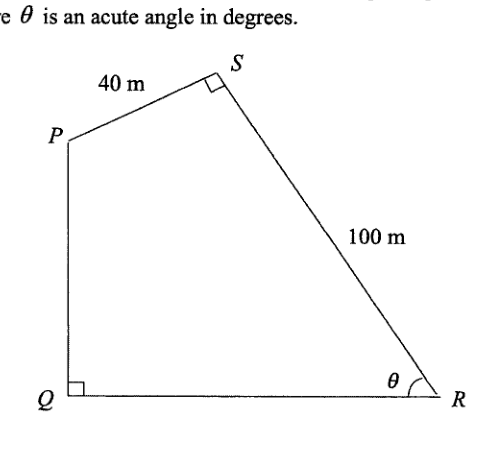
The diagram below shows a fenced field PQRSPQRS. It is given that PS=40 mPS = 40\text{ m}, SR=100 mSR = 100\text{ m}, both angles PQRPQR and PSRPSR are right angles and angle QRS=θQRS = \theta, where θ\theta is an acute angle in degrees.

  1. (a)

    Show that the perimeter, P mP\text{ m}, of the fence PQRSPQRS is given by P=140+140sin⁡θ+60cos⁡θP = 140 + 140 \sin \theta + 60 \cos \theta.

  2. (b)

    Express PP in the form 140+Rcos⁡(θ−α)140 + R \cos(\theta - \alpha), where R>0R > 0 and 0∘≤θ≤90∘0^\circ \le \theta \le 90^\circ.

  3. (c)

    Find the value of θ\theta when P=250P = 250.

Work through it with AI →

It won't just hand you the answer — it asks where you're stuck.How the checker works

Worked solution

7(a)

1. Draw perpendiculars to form right-angled triangles and find the lengths of the segments related to $SR$.

Draw a vertical line from SS to meet QRQR at AA. In △SAR\triangle SAR, ∠SAR=90∘\angle SAR = 90^\circ.
SA=SRsin⁡θ=100sin⁡θSA = SR \sin \theta = 100 \sin \theta
AR=SRcos⁡θ=100cos⁡θAR = SR \cos \theta = 100 \cos \theta

2. Draw a horizontal line from $S$ to $PQ$ and find the lengths of the segments related to $PS$.

Draw a horizontal line from SS to meet PQPQ (or its extension) at BB. In △PBS\triangle PBS, ∠PBS=90∘\angle PBS = 90^\circ.
Since ∠PSR=90∘\angle PSR = 90^\circ and the angle of SRSR with the horizontal is θ\theta, the angle of PSPS with the vertical is θ\theta. Thus, ∠PSB=90∘−θ\angle PSB = 90^\circ - \theta and ∠SPB=θ\angle SPB = \theta.
SB=PSsin⁡θ=40sin⁡θSB = PS \sin \theta = 40 \sin \theta
PB=PScos⁡θ=40cos⁡θPB = PS \cos \theta = 40 \cos \theta

3. Express $QR$ and $PQ$ in terms of $\theta$ and calculate the total perimeter.

From the rectangle SBAQSBAQ (where QA=SBQA = SB and QB=SAQB = SA):
QR=QA+AR=SB+AR=40sin⁡θ+100cos⁡θQR = QA + AR = SB + AR = 40 \sin \theta + 100 \cos \theta
PQ=QB−PB=SA−PB=100sin⁡θ−40cos⁡θPQ = QB - PB = SA - PB = 100 \sin \theta - 40 \cos \theta

Perimeter P=PQ+QR+RS+SPP = PQ + QR + RS + SP
P=(100sin⁡θ−40cos⁡θ)+(40sin⁡θ+100cos⁡θ)+100+40P = (100 \sin \theta - 40 \cos \theta) + (40 \sin \theta + 100 \cos \theta) + 100 + 40
P=140+140sin⁡θ+60cos⁡θP = 140 + 140 \sin \theta + 60 \cos \theta (shown)

Answer

Shown as required.

7(b)

1. Set up the R-formula equation for the trigonometric part of $P$

We want to express 60cos⁡θ+140sin⁡θ60 \cos \theta + 140 \sin \theta in the form Rcos⁡(θ−α)R \cos(\theta - \alpha).
Expanding Rcos⁡(θ−α)R \cos(\theta - \alpha) gives Rcos⁡θcos⁡α+Rsin⁡θsin⁡αR \cos \theta \cos \alpha + R \sin \theta \sin \alpha.
Comparing coefficients:
Rcos⁡α=60R \cos \alpha = 60
Rsin⁡α=140R \sin \alpha = 140

2. Calculate the value of $R$

R=602+1402R = \sqrt{60^2 + 140^2}
R=3600+19600=23200R = \sqrt{3600 + 19600} = \sqrt{23200}
R=2058≈152.315R = 20\sqrt{58} \approx 152.315

3. Calculate the value of $\alpha$ and write the final expression

tan⁡α=14060=73\tan \alpha = \frac{140}{60} = \frac{7}{3}
α=tan⁡−1(73)≈66.801∘\alpha = \tan^{-1}\left(\frac{7}{3}\right) \approx 66.801^\circ
Therefore, P=140+152.3cos⁡(θ−66.8∘)P = 140 + 152.3 \cos(\theta - 66.8^\circ) (to 1 d.p.)

Answer

140+152.3cos⁡(θ−66.8∘)140 + 152.3 \cos(\theta - 66.8^\circ)

7(c)

1. Set up the equation using the R-formula result from part (b)

From part (b), P=140+23200cos⁡(θ−66.801∘)P = 140 + \sqrt{23200} \cos(\theta - 66.801^\circ).
Given P=250P = 250,
140+23200cos⁡(θ−66.801∘)=250140 + \sqrt{23200} \cos(\theta - 66.801^\circ) = 250
23200cos⁡(θ−66.801∘)=110\sqrt{23200} \cos(\theta - 66.801^\circ) = 110
cos⁡(θ−66.801∘)=11023200≈0.72217\cos(\theta - 66.801^\circ) = \frac{110}{\sqrt{23200}} \approx 0.72217

2. Solve for $\theta$ and select the acute angle

θ−66.801∘=cos⁡−1(0.72217)\theta - 66.801^\circ = \cos^{-1}(0.72217)
θ−66.801∘=±43.765∘\theta - 66.801^\circ = \pm 43.765^\circ
θ=66.801∘+43.765∘ or 66.801∘−43.765∘\theta = 66.801^\circ + 43.765^\circ \text{ or } 66.801^\circ - 43.765^\circ
θ=110.566∘ or 23.036∘\theta = 110.566^\circ \text{ or } 23.036^\circ
Since 0∘≤θ≤90∘0^\circ \le \theta \le 90^\circ, we reject 110.566∘110.566^\circ.
θ≈23.0∘ (to 1 d.p.)\theta \approx 23.0^\circ \text{ (to 1 d.p.)}

Answer

23.0∘23.0^\circ

AI analysis — may contain mistakes.

Worked this one out on paper? Snap your steps and Gigle's AI math checker will circle the step where it went wrong.

More questions on this topic

  1. 1Solve the equation 2cot⁡22x=1−5sin⁡2x2 \cot^2 2x = 1 - \frac{5}{\sin 2x} for −180∘≤x≤180∘-180^\circ \le x \le 180^\circ.
  2. 2已知sin⁡(α+π12)=55\sin (α+ \dfrac {π}{12} )= \dfrac { \sqrt {5}}{5},则sin⁡(π3−2α)=(    )\sin ( \dfrac {π}{3} -2α)= (\:\:\:\:) A. 45 \dfrac {4}{5}…
  3. 38.8.设△ABC\triangle ABC的内角AA,BB,CC所对的边分别为aa,bb,cc,若bcos⁡C+ccos⁡B=asin⁡Ab\cos C+c\cos B=a\sin A,则△ABC\triangle ABC的形状为…
  4. 4Prove that sin⁡3xsec⁡2x+sin⁡x=tan⁡xsec⁡x\sin^{3} x\sec^{2} x + \sin x = \tan x\sec x. Solve the equation sin⁡3xsec⁡2x+sin⁡x=5\sin^{3} x\sec^{2} x + \sin x = 5 for 0≤x≤360∘0 \le x \le 360^\circ…
  5. 5Given that cos⁡x=−45\cos x = -\frac{4}{5} and tan⁡x>0\tan x > 0, find sin⁡2x\sin 2x, cos⁡x2\cos \frac{x}{2}.