The graph of a function f(x) has undergone the following transformations: Step 1: Translation in the negative x-direction by 1 unit Step 2: Translation in the positive y-direction by 5 units Step 3: Scaling parallel to the x-axis by a factor of The function of the resulting graph is . Express in terms of . Hence, obtain an expression for function .
- (a)
The graph of a function f(x) has undergone the following transformations:
Step 1: Translation in the negative x-direction by 1 unit
Step 2: Translation in the positive y-direction by 5 units
Step 3: Scaling parallel to the x-axis by a factor of
The function of the resulting graph is . Express in terms of . Hence, obtain an expression for function .
- (b)
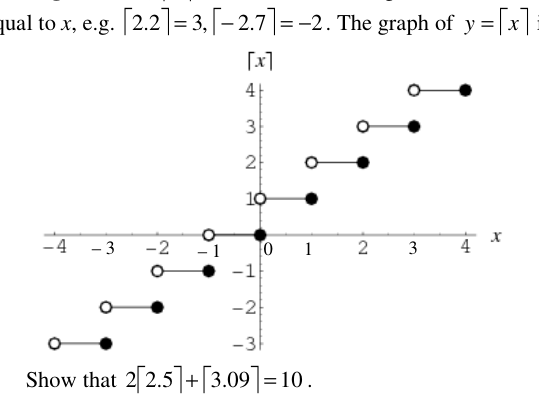
The ceiling function, , is a function which gives the smallest integer greater than or equal to x, e.g. . The graph of is shown below:
A function is defined by
- (i)
Show that .
- (ii)
Evaluate .
- (iii)
Sketch the graph of for .
- (iv)
State the range of g for all positive real values of x.
- (i)
It won't just hand you the answer — it asks where you're stuck.How the checker works
Worked solution
5(a)
1. Express $h(x)$ in terms of $f(x)$ by applying the transformations sequentially.
Let the initial function be .
Step 1: Translation in the negative -direction by unit (replace with ):
Step 2: Translation in the positive -direction by units (add to the function):
Step 3: Scaling parallel to the -axis by a factor of (replace with ):
2. Equate the derived expression for $h(x)$ to the given quadratic equation and isolate the $f$ term.
Given , we equate the two expressions:
3. Find an expression for $f(x)$ by rewriting the right-hand side in terms of $(2x + 1)$.
Notice that contains a perfect square. We can rewrite it in terms of :
Replacing the expression with , we obtain the original function:
5(b)(i)
1. Evaluate the individual ceiling functions
2. Substitute the evaluated values into the expression and calculate the total
(shown)
As shown above.
5(b)(ii)
1. Evaluate $g(0.12)$ by substituting $x = 0.12$ into the function
2. Evaluate $g(3)$ by substituting $x = 3$ into the function
3. Calculate the sum of $g(0.12)$ and $g(3)$
5(b)(iii)
1. Determine the intervals of $x$ for which $g(x)$ takes integer values within the given domain $0 < x \le 4$.
To find where :
Restricting to the given domain , for .
To find where :
To find where :
Restricting to the given domain , for .
2. Describe the features of the graph to be sketched.
Based on the intervals, sketch three horizontal line segments:
- A segment at for , with an open circle at and a solid dot at .
- A segment at for , with an open circle at and a solid dot at .
- A segment at for , with an open circle at and a solid dot at .
for
for
for
(The correct sketch consists of horizontal line segments for these intervals, with open circles at the left endpoints and solid dots at the right endpoints)
5(b)(iv)
1. Determine the range of values for the expression inside the ceiling function.
Given , we have , which means .
The expression inside the ceiling function can take any real value greater than .
2. Apply the ceiling function to find the range.
The ceiling function rounds up to the nearest integer.
For any real number , the possible values of are the integers
Therefore, the range of is the set of all positive integers.
(or all positive integers)
AI analysis — may contain mistakes.
Worked this one out on paper? Snap your steps and Gigle's AI math checker will circle the step where it went wrong.
More questions on this topic
- 1将函数的图象保持纵坐标不变,先将横坐标缩短为原来的,再向右平移个单位长度后得到,则的解析式为…
- 2By expressing the equation of the curve in the form , where …
- 3A curve has the equation where . Sketch , stating the coordinates of any points o…
- 4The diagram shows the graphs of and . The graph of has t…
- 5The curve with equation is transformed to curve by a translation of …