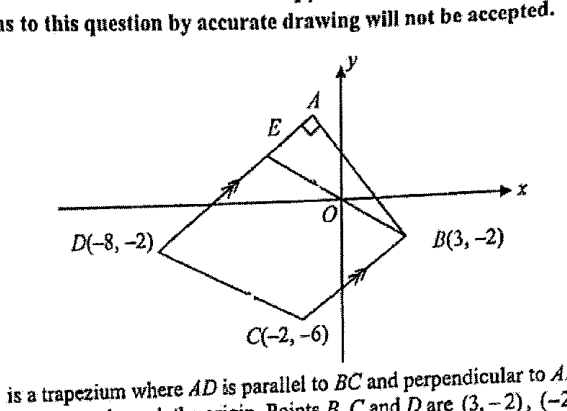
Solutions to this question by accurate drawing will not be accepted. ABCDABCD is a trapezium where ADAD is parallel to BCBC and perpendicular to ABAB. EE is a point on ADAD and BEBE passes through the origin. Points BB, CC and DD are (3,−2)(3, -2), (−2,−6)(-2, -6) and (−8,−2)(-8, -2) respectively.

  1. (i)

    Show that BCDEBCDE is a parallelogram.

  2. (ii)

    Find the coordinates of EE.

  3. (iii)

    Show that the coordinates of AA is (−11241,31541)\left(-1\frac{12}{41}, 3\frac{15}{41}\right).

  4. (iv)

    Calculate the area of parallelogram BCDEBCDE.

  5. (9)
    1. (b)

      Given that p=log⁡3yp = \log_3 y, express log⁡y27\log_y 27 in terms of pp.

    2. (c)

      Solve the equation log⁡27x3=log⁡36−1log⁡5x3\log_{27} x^3 = \log_3 6 - \frac{1}{\log_{5x} 3}.

  6. (10)
    1. (ii)

      Find the equation of the curve.

    2. (iii)

      Explain why the equation of the normal at QQ must be of the form x=kx = k, where kk is a constant. State the value of kk.

Work through it with AI →

It won't just hand you the answer — it asks where you're stuck.How the checker works

Worked solution

8(i)

1. State that one pair of opposite sides is parallel

Since EE lies on ADAD and it is given that ADAD is parallel to BCBC, we have ED∥BCED \parallel BC.

2. Calculate the gradient of the line $BE$

The line BEBE passes through the origin O(0,0)O(0, 0) and B(3,−2)B(3, -2).
Gradient of BE=−2−03−0=−23BE = \frac{-2 - 0}{3 - 0} = -\frac{2}{3}

3. Calculate the gradient of the line $CD$

Using C(−2,−6)C(-2, -6) and D(−8,−2)D(-8, -2):
Gradient of CD=−2−(−6)−8−(−2)=4−6=−23CD = \frac{-2 - (-6)}{-8 - (-2)} = \frac{4}{-6} = -\frac{2}{3}

4. Conclude that $BCDE$ is a parallelogram

Since the gradient of BEBE equals the gradient of CDCD, BE∥CDBE \parallel CD.
Because both pairs of opposite sides are parallel (ED∥BCED \parallel BC and BE∥CDBE \parallel CD), BCDEBCDE is a parallelogram.

Answer

Shown that BCDEBCDE is a parallelogram.

8(ii)

1. Use the property of the parallelogram $BCDE$ to relate the coordinates of $E$ to known points

Since BCDEBCDE is a parallelogram (from part i), the translation from CC to BB is the same as the translation from DD to EE.
CB⃗=(3−(−2)−2−(−6))=(54)\vec{CB} = \begin{pmatrix} 3 - (-2) \\ -2 - (-6) \end{pmatrix} = \begin{pmatrix} 5 \\ 4 \end{pmatrix}

2. Calculate the coordinates of $E$

DE⃗=CB⃗=(54)\vec{DE} = \vec{CB} = \begin{pmatrix} 5 \\ 4 \end{pmatrix}
Coordinates of E=(−8+5,−2+4)=(−3,2)E = (-8 + 5, -2 + 4) = (-3, 2)

Answer

(−3,2)(-3, 2)

8(iii)

1. Find the gradient of the line $AD$.

Since ADAD is parallel to BCBC, their gradients are equal.
Gradient of BC=−6−(−2)−2−3=−4−5=45BC = \frac{-6 - (-2)}{-2 - 3} = \frac{-4}{-5} = \frac{4}{5}
Gradient of AD=45AD = \frac{4}{5}

2. Find the equation of the line $AD$.

Using point D(−8,−2)D(-8, -2) and gradient 45\frac{4}{5}:
y−(−2)=45(x−(−8))y - (-2) = \frac{4}{5}(x - (-8))
y=45x+325−2y = \frac{4}{5}x + \frac{32}{5} - 2
y=45x+225y = \frac{4}{5}x + \frac{22}{5}

3. Find the equation of the line $AB$.

Since ABAB is perpendicular to ADAD, the gradient of ABAB is −145=−54-\frac{1}{\frac{4}{5}} = -\frac{5}{4}.
Using point B(3,−2)B(3, -2):
y−(−2)=−54(x−3)y - (-2) = -\frac{5}{4}(x - 3)
y=−54x+154−2y = -\frac{5}{4}x + \frac{15}{4} - 2
y=−54x+74y = -\frac{5}{4}x + \frac{7}{4}

4. Solve the simultaneous equations to find the coordinates of $A$.

Equating the two expressions for yy:
45x+225=−54x+74\frac{4}{5}x + \frac{22}{5} = -\frac{5}{4}x + \frac{7}{4}
Multiply the entire equation by 2020 to clear denominators:
16x+88=−25x+3516x + 88 = -25x + 35
41x=−5341x = -53
x=−5341=−11241x = -\frac{53}{41} = -1\frac{12}{41}

Substitute xx back into the equation for ABAB:
y=−54(−5341)+74y = -\frac{5}{4}\left(-\frac{53}{41}\right) + \frac{7}{4}
y=265164+287164=552164y = \frac{265}{164} + \frac{287}{164} = \frac{552}{164}
y=13841=31541y = \frac{138}{41} = 3\frac{15}{41}

Thus, the coordinates of AA are (−11241,31541)\left(-1\frac{12}{41}, 3\frac{15}{41}\right) (shown).

Answer

The coordinates of AA are (−11241,31541)\left(-1\frac{12}{41}, 3\frac{15}{41}\right).

8(iv)

1. Recall the coordinates of the vertices of the parallelogram

From the given information and earlier parts, the vertices of parallelogram BCDEBCDE are B(3,−2)B(3, -2), C(−2,−6)C(-2, -6), D(−8,−2)D(-8, -2), and E(−3,2)E(-3, 2).

2. Apply the shoelace formula to find the area of the parallelogram

Area=12∣3−2−8−33−2−6−22−2∣=12∣[3(−6)+(−2)(−2)+(−8)(2)+(−3)(−2)]−[(−2)(−2)+(−6)(−8)+(−2)(−3)+(2)(3)]∣=12∣(−18+4−16+6)−(4+48+6+6)∣=12∣−24−64∣=12∣−88∣=44\begin{aligned} \text{Area} &= \frac{1}{2} \left| \begin{matrix} 3 & -2 & -8 & -3 & 3 \\ -2 & -6 & -2 & 2 & -2 \end{matrix} \right| \\ &= \frac{1}{2} | [3(-6) + (-2)(-2) + (-8)(2) + (-3)(-2)] - [(-2)(-2) + (-6)(-8) + (-2)(-3) + (2)(3)] | \\ &= \frac{1}{2} | (-18 + 4 - 16 + 6) - (4 + 48 + 6 + 6) | \\ &= \frac{1}{2} | -24 - 64 | \\ &= \frac{1}{2} |-88| \\ &= 44 \end{aligned}

Answer

4444 units2^2

8(9)(b)

1. Apply the change of base formula to convert the logarithm to base 3

log⁡y27=log⁡327log⁡3y\log_y 27 = \frac{\log_3 27}{\log_3 y}

2. Evaluate the numerator and substitute the given expression for the denominator

log⁡327=3\log_3 27 = 3
log⁡y27=3p\log_y 27 = \frac{3}{p}

Answer

3p\frac{3}{p}

8(9)(c)

1. Change the base of $\log_{27} x^3$ to base 3

log⁡27x3=log⁡3x3log⁡327=3log⁡3x3=log⁡3x\log_{27} x^3 = \frac{\log_3 x^3}{\log_3 27} = \frac{3 \log_3 x}{3} = \log_3 x

2. Change the base of $\frac{1}{\log_{5x} 3}$ to base 3

1log⁡5x3=log⁡35x\frac{1}{\log_{5x} 3} = \log_3 5x

3. Substitute back into the equation and combine the logarithmic terms

log⁡3x=log⁡36−log⁡35x\log_3 x = \log_3 6 - \log_3 5x
log⁡3x+log⁡35x=log⁡36\log_3 x + \log_3 5x = \log_3 6
log⁡3(x⋅5x)=log⁡36\log_3 (x \cdot 5x) = \log_3 6
log⁡3(5x2)=log⁡36\log_3 (5x^2) = \log_3 6

4. Solve for $x$ and reject the invalid root

5x2=65x^2 = 6
x2=65=1.2x^2 = \frac{6}{5} = 1.2
x=1.2 or x=−1.2x = \sqrt{1.2} \text{ or } x = -\sqrt{1.2}
Since x>0x > 0 for the logarithms to be defined, we reject x=−1.2x = -\sqrt{1.2}.
x=1.2≈1.0954≈1.10x = \sqrt{1.2} \approx 1.0954 \approx 1.10 (to 3 s.f.)

Answer

x=1.10x = 1.10

AI analysis — may contain mistakes.

Worked this one out on paper? Snap your steps and Gigle's AI math checker will circle the step where it went wrong.

More questions on this topic

  1. 1A curve has the equation y=2x−33x+4y = \frac{2x - 3}{3x + 4}, where x≠−43x \ne -\frac{4}{3}. The normal to the point PP on the cur…
  2. 2The normal to the curve y=2tan⁡3x−1y = 2\tan 3x - 1 at point P(π3,−1)P\left(\frac{\pi}{3}, -1\right) crosses the yy-axis at point AA…
  3. 3The point PP lies on the curve y=ln⁡(x+1x−1)y = \ln\left(\frac{x+1}{x-1}\right) for x>1x > 1. The normal to the curve at PP is par…
  4. 4The figure shows part of the curve y=g(x)y = g(x). (2,8)(2, 8) and (6,1)(6, 1) are two points on the curve. Given that ∫26y dx=32\int_{2}^{6} y \text{ } dx = 32…
  5. 5The diagram shows part of the curve y=3e−12x−6y = 3e^{-\frac{1}{2}x} - 6 which crosses the xx-axis at PP and the yy-axis at QQ…