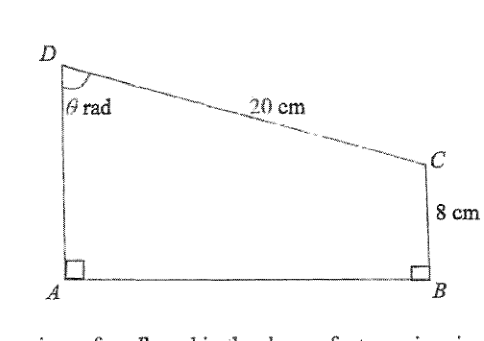
The figure shows a piece of cardboard in the shape of a trapezium in which ∠BAD\angle BAD and ∠ABC\angle ABC are right angles. CD=20 cmCD = 20\text{ cm}, BC=8 cmBC = 8\text{ cm} and ∠ADC=θ\angle ADC = \theta radians.

  1. (i)

    Show that the perimeter, P cmP\text{ cm}, is given by P=20cos⁡θ+20sin⁡θ+36P = 20\cos\theta + 20\sin\theta + 36.

  2. (ii)

    Express PP in the form Rcos⁡(θ−α)+kR\cos(\theta - \alpha) + k, where α\alpha is acute and kk is a constant.

  3. (iii)

    If θ\theta can vary, find the maximum value of PP and the corresponding value of θ\theta.

  4. (iv)

    Find the value of θ\theta when the perimeter of the cardboard is 60 cm60\text{ cm}.

Work through it with AI →

It won't just hand you the answer — it asks where you're stuck.How the checker works

Worked solution

8(i)

1. Construct a right-angled triangle to find the unknown lengths.

Draw a perpendicular line from CC to ADAD, meeting ADAD at EE.
Since ∠BAD=90∘\angle BAD = 90^\circ and ∠ABC=90∘\angle ABC = 90^\circ, ABCEABCE is a rectangle.
Therefore, AE=BC=8AE = BC = 8 and AB=CEAB = CE.

2. Use trigonometry to find the lengths of $CE$ and $DE$.

In the right-angled △CDE\triangle CDE:
sin⁡θ=CECD  ⟹  CE=20sin⁡θ\sin\theta = \frac{CE}{CD} \implies CE = 20\sin\theta
cos⁡θ=DECD  ⟹  DE=20cos⁡θ\cos\theta = \frac{DE}{CD} \implies DE = 20\cos\theta

3. Express the lengths of $AB$ and $AD$ in terms of $\theta$.

AB=CE=20sin⁡θAB = CE = 20\sin\theta
AD=AE+DE=8+20cos⁡θAD = AE + DE = 8 + 20\cos\theta

4. Calculate the perimeter of the trapezium.

P=AB+BC+CD+ADP = AB + BC + CD + AD
P=20sin⁡θ+8+20+(8+20cos⁡θ)P = 20\sin\theta + 8 + 20 + (8 + 20\cos\theta)
P=20cos⁡θ+20sin⁡θ+36P = 20\cos\theta + 20\sin\theta + 36 (Shown)

Answer

P=20cos⁡θ+20sin⁡θ+36P = 20\cos\theta + 20\sin\theta + 36 (Shown)

8(ii)

1. Find the value of $R$

Let 20cos⁡θ+20sin⁡θ=Rcos⁡(θ−α)=Rcos⁡θcos⁡α+Rsin⁡θsin⁡α20\cos\theta + 20\sin\theta = R\cos(\theta - \alpha) = R\cos\theta\cos\alpha + R\sin\theta\sin\alpha.
Comparing coefficients:
Rcos⁡α=20R\cos\alpha = 20
Rsin⁡α=20R\sin\alpha = 20
R=202+202=800=202R = \sqrt{20^2 + 20^2} = \sqrt{800} = 20\sqrt{2}

2. Find the value of $\alpha$ in radians

tan⁡α=2020=1\tan\alpha = \frac{20}{20} = 1
Since θ\theta is in radians, α=tan⁡−1(1)=π4\alpha = \tan^{-1}(1) = \frac{\pi}{4}

3. Write the final expression for $P$

P=202cos⁡(θ−π4)+36P = 20\sqrt{2}\cos\left(\theta - \frac{\pi}{4}\right) + 36

Answer

202cos⁡(θ−π4)+3620\sqrt{2}\cos\left(\theta - \frac{\pi}{4}\right) + 36

8(iii)

1. Express $P$ using the result from part (ii) to find its maximum value

From part (ii), 20cos⁡θ+20sin⁡θ=Rcos⁡(θ−α)20\cos\theta + 20\sin\theta = R\cos(\theta - \alpha).
R=202+202=800=202R = \sqrt{20^2 + 20^2} = \sqrt{800} = 20\sqrt{2}
tan⁡α=2020=1  ⟹  α=π4\tan\alpha = \frac{20}{20} = 1 \implies \alpha = \frac{\pi}{4} rad.
So, P=202cos⁡(θ−π4)+36P = 20\sqrt{2}\cos\left(\theta - \frac{\pi}{4}\right) + 36.
The maximum value of PP occurs when cos⁡(θ−π4)=1\cos\left(\theta - \frac{\pi}{4}\right) = 1.
Maximum P=202(1)+36=202+36≈64.3P = 20\sqrt{2}(1) + 36 = 20\sqrt{2} + 36 \approx 64.3 cm.

2. Find the corresponding value of $\theta$

For maximum PP, cos⁡(θ−π4)=1\cos\left(\theta - \frac{\pi}{4}\right) = 1.
θ−π4=0\theta - \frac{\pi}{4} = 0
θ=π4≈0.785\theta = \frac{\pi}{4} \approx 0.785 rad.

Answer

Maximum P=202+36≈64.3P = 20\sqrt{2} + 36 \approx 64.3, θ=π4≈0.785\theta = \frac{\pi}{4} \approx 0.785 rad

8(iv)

1. Equate the R-formula expression for perimeter to 60

From part (ii), P=202cos⁡(θ−π4)+36P = 20\sqrt{2}\cos\left(\theta - \frac{\pi}{4}\right) + 36.
202cos⁡(θ−π4)+36=6020\sqrt{2}\cos\left(\theta - \frac{\pi}{4}\right) + 36 = 60

2. Isolate the cosine term

202cos⁡(θ−π4)=2420\sqrt{2}\cos\left(\theta - \frac{\pi}{4}\right) = 24
cos⁡(θ−π4)=24202=652≈0.8485\cos\left(\theta - \frac{\pi}{4}\right) = \frac{24}{20\sqrt{2}} = \frac{6}{5\sqrt{2}} \approx 0.8485

3. Solve for $\theta$

Basic angle α=cos⁡−1(652)≈0.55759\alpha = \cos^{-1}\left(\frac{6}{5\sqrt{2}}\right) \approx 0.55759
Since θ\theta is an acute angle in the trapezium, we consider the principal and fourth quadrant solutions for the argument:
θ−π4=±0.55759\theta - \frac{\pi}{4} = \pm 0.55759
θ=π4±0.55759\theta = \frac{\pi}{4} \pm 0.55759
θ≈0.78540±0.55759\theta \approx 0.78540 \pm 0.55759
θ≈1.34299 or 0.22781\theta \approx 1.34299 \text{ or } 0.22781

Answer

0.2280.228 or 1.341.34 radians

AI analysis — may contain mistakes.

Worked this one out on paper? Snap your steps and Gigle's AI math checker will circle the step where it went wrong.

More questions on this topic

  1. 1Solve the equation 2cot⁡22x=1−5sin⁡2x2 \cot^2 2x = 1 - \frac{5}{\sin 2x} for −180∘≤x≤180∘-180^\circ \le x \le 180^\circ.
  2. 2已知sin⁡(α+π12)=55\sin (α+ \dfrac {π}{12} )= \dfrac { \sqrt {5}}{5},则sin⁡(π3−2α)=(    )\sin ( \dfrac {π}{3} -2α)= (\:\:\:\:) A. 45 \dfrac {4}{5}…
  3. 38.8.设△ABC\triangle ABC的内角AA,BB,CC所对的边分别为aa,bb,cc,若bcos⁡C+ccos⁡B=asin⁡Ab\cos C+c\cos B=a\sin A,则△ABC\triangle ABC的形状为…
  4. 4Prove that sin⁡3xsec⁡2x+sin⁡x=tan⁡xsec⁡x\sin^{3} x\sec^{2} x + \sin x = \tan x\sec x. Solve the equation sin⁡3xsec⁡2x+sin⁡x=5\sin^{3} x\sec^{2} x + \sin x = 5 for 0≤x≤360∘0 \le x \le 360^\circ…
  5. 5Given that cos⁡x=−45\cos x = -\frac{4}{5} and tan⁡x>0\tan x > 0, find sin⁡2x\sin 2x, cos⁡x2\cos \frac{x}{2}.