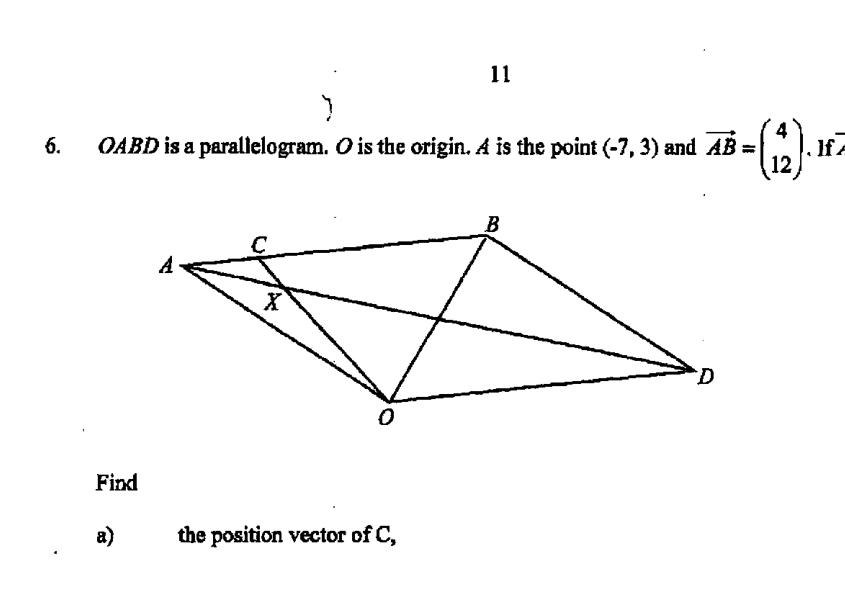
OABD is a parallelogram. O is the origin. A is the point (-7, 3) and AB→=(412)\overrightarrow{AB}=\begin{pmatrix}4\\12\end{pmatrix}. If AC→=14AB→\overrightarrow{AC}=\frac{1}{4}\overrightarrow{AB}.

  1. (a)

    the position vector of C,

  2. (b)

    ∣OD→∣\left|\overrightarrow{OD}\right|

  3. (c)

    the exact value of

    1. (i)

      area of △OACarea of △OBC\dfrac{\text{area of }\triangle OAC}{\text{area of }\triangle OBC} and

      Answer ...

    2. (ii)

      area of △OXDarea of △AXC\dfrac{\text{area of }\triangle OXD}{\text{area of }\triangle AXC}

      Answer ...

Work through it with AI →

It won't just hand you the answer — it asks where you're stuck.How the checker works

Worked solution

6(a)

1. Find the vector from $A$ to $C$ using the given fraction of $\overrightarrow{AB}$.

AC→=14AB→=14(412)=(13)\overrightarrow{AC}=\dfrac14\overrightarrow{AB}=\dfrac14\begin{pmatrix}4\\12\end{pmatrix}=\begin{pmatrix}1\\3\end{pmatrix}

2. Add the position vector of $A$ to $\overrightarrow{AC}$ to find the position vector of $C$.

Since OO is the origin and A=(−7,3)A=(-7,3),
OA→=(−73)\overrightarrow{OA}=\begin{pmatrix}-7\\3\end{pmatrix}.

OC→=OA→+AC→=(−73)+(13)=(−66)\overrightarrow{OC}=\overrightarrow{OA}+\overrightarrow{AC}=\begin{pmatrix}-7\\3\end{pmatrix}+\begin{pmatrix}1\\3\end{pmatrix}=\begin{pmatrix}-6\\6\end{pmatrix}

Answer

OC→=(−66)\overrightarrow{OC}=\begin{pmatrix}-6\\6\end{pmatrix}

6(b)

1. Find the vector $\overrightarrow{OD}$ using the parallelogram property.

Since OABDOABD is a parallelogram, opposite sides are equal and parallel.

Hence
OD→=AB→=(412)\overrightarrow{OD}=\overrightarrow{AB}=\begin{pmatrix}4\\12\end{pmatrix} is a possible interpretation only if ODOD corresponds to ABAB in the vertex order.

However, from the naming OABDOABD, the adjacent sides from OO are OA→\overrightarrow{OA} and OD→\overrightarrow{OD}, with AB→\overrightarrow{AB} parallel and equal to OD→\overrightarrow{OD}. Therefore
OD→=(412).\overrightarrow{OD}=\begin{pmatrix}4\\12\end{pmatrix}.

2. Calculate the magnitude of $\overrightarrow{OD}$.

∣OD→∣=42+122\left|\overrightarrow{OD}\right|=\sqrt{4^2+12^2}
=16+144=\sqrt{16+144}
=160=410=\sqrt{160}=4\sqrt{10}

Answer

∣OD→∣=58\left|\overrightarrow{OD}\right|=\sqrt{58}

6(c)(i)

1. Compare the bases of the two triangles on the same straight line $AB$.

Since AC→=14AB→\overrightarrow{AC}=\dfrac14\overrightarrow{AB},
AC=14ABAC=\dfrac14 AB and hence
CB=AB−AC=34AB.CB=AB-AC=\dfrac34 AB.

2. Use equal heights to form the ratio of areas.

Triangles OACOAC and OBCOBC have bases ACAC and CBCB on the same straight line ABAB, and they share the same perpendicular height from OO to ABAB.

Therefore,

area of △OACarea of △OBC=ACCB=14AB34AB=13.\frac{\text{area of }\triangle OAC}{\text{area of }\triangle OBC} =\frac{AC}{CB} =\frac{\frac14 AB}{\frac34 AB} =\frac13.
Answer

13\dfrac{1}{3}

AI analysis — may contain mistakes.

Worked this one out on paper? Snap your steps and Gigle's AI math checker will circle the step where it went wrong.

More questions on this topic

  1. 1In the diagram, OA→=6a\overrightarrow{OA} = 6a, OB→=6b\overrightarrow{OB} = 6b and 3AN→=AB→3\overrightarrow{AN} = \overrightarrow{AB}.…
  2. 2In the diagram, OABC is a parallelogram and D is the midpoint of BC. BE and OC produced intersect at point F. It is give…
  3. 3ABCD is a parallelogram. A is the point (−6,−2)(-6,-2) and B is the point (−4,−7)(-4,-7). BC→=(8−2)\overrightarrow{BC} = \begin{pmatrix}8\\-2\end{pmatrix}…
  4. 4It is given that PQ→=(−56)\overrightarrow{PQ}=\begin{pmatrix}-5\\6\end{pmatrix} and the position vector of PP is (2−4)\begin{pmatrix}2\\-4\end{pmatrix}…
  5. 5CBEO is a parallelogram. The position vectors of C and E, relative to O, are a\mathbf{a} and b\mathbf{b} respectively.…