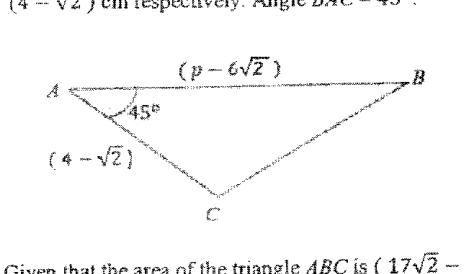
In triangle ABCABC shown below, sides ABAB and ACAC are (p−62) cm(p - 6\sqrt{2})\text{ cm} and (4−2) cm(4 - \sqrt{2})\text{ cm} respectively. Angle BAC=45∘BAC = 45^\circ.

  1. (i)

    Given that the area of the triangle ABCABC is (172−19) cm2(17\sqrt{2} - 19)\text{ cm}^2, show that p=14p = 14.

  2. (ii)

    find the perpendicular distance from BB to ACAC, leaving your answer in the form a2+ba\sqrt{2} + b.

Work through it with AI →

It won't just hand you the answer — it asks where you're stuck.How the checker works

Worked solution

9(i)

1. Set up the equation for the area of the triangle using the formula $\frac{1}{2}ab\sin C$.

Area=12(AB)(AC)sin⁡(∠BAC)\text{Area} = \frac{1}{2}(AB)(AC)\sin(\angle BAC)
12(p−62)(4−2)sin⁡45∘=172−19\frac{1}{2}(p - 6\sqrt{2})(4 - \sqrt{2})\sin 45^\circ = 17\sqrt{2} - 19

2. Substitute the exact value of $\sin 45^\circ$ and expand the brackets.

12(p−62)(4−2)(22)=172−19\frac{1}{2}(p - 6\sqrt{2})(4 - \sqrt{2})\left(\frac{\sqrt{2}}{2}\right) = 17\sqrt{2} - 19
24(4p−p2−242+12)=172−19\frac{\sqrt{2}}{4}(4p - p\sqrt{2} - 24\sqrt{2} + 12) = 17\sqrt{2} - 19

3. Distribute $\frac{\sqrt{2}}{4}$ into the expanded expression.

4p2−2p−48+1224=172−19\frac{4p\sqrt{2} - 2p - 48 + 12\sqrt{2}}{4} = 17\sqrt{2} - 19
p2−12p−12+32=172−19p\sqrt{2} - \frac{1}{2}p - 12 + 3\sqrt{2} = 17\sqrt{2} - 19
(p+3)2−(12p+12)=172−19(p + 3)\sqrt{2} - \left(\frac{1}{2}p + 12\right) = 17\sqrt{2} - 19

4. Equate the rational or irrational parts to solve for $p$.

Comparing the coefficients of 2\sqrt{2}:
p+3=17p + 3 = 17
p=14p = 14

(Alternatively, comparing the rational parts:
−12p−12=−19  ⟹  −12p=−7  ⟹  p=14-\frac{1}{2}p - 12 = -19 \implies -\frac{1}{2}p = -7 \implies p = 14)

Answer

p=14p = 14

9(ii)

1. Express the perpendicular distance in terms of $AB$ and $\sin 45^\circ$

Let the perpendicular distance from BB to ACAC be hh.
h=ABsin⁡45∘h = AB \sin 45^\circ

2. Substitute the known values into the expression

From part (i), p=14p = 14, so AB=14−62AB = 14 - 6\sqrt{2}.
sin⁡45∘=22\sin 45^\circ = \frac{\sqrt{2}}{2}
h=(14−62)(22)h = (14 - 6\sqrt{2})\left(\frac{\sqrt{2}}{2}\right)

3. Expand and simplify the surd expression

h=1422−6(2)(2)2h = \frac{14\sqrt{2}}{2} - \frac{6(\sqrt{2})(\sqrt{2})}{2}
h=72−6(2)2h = 7\sqrt{2} - \frac{6(2)}{2}
h=72−6h = 7\sqrt{2} - 6

Answer

72−67\sqrt{2} - 6

AI analysis — may contain mistakes.

Worked this one out on paper? Snap your steps and Gigle's AI math checker will circle the step where it went wrong.

More questions on this topic

  1. 1Answer all questions. Given that a=b2+4ac2aa = \sqrt{\frac{b^2+4ac}{2a}}, find the values of bb when a=4a = 4 and c=−1c = -1. Answ…
  2. 2The triangle ABC is such that its area is 16+7102 cm2\dfrac{16 + 7\sqrt{10}}{2}\ \text{cm}^2, the length of AB is (32+5) cm(3\sqrt{2} + \sqrt{5})\ \text{cm}…
  3. 3Find the coordinates of the points of intersection of the curve x+3=2xyx + 3 = 2xy and the curve y=2xy = \frac{2}{\sqrt{x}}.
  4. 4It is given that 2x×32(2x)8x+1=9(52x)−52x+15x−5x−1\frac{2^x \times 32(2^x)}{8^{x+1}} = \frac{9(5^{2x}) - 5^{2x+1}}{5^x - 5^{x-1}}. Evaluate 10x10^x with…
  5. 5The diagram shows part of the curve y=3x+4y = \sqrt{3x + 4}. The line ABAB is tangent to the curve at AA. The points BB an…