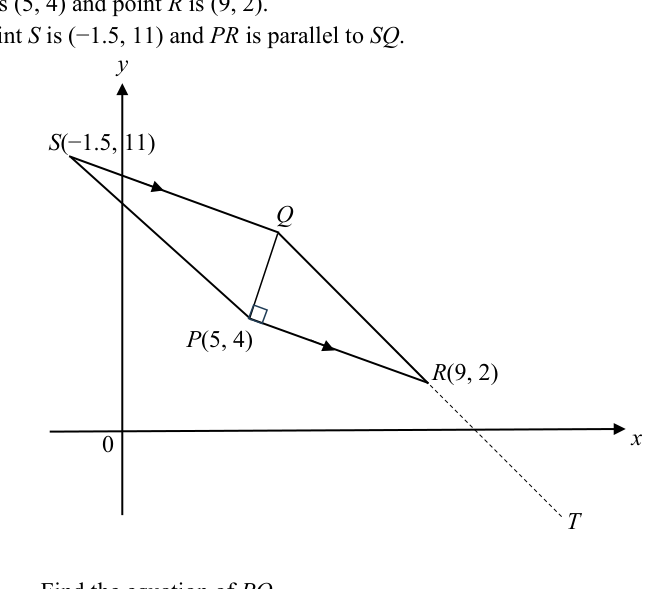
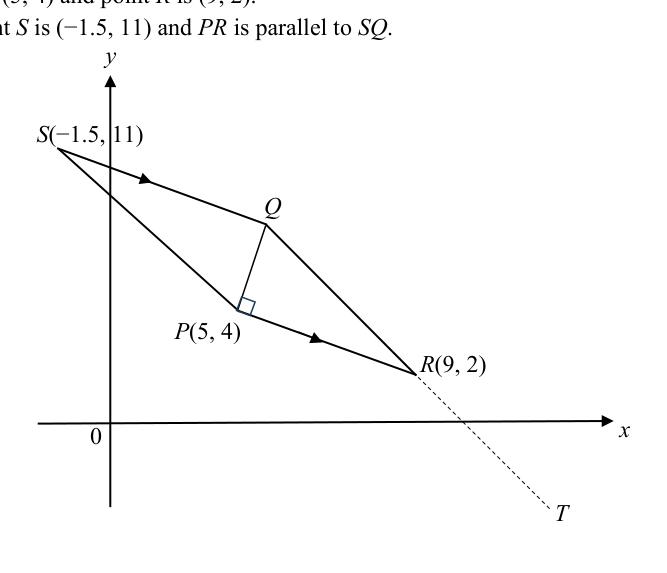
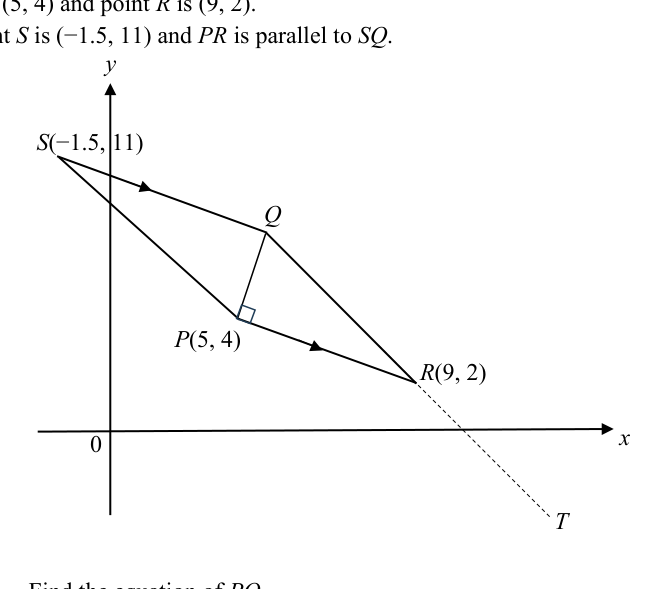
The diagram (not drawn to scale) shows a right-angled triangle PQR in which point P is (5, 4) and point R is (9, 2). Point S is (-1.5, 11) and PR is parallel to SQ.
  1. (a)

    Find the equation of PQ.

  2. (b)

    Find the coordinates of Q.

  3. (c)

    Given that T is a point on QR extended such that QT=105QT = 10\sqrt{5} units, find the coordinates of T.

Work through it with AI →

It won't just hand you the answer — it asks where you're stuck.How the checker works

Worked solution

13(a)

1. Find the gradient of the line PR

Gradient of PR=2−49−5=−24=−12PR = \frac{2 - 4}{9 - 5} = \frac{-2}{4} = -\frac{1}{2}

2. Find the gradient of PQ using the perpendicularity condition

Since ∠QPR=90∘\angle QPR = 90^\circ, PQ⊥PRPQ \perp PR.
Gradient of PQ=−1−12=2PQ = -\frac{1}{-\frac{1}{2}} = 2

3. Find the equation of the line PQ

Using point P(5,4)P(5, 4) and gradient m=2m = 2:
y−4=2(x−5)y - 4 = 2(x - 5)
y=2x−10+4y = 2x - 10 + 4
y=2x−6y = 2x - 6

Answer

y=2x−6y = 2x - 6

13(b)

1. Find the equation of line SQ

From part (a), the gradient of PRPR is −12-\frac{1}{2}.
Since SQSQ is parallel to PRPR, the gradient of SQSQ is also −12-\frac{1}{2}.
Using point S(−1.5,11)S(-1.5, 11):
y−11=−12(x−(−1.5))y - 11 = -\frac{1}{2}(x - (-1.5))
y=−0.5x−0.75+11y = -0.5x - 0.75 + 11
y=−0.5x+10.25y = -0.5x + 10.25

2. Set up simultaneous equations to find Q

From part (a), the equation of PQPQ is y=2x−6y = 2x - 6.
Equating the two equations for yy:
2x−6=−0.5x+10.252x - 6 = -0.5x + 10.25

3. Solve for the coordinates of Q

2.5x=16.252.5x = 16.25
x=6.5x = 6.5
Substitute x=6.5x = 6.5 into y=2x−6y = 2x - 6:
y=2(6.5)−6=13−6=7y = 2(6.5) - 6 = 13 - 6 = 7
The coordinates of QQ are (6.5,7)(6.5, 7).

Answer

(6.5,7)(6.5, 7)

13(c)

1. Find the coordinates of Q from earlier parts

Gradient of PR=2−49−5=−12PR = \frac{2 - 4}{9 - 5} = -\frac{1}{2}.
Since PQ⊥PRPQ \perp PR, gradient of PQ=2PQ = 2.
Equation of PQPQ: y−4=2(x−5)  ⟹  y=2x−6y - 4 = 2(x - 5) \implies y = 2x - 6.
Since SQ∥PRSQ \parallel PR, gradient of SQ=−12SQ = -\frac{1}{2}.
Equation of SQSQ: y−11=−12(x−(−1.5))  ⟹  y=−12x+10.25y - 11 = -\frac{1}{2}(x - (-1.5)) \implies y = -\frac{1}{2}x + 10.25.
Solving simultaneously:
2x−6=−12x+10.25  ⟹  2.5x=16.25  ⟹  x=6.52x - 6 = -\frac{1}{2}x + 10.25 \implies 2.5x = 16.25 \implies x = 6.5.
y=2(6.5)−6=7y = 2(6.5) - 6 = 7.
So Q=(6.5,7)Q = (6.5, 7).

2. Calculate the length of QR

QR=(9−6.5)2+(2−7)2=2.52+(−5)2=6.25+25=31.25QR = \sqrt{(9 - 6.5)^2 + (2 - 7)^2} = \sqrt{2.5^2 + (-5)^2} = \sqrt{6.25 + 25} = \sqrt{31.25}
31.25=1254=552=2.55\sqrt{31.25} = \sqrt{\frac{125}{4}} = \frac{5\sqrt{5}}{2} = 2.5\sqrt{5} units.

3. Use the ratio of lengths to find the coordinates of T

Since T is on QR extended, Q, R, and T are collinear in that order.
The ratio of lengths is QTQR=1052.55=4\frac{QT}{QR} = \frac{10\sqrt{5}}{2.5\sqrt{5}} = 4.
This means the horizontal and vertical displacements from Q to T are 4 times those from Q to R.
Displacement from Q to R: Δx=9−6.5=2.5\Delta x = 9 - 6.5 = 2.5, Δy=2−7=−5\Delta y = 2 - 7 = -5.
Displacement from Q to T: ΔxT=4×2.5=10\Delta x_T = 4 \times 2.5 = 10, ΔyT=4×(−5)=−20\Delta y_T = 4 \times (-5) = -20.
Coordinates of T: (6.5+10,7−20)=(16.5,−13)(6.5 + 10, 7 - 20) = (16.5, -13).

Answer

(16.5,−13)(16.5, -13)

AI analysis — may contain mistakes.

Worked this one out on paper? Snap your steps and Gigle's AI math checker will circle the step where it went wrong.

More questions on this topic

  1. 1A curve has the equation y=2x−33x+4y = \frac{2x - 3}{3x + 4}, where x≠−43x \ne -\frac{4}{3}. The normal to the point PP on the cur…
  2. 2The normal to the curve y=2tan⁡3x−1y = 2\tan 3x - 1 at point P(π3,−1)P\left(\frac{\pi}{3}, -1\right) crosses the yy-axis at point AA…
  3. 3The point PP lies on the curve y=ln⁡(x+1x−1)y = \ln\left(\frac{x+1}{x-1}\right) for x>1x > 1. The normal to the curve at PP is par…
  4. 4The figure shows part of the curve y=g(x)y = g(x). (2,8)(2, 8) and (6,1)(6, 1) are two points on the curve. Given that ∫26y dx=32\int_{2}^{6} y \text{ } dx = 32…
  5. 5The diagram shows part of the curve y=3e−12x−6y = 3e^{-\frac{1}{2}x} - 6 which crosses the xx-axis at PP and the yy-axis at QQ…