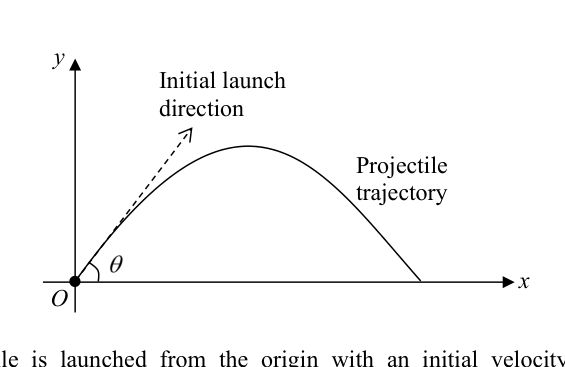
Projectile motion is the motion of a launched object, subject to only the constant acceleration of gravity, g ms−2g\text{ ms}^{-2}. The object is called a projectile, and its path is called a trajectory. A projectile is launched from the origin with an initial velocity of u ms−1u\text{ ms}^{-1} at an angle θ\theta radian above the horizontal, where 0<θ<π20 < \theta < \frac{\pi}{2}, as shown in the diagram above. The trajectory of a projectile depends on its motion in two dimensions - horizontal (xx) and vertical (yy) components. The position of the projectile at time tt seconds after it is launched can be defined by
x=utcos⁡θandy=utsin⁡θ−12gt2,x = ut \cos \theta \quad \text{and} \quad y = ut \sin \theta - \frac{1}{2}gt^2,
where uu and gg are positive real constants.

  1. (a)

    When y=0y = 0, find the value of tt in terms of θ\theta, gg and uu, where t≠0t \ne 0. State what this value of tt means in the context of the question.

  2. (b)

    The range of the projectile is defined as the horizontal distance the projectile travels from the time it is launched to the time it returns to the same height at which it is launched.

    Show that the range of the projectile can be expressed as x=u2gsin⁡(2θ)x = \frac{u^2}{g}\sin(2\theta).

  3. (c)

    Use differentiation to find the value of θ\theta that gives the maximum range of the projectile. Hence find the maximum range of the projectile in terms of gg and uu.

Work through it with AI →

It won't just hand you the answer — it asks where you're stuck.How the checker works

Worked solution

4(a)

1. Set the vertical displacement $y$ to $0$ and factorise the equation.

utsin⁡θ−12gt2=0ut \sin \theta - \frac{1}{2}gt^2 = 0
t(usin⁡θ−12gt)=0t \left(u \sin \theta - \frac{1}{2}gt\right) = 0

2. Solve for the non-zero value of $t$.

Since t≠0t \neq 0,
usin⁡θ−12gt=0u \sin \theta - \frac{1}{2}gt = 0
12gt=usin⁡θ\frac{1}{2}gt = u \sin \theta
t=2usin⁡θgt = \frac{2u\sin\theta}{g}

3. Interpret the physical meaning of this value of $t$ in context.

This value of tt represents the total time of flight of the projectile (i.e. the time taken for the projectile to return to the same horizontal level from which it was launched).

Answer

t=2usin⁡θgt = \frac{2u\sin\theta}{g}

It is the total time of flight of the projectile (or the time taken for the projectile to return to its initial launch height).

4(b)

1. Determine the time of flight $t$ when the projectile returns to its initial height, based on part (a).

Setting y=0y = 0:
utsin⁡θ−12gt2=0ut \sin \theta - \frac{1}{2}gt^2 = 0
t(usin⁡θ−12gt)=0t \left( u \sin \theta - \frac{1}{2}gt \right) = 0
For the return to the initial height, t≠0t \ne 0, so:
usin⁡θ−12gt=0  ⟹  t=2usin⁡θgu \sin \theta - \frac{1}{2}gt = 0 \implies t = \frac{2u \sin \theta}{g}

2. Substitute $t$ into the equation for the horizontal distance $x$.

x=utcos⁡θx = ut \cos \theta
x=u(2usin⁡θg)cos⁡θx = u \left( \frac{2u \sin \theta}{g} \right) \cos \theta
x=2u2sin⁡θcos⁡θgx = \frac{2u^2 \sin \theta \cos \theta}{g}

3. Use the double angle formula to complete the proof.

Applying the trigonometric identity 2sin⁡θcos⁡θ=sin⁡(2θ)2 \sin \theta \cos \theta = \sin(2\theta):
x=u2gsin⁡(2θ)(shown)x = \frac{u^2}{g} \sin(2\theta) \quad \text{(shown)}

Answer

x=u2gsin⁡(2θ)x = \frac{u^2}{g}\sin(2\theta) (shown)

4(c)

1. Differentiate the range $x$ with respect to $\theta$.

dxdθ=u2g(2cos⁡2θ)=2u2gcos⁡2θ\frac{\mathrm{d}x}{\mathrm{d}\theta} = \frac{u^2}{g}(2\cos 2\theta) = \frac{2u^2}{g}\cos 2\theta

2. Equate the derivative to zero to find the stationary point.

For maximum range, dxdθ=0\text{For maximum range, } \frac{\mathrm{d}x}{\mathrm{d}\theta} = 0
2u2gcos⁡2θ=0\frac{2u^2}{g}\cos 2\theta = 0
cos⁡2θ=0\cos 2\theta = 0

3. Solve the trigonometric equation for $\theta$.

Since 0<θ<π20 < \theta < \frac{\pi}{2}, we have 0<2θ<π0 < 2\theta < \pi.
2θ=π22\theta = \frac{\pi}{2}
θ=π4\theta = \frac{\pi}{4}

4. Perform the second derivative test to confirm it is a maximum.

d2xdθ2=2u2g(−2sin⁡2θ)=−4u2gsin⁡2θ\frac{\mathrm{d}^2x}{\mathrm{d}\theta^2} = \frac{2u^2}{g}(-2\sin 2\theta) = -\frac{4u^2}{g}\sin 2\theta
When θ=π4\theta = \frac{\pi}{4}, d2xdθ2=−4u2gsin⁡(π2)=−4u2g\frac{\mathrm{d}^2x}{\mathrm{d}\theta^2} = -\frac{4u^2}{g}\sin\left(\frac{\pi}{2}\right) = -\frac{4u^2}{g}.
Since uu and gg are positive, d2xdθ2<0\frac{\mathrm{d}^2x}{\mathrm{d}\theta^2} < 0, which confirms that the range is maximum at θ=π4\theta = \frac{\pi}{4}.

5. Find the maximum range by substituting $\theta = \frac{\pi}{4}$ back into the equation for $x$.

Maximum range x=u2gsin⁡(2×π4)\text{Maximum range } x = \frac{u^2}{g}\sin\left(2 \times \frac{\pi}{4}\right)
x=u2gsin⁡(π2)=u2g(1)=u2gx = \frac{u^2}{g}\sin\left(\frac{\pi}{2}\right) = \frac{u^2}{g}(1) = \frac{u^2}{g}

Answer

θ=π4\theta = \frac{\pi}{4}, Maximum range = u2g\frac{u^2}{g}

AI analysis — may contain mistakes.

Worked this one out on paper? Snap your steps and Gigle's AI math checker will circle the step where it went wrong.

More questions on this topic

  1. 1A curve CC has parametric equations x=2cos⁡θ+cos⁡2θ,y=2sin⁡θ−sin⁡2θ,x = 2\cos\theta + \cos 2\theta, \quad y = 2\sin\theta - \sin 2\theta, where 0<θ<2π0 < \theta < 2\pi…
  2. 2The parametric equations of a curve C are x=at,  y=at3x = at,\; y = at^{3}, where aa is a positive constant. The point P on the c…
  3. 3选修4−44-4:坐标系与参数方程 在直角坐标系xOyxOy中,曲线C1C_{1}的参数方程为{x=3cos⁡α,y=sin⁡α(α\begin{cases}x= \sqrt{3}\cos α, \\ y=\sin α\end{cases}(α为参数).).…
  4. 4The curve CC is defined by the parametric equations x=t−sin⁡tx = t - \sin t, y=sin⁡2ty = \sin^{2} t,   0≤t≤π\;0 \le t \le \pi. The point…
  5. 5A curve C is defined by the parametric equations x=θ2−1,y=tan⁡θ2,0≤θ<πx = \theta^2 - 1,\quad y = \tan\frac{\theta}{2},\quad 0 \le \theta < \pi…