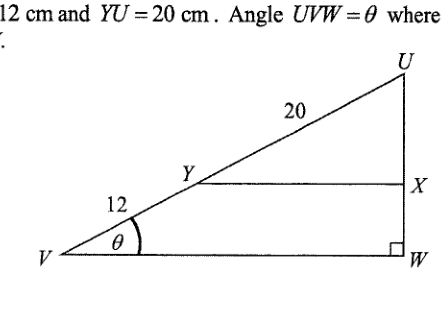
The diagram shows a pair of similar triangles YUXYUX and VUWVUW. Point YY lies on the straight line VUVU such that VY=12 cmVY = 12\text{ cm} and YU=20 cmYU = 20\text{ cm}. Angle UVW=θUVW = \theta where 0∘≤θ≤90∘0^\circ \le \theta \le 90^\circ and UWUW is perpendicular to VWVW.

  1. (a)

    Show that L cmL\text{ cm}, the perimeter of the trapezium VYXWVYXW, is given by L=12sin⁡θ+52cos⁡θ+12L = 12\sin\theta + 52\cos\theta + 12.

  2. (b)

    Express LL in the form 12+Rsin⁡(θ+α)12 + R\sin(\theta + \alpha) where R>0R > 0 and 0∘<α<90∘0^\circ < \alpha < 90^\circ.

  3. (c)

    State the maximum value of LL and the corresponding value of θ\theta.

  4. (d)

    Find the value of θ\theta when L=30L = 30.

Work through it with AI →

It won't just hand you the answer — it asks where you're stuck.How the checker works

Worked solution

8(a)

1. Identify the lengths of the sides of the large triangle VUW

In △VUW\triangle VUW, ∠UVW=θ\angle UVW = \theta and ∠UWV=90∘\angle UWV = 90^\circ.
The hypotenuse VU=VY+YU=12+20=32 cmVU = VY + YU = 12 + 20 = 32\text{ cm}.
Using trigonometric ratios:
sin⁡θ=UWVU  ⟹  UW=32sin⁡θ\sin\theta = \frac{UW}{VU} \implies UW = 32\sin\theta
cos⁡θ=VWVU  ⟹  VW=32cos⁡θ\cos\theta = \frac{VW}{VU} \implies VW = 32\cos\theta

2. Identify the lengths of the sides of the small triangle YUX

Since △YUX\triangle YUX is similar to △VUW\triangle VUW, ∠UYX=∠UVW=θ\angle UYX = \angle UVW = \theta and ∠UXY=90∘\angle UXY = 90^\circ.
The hypotenuse YU=20 cmYU = 20\text{ cm}.
Using trigonometric ratios:
sin⁡θ=UXYU  ⟹  UX=20sin⁡θ\sin\theta = \frac{UX}{YU} \implies UX = 20\sin\theta
cos⁡θ=YXYU  ⟹  YX=20cos⁡θ\cos\theta = \frac{YX}{YU} \implies YX = 20\cos\theta

3. Calculate the length of XW and the perimeter of the trapezium VYXW

The length XW=UW−UX=32sin⁡θ−20sin⁡θ=12sin⁡θXW = UW - UX = 32\sin\theta - 20\sin\theta = 12\sin\theta.
The perimeter of trapezium VYXWVYXW is L=VY+YX+XW+VWL = VY + YX + XW + VW.
L=12+20cos⁡θ+12sin⁡θ+32cos⁡θL = 12 + 20\cos\theta + 12\sin\theta + 32\cos\theta
L=12sin⁡θ+52cos⁡θ+12L = 12\sin\theta + 52\cos\theta + 12 (Shown)

Answer

L=12sin⁡θ+52cos⁡θ+12L = 12\sin\theta + 52\cos\theta + 12 (Shown)

8(b)

1. Set up the R-formula equation for the trigonometric part of $L$.

Let 12sin⁡θ+52cos⁡θ=Rsin⁡(θ+α)12\sin\theta + 52\cos\theta = R\sin(\theta + \alpha).
Rsin⁡(θ+α)=Rsin⁡θcos⁡α+Rcos⁡θsin⁡αR\sin(\theta + \alpha) = R\sin\theta\cos\alpha + R\cos\theta\sin\alpha
Comparing coefficients:
Rcos⁡α=12R\cos\alpha = 12
Rsin⁡α=52R\sin\alpha = 52

2. Calculate the value of $R$.

R=122+522R = \sqrt{12^2 + 52^2}
R=144+2704=2848≈53.366R = \sqrt{144 + 2704} = \sqrt{2848} \approx 53.366

3. Calculate the value of $\alpha$ and write the final expression.

tan⁡α=5212\tan\alpha = \frac{52}{12}
α=tan⁡−1(133)≈77.005∘≈77.0∘\alpha = \tan^{-1}\left(\frac{13}{3}\right) \approx 77.005^\circ \approx 77.0^\circ (to 1 d.p.)
L=12+53.4sin⁡(θ+77.0∘)L = 12 + 53.4\sin(\theta + 77.0^\circ)

Answer

12+53.4sin⁡(θ+77.0∘)12 + 53.4\sin(\theta + 77.0^\circ)

8(c)

1. Find the maximum value of $L$ using the $R$ value from part (b)

From part (b), L=12+2848sin⁡(θ+77.005∘)L = 12 + \sqrt{2848}\sin(\theta + 77.005^\circ).
The maximum value of sin⁡(θ+77.005∘)\sin(\theta + 77.005^\circ) is 11.
Maximum L=12+2848=12+4178≈65.4L = 12 + \sqrt{2848} = 12 + 4\sqrt{178} \approx 65.4

2. Find the corresponding value of $\theta$

For maximum LL, sin⁡(θ+77.005∘)=1\sin(\theta + 77.005^\circ) = 1
θ+77.005∘=90∘\theta + 77.005^\circ = 90^\circ
θ=90∘−77.005∘=12.995∘≈13.0∘\theta = 90^\circ - 77.005^\circ = 12.995^\circ \approx 13.0^\circ

Answer

Maximum L=65.4L = 65.4, θ=13.0∘\theta = 13.0^\circ

8(d)

1. Find the values of $R$ and $\alpha$ from part (b) to use in the equation

12sin⁡θ+52cos⁡θ=Rsin⁡(θ+α)12\sin\theta + 52\cos\theta = R\sin(\theta + \alpha)
R=122+522=2848R = \sqrt{12^2 + 52^2} = \sqrt{2848}
tan⁡α=5212  ⟹  α=77.005∘\tan\alpha = \frac{52}{12} \implies \alpha = 77.005^\circ
L=12+2848sin⁡(θ+77.005∘)L = 12 + \sqrt{2848}\sin(\theta + 77.005^\circ)

2. Set up the equation for $L = 30$ and isolate the sine term

12+2848sin⁡(θ+77.005∘)=3012 + \sqrt{2848}\sin(\theta + 77.005^\circ) = 30
2848sin⁡(θ+77.005∘)=18\sqrt{2848}\sin(\theta + 77.005^\circ) = 18
sin⁡(θ+77.005∘)=182848≈0.33729\sin(\theta + 77.005^\circ) = \frac{18}{\sqrt{2848}} \approx 0.33729

3. Solve for $\theta$ in the given domain $0^\circ \le \theta \le 90^\circ$

Basic angle =sin⁡−1(0.33729)≈19.712∘= \sin^{-1}(0.33729) \approx 19.712^\circ
Since 0∘≤θ≤90∘0^\circ \le \theta \le 90^\circ, the angle θ+77.005∘\theta + 77.005^\circ must be in the second quadrant.
θ+77.005∘=180∘−19.712∘=160.288∘\theta + 77.005^\circ = 180^\circ - 19.712^\circ = 160.288^\circ
θ=160.288∘−77.005∘=83.283∘≈83.3∘\theta = 160.288^\circ - 77.005^\circ = 83.283^\circ \approx 83.3^\circ

Answer

83.3∘83.3^\circ

AI analysis — may contain mistakes.

Worked this one out on paper? Snap your steps and Gigle's AI math checker will circle the step where it went wrong.

More questions on this topic

  1. 1Solve the equation 2cot⁡22x=1−5sin⁡2x2 \cot^2 2x = 1 - \frac{5}{\sin 2x} for −180∘≤x≤180∘-180^\circ \le x \le 180^\circ.
  2. 2已知sin⁡(α+π12)=55\sin (α+ \dfrac {π}{12} )= \dfrac { \sqrt {5}}{5},则sin⁡(π3−2α)=(    )\sin ( \dfrac {π}{3} -2α)= (\:\:\:\:) A. 45 \dfrac {4}{5}…
  3. 38.8.设△ABC\triangle ABC的内角AA,BB,CC所对的边分别为aa,bb,cc,若bcos⁡C+ccos⁡B=asin⁡Ab\cos C+c\cos B=a\sin A,则△ABC\triangle ABC的形状为…
  4. 4Prove that sin⁡3xsec⁡2x+sin⁡x=tan⁡xsec⁡x\sin^{3} x\sec^{2} x + \sin x = \tan x\sec x. Solve the equation sin⁡3xsec⁡2x+sin⁡x=5\sin^{3} x\sec^{2} x + \sin x = 5 for 0≤x≤360∘0 \le x \le 360^\circ…
  5. 5Given that cos⁡x=−45\cos x = -\frac{4}{5} and tan⁡x>0\tan x > 0, find sin⁡2x\sin 2x, cos⁡x2\cos \frac{x}{2}.