In the diagram, BE intersects AD at F. AF = 7 cm and FD = 4 cm. , and are right angles. BCDF is a trapezium and is an acute angle.
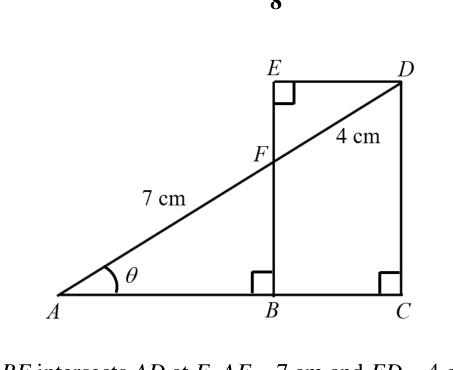
- (a)
Show that the perimeter of BCDF, cm, is given by
.
- (b)
Express in the form , where is a constant, and .
- (c)
Find the maximum exact value of and the corresponding value of
- (d)
Find the value of when .
- (e)
Without evaluating , determine whether the perimeter of can have a value of 28 cm. Justify your answer.
It won't just hand you the answer — it asks where you're stuck.How the checker works
Worked solution
4(a)
1. Find the lengths of $BF$ and $AB$ using triangle $ABF$.
In right-angled ,
2. Find the lengths of $CD$ and $AC$ using triangle $ACD$.
The total length cm.
In right-angled ,
3. Find the length of $BC$.
4. Calculate the perimeter of the trapezium $BCDF$.
Perimeter
(Shown)
(Shown)
4(b)
1. Identify the constant $a$ and set up the R-formula for the trigonometric terms
From , we can see that .
We need to express in the form .
Comparing coefficients:
2. Calculate the value of $R$
(or )
3. Calculate the value of $\alpha$
(to 1 d.p.)
4. Write the final expression for $P$
4(c)
1. Determine the constants $R$ and $\alpha$ from part (b)
From part (a), .
Using the -formula, .
So, .
2. Find the maximum exact value of $P$
The maximum value of is .
Maximum exact value of .
3. Find the corresponding value of $\theta$
For maximum , .
(to 1 d.p.)
Maximum exact value of ,
4(d)
1. Substitute $P = 11$ into the $R$-formula expression from part (b)
From part (b), .
2. Isolate the sine term and find the basic angle
3. Solve for $\theta$, considering the given domain
Since is an acute angle, we take the first quadrant solution:
4(e)
1. State the maximum value of the perimeter $P$ from earlier parts
From part (c), the maximum exact value of is .
2. Compare the maximum value with 28 to draw a conclusion
Since , the maximum value of is strictly less than .
Therefore, .
Thus, the perimeter cannot be 28 cm.
No, because the maximum possible perimeter is cm, which is less than 28 cm.
AI analysis — may contain mistakes.
Worked this one out on paper? Snap your steps and Gigle's AI math checker will circle the step where it went wrong.