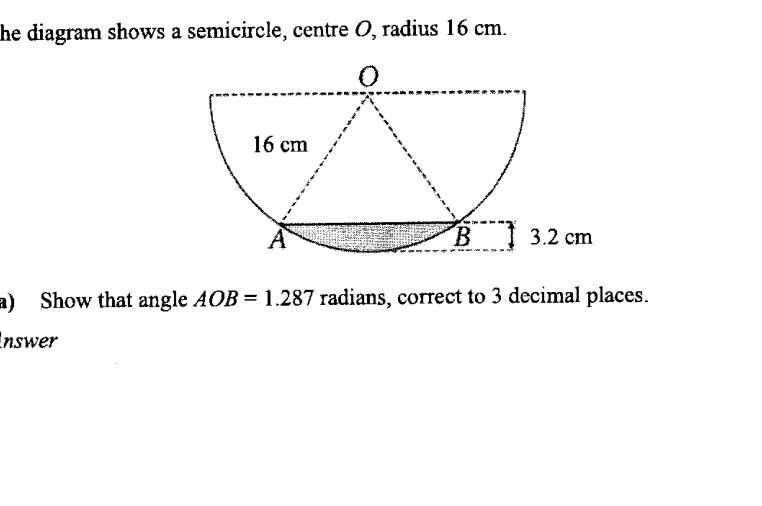
The diagram shows a semicircle, centre O, radius 16 cm.
- (a)
Show that angle AOB = 1.287 radians, correct to 3 decimal places.
Answer
- (b)
Calculate the area of the shaded region.
Answer ... cm^2
- (c)
The semicircle is the cross section of a water trough of length 2.8 m, standing on level ground.
The shaded area represents the water in the trough.
- (i)
Calculate the volume of water, in cm^3, in the trough.
Leave your answer in standard form.
Answer ... cm^3
- (ii)
Calculate the number of litres of water that must be added to fill the trough.
Answer ... litres
- (i)
It won't just hand you the answer — it asks where you're stuck.How the checker works
Worked solution
6(a)
1. Find the distance from $O$ to the foot of the perpendicular on chord $AB$.
Let be the point on the diameter where the perpendicular from meets chord .
The radius is cm and the labelled gap to the end of the diameter is cm, so
2. Use cosine to find half of the central angle, then double it.
Since , the perpendicular from to chord bisects .
In right-angled triangle ,
Hence
radians, correct to 3 decimal places.
6(b)
1. Find the area of sector $AOB$.
Using cm and radians,
2. Find the area of triangle $AOB$.
Since cm and the included angle is radians,
3. Subtract the triangle area from the sector area to get the shaded segment area.
6(c)(i)
1. Convert the length of the trough from metres to centimetres.
2. Multiply the cross-sectional area by the length of the trough.
Using the shaded area from part (b),
3. Write the volume in standard form.
To 3 significant figures,
6(c)(ii)
1. Calculate the total capacity of the trough in cubic centimetres.
The cross-section of the full trough is a semicircle of radius cm.
Length of trough .
2. Subtract the volume of water already in the trough.
From part (c)(i), the volume of water already in the trough is
So the volume still needed is
3. Convert the remaining volume from cubic centimetres to litres.
Since litre,
litres
AI analysis — may contain mistakes.
Worked this one out on paper? Snap your steps and Gigle's AI math checker will circle the step where it went wrong.
More questions on this topic
- 1In the diagram, there are two right-angled triangles ΔABD and ΔCEB such that AD = 12 cm, BD = 15 cm and BE = 20 cm. Find…
- 2In triangle ABC, , and . Express as a fraction in its…
- 3The diagram shows the positions of a harbour, H, a lighthouse, L, and two buoys P and Q. HPQ is a straight line. The bea…
- 4A piece of wood which was 50 cm long, was in the shape of a uniform cylinder. A prism is cut out from the wood such that…
- 5The points A, B, C, D and E are shown in the diagram below such that ABC and AED are straight lines and BE = …