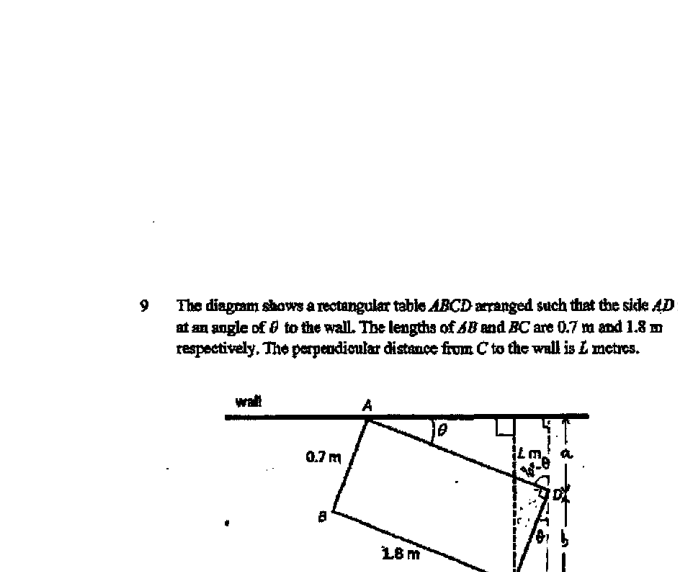
The diagram shows a rectangular table ABCD arranged such that the side AD is inclined at an angle of to the wall. The lengths of AB and BC are 0.7 m and 1.8 m respectively. The perpendicular distance from C to the wall is metres.
- ((i))
Explain clearly why .
- ((ii))
Express in the form , where and .
- ((iii))
Hence, state the maximum value of and find the corresponding value of .
- ((iv))
Find the value of when .
It won't just hand you the answer — it asks where you're stuck.How the checker works
Worked solution
9((i))
1. Find the perpendicular component contributed by side $BC$.
Since is inclined at angle to the wall and , side also makes angle with the wall.
Hence the component of perpendicular to the wall is
2. Find the perpendicular component contributed by side $AB$ and add the components.
Since , the component of perpendicular to the wall is
Therefore the total perpendicular distance from to the wall is
The perpendicular distance of from the wall is the sum of the perpendicular components of and :
9((ii))
1. Expand the required form using the cosine compound-angle formula.
2. Compare coefficients with $1.8\sin\theta+0.7\cos\theta$ and find $R$.
Comparing
we get
Hence
so
3. Find the acute angle $\alpha$.
Therefore,
9((iii))
1. Use the maximum value of the cosine function to identify the maximum possible value of $L$.
From part (ii),
Since the maximum value of is ,
2. Find the value of $\theta$ that gives the maximum value of $L$.
For the maximum value,
Thus
so
Maximum value of , or .
Corresponding value of .
9((iv))
1. Substitute $L=\sqrt{2.5}$ into the form found in part (ii).
From part (ii),
When ,
2. Use inverse cosine to find the possible angle, then choose the value of $\theta$ consistent with the diagram.
So
or
Since is an acute angle of inclination in the diagram,
AI analysis — may contain mistakes.
Worked this one out on paper? Snap your steps and Gigle's AI math checker will circle the step where it went wrong.
More questions on this topic
- 1In the diagram, there are two right-angled triangles ΔABD and ΔCEB such that AD = 12 cm, BD = 15 cm and BE = 20 cm. Find…
- 2In triangle ABC, , and . Express as a fraction in its…
- 3The diagram shows the positions of a harbour, H, a lighthouse, L, and two buoys P and Q. HPQ is a straight line. The bea…
- 4A piece of wood which was 50 cm long, was in the shape of a uniform cylinder. A prism is cut out from the wood such that…
- 5The points A, B, C, D and E are shown in the diagram below such that ABC and AED are straight lines and BE = …