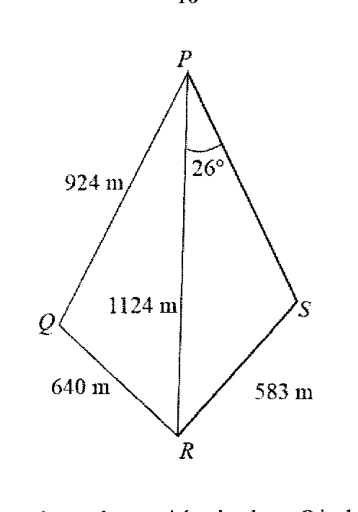
PP, QQ, RR and SS are four villages located on an island, where QQ is due north of RR.
PQ=924 mPQ = 924\text{ m}, QR=640 mQR = 640\text{ m}, PR=1124 mPR = 1124\text{ m}, RS=583 mRS = 583\text{ m}.
Angle RPS=26∘RPS = 26^\circ and angle PSRPSR is obtuse.

  1. (a)

    Show that PP is due east of QQ.

    Answer

  2. (b)

    Find the bearing of SS from RR.

    Answer ... ∘^\circ

  3. (c)

    A villager took the shortest route to jog from Village QQ to Village SS at a constant speed of 9.5 km/h. Find the time taken by the villager to jog from Village QQ to Village SS. Give your answers in minutes and seconds, correct to the nearest ten seconds.

    Answer ... min ... s

Work through it with AI →

It won't just hand you the answer — it asks where you're stuck.How the checker works

Worked solution

4(a)

1. Calculate the sum of the squares of the two shorter sides of triangle PQR.

PQ2+QR2=9242+6402PQ^2 + QR^2 = 924^2 + 640^2
=853776+409600= 853776 + 409600
=1263376= 1263376

2. Calculate the square of the longest side and compare.

PR2=11242=1263376PR^2 = 1124^2 = 1263376
Since PQ2+QR2=PR2PQ^2 + QR^2 = PR^2, by the converse of Pythagoras' theorem, △PQR\triangle PQR is a right-angled triangle with ∠PQR=90∘\angle PQR = 90^\circ.

3. Use the bearing information to conclude the relative position of P.

We are given that QQ is due north of RR, which means the line segment QRQR lies on the North-South axis.
Since ∠PQR=90∘\angle PQR = 90^\circ and from the given layout PP is to the right of the North-South line QRQR, PP must be due east of QQ.

Answer

Since PQ2+QR2=PR2PQ^2 + QR^2 = PR^2, ∠PQR=90∘\angle PQR = 90^\circ. As QQ is due north of RR, PP is due east of QQ.

4(b)

1. Find angle PRQ using right-angled trigonometry

In △PQR\triangle PQR, since PP is due east of QQ and QQ is due north of RR, ∠PQR=90∘\angle PQR = 90^\circ.
tan⁡(∠PRQ)=PQQR=924640\tan(\angle PRQ) = \frac{PQ}{QR} = \frac{924}{640}
∠PRQ=tan⁡−1(924640)≈55.291∘\angle PRQ = \tan^{-1}\left(\frac{924}{640}\right) \approx 55.291^\circ

2. Find the obtuse angle PSR using the Sine Rule

In △PRS\triangle PRS, using the Sine Rule:
sin⁡(∠PSR)1124=sin⁡26∘583\frac{\sin(\angle PSR)}{1124} = \frac{\sin 26^\circ}{583}
sin⁡(∠PSR)=1124sin⁡26∘583≈0.84516\sin(\angle PSR) = \frac{1124 \sin 26^\circ}{583} \approx 0.84516
Since ∠PSR\angle PSR is obtuse:
∠PSR=180∘−sin⁡−1(0.84516)≈180∘−57.689∘=122.311∘\angle PSR = 180^\circ - \sin^{-1}(0.84516) \approx 180^\circ - 57.689^\circ = 122.311^\circ

3. Find angle PRS

Using the sum of angles in △PRS\triangle PRS:
∠PRS=180∘−26∘−122.311∘=31.689∘\angle PRS = 180^\circ - 26^\circ - 122.311^\circ = 31.689^\circ

4. Calculate the bearing of S from R

Since QQ is due north of RR, the bearing of SS from RR is the angle QRSQRS.
∠QRS=∠PRQ+∠PRS=55.291∘+31.689∘=86.980∘\angle QRS = \angle PRQ + \angle PRS = 55.291^\circ + 31.689^\circ = 86.980^\circ
Bearing =087.0∘= 087.0^\circ (to 1 d.p.)

Answer

087.0∘087.0^\circ

4(c)

1. Find angle $PRS$ using the sine rule in triangle $PRS$.

Using the sine rule in △PRS\triangle PRS:
sin⁡∠PSR1124=sin⁡26∘583\frac{\sin \angle PSR}{1124} = \frac{\sin 26^\circ}{583}
sin⁡∠PSR=1124sin⁡26∘583≈0.8451\sin \angle PSR = \frac{1124 \sin 26^\circ}{583} \approx 0.8451
Since ∠PSR\angle PSR is obtuse:
∠PSR=180∘−sin⁡−1(0.8451)≈122.317∘\angle PSR = 180^\circ - \sin^{-1}(0.8451) \approx 122.317^\circ
∠PRS=180∘−26∘−122.317∘=31.683∘\angle PRS = 180^\circ - 26^\circ - 122.317^\circ = 31.683^\circ

2. Find angle $QRS$ by adding angle $PRQ$ and angle $PRS$.

In right-angled △PQR\triangle PQR (since PP is due east of QQ and QQ is due north of RR):
tan⁡∠PRQ=924640\tan \angle PRQ = \frac{924}{640}
∠PRQ=tan⁡−1(924640)≈55.292∘\angle PRQ = \tan^{-1}\left(\frac{924}{640}\right) \approx 55.292^\circ
∠QRS=∠PRQ+∠PRS=55.292∘+31.683∘=86.975∘\angle QRS = \angle PRQ + \angle PRS = 55.292^\circ + 31.683^\circ = 86.975^\circ

3. Calculate the distance $QS$ using the cosine rule in triangle $QRS$.

Using the cosine rule in △QRS\triangle QRS:
QS2=QR2+RS2−2(QR)(RS)cos⁡∠QRSQS^2 = QR^2 + RS^2 - 2(QR)(RS)\cos \angle QRS
QS2=6402+5832−2(640)(583)cos⁡86.975∘QS^2 = 640^2 + 583^2 - 2(640)(583)\cos 86.975^\circ
QS2=409600+339889−746240(0.05276)≈710115QS^2 = 409600 + 339889 - 746240(0.05276) \approx 710115
QS=710115≈842.68 mQS = \sqrt{710115} \approx 842.68 \text{ m}

4. Calculate the time taken to jog from $Q$ to $S$ and round to the nearest ten seconds.

Speed =9.5 km/h=95003600 m/s≈2.6389 m/s= 9.5 \text{ km/h} = \frac{9500}{3600} \text{ m/s} \approx 2.6389 \text{ m/s}
Time taken =DistanceSpeed=842.682.6389≈319.33 s= \frac{\text{Distance}}{\text{Speed}} = \frac{842.68}{2.6389} \approx 319.33 \text{ s}
319.33 s=5 min 19.33 s319.33 \text{ s} = 5 \text{ min } 19.33 \text{ s}
Correct to the nearest ten seconds, the time is 5 min 20 s5 \text{ min } 20 \text{ s}.

Answer

5 min 20 s

AI analysis — may contain mistakes.

Worked this one out on paper? Snap your steps and Gigle's AI math checker will circle the step where it went wrong.

More questions on this topic

  1. 1The triangle ABC is such that its area is 16+7102 cm2\dfrac{16 + 7\sqrt{10}}{2}\ \text{cm}^2, the length of AB is (32+5) cm(3\sqrt{2} + \sqrt{5})\ \text{cm}…
  2. 2如果三角形的两条边分别为4和6,那么连结该三角形三边中点所得的周长可能是下列数据中的【 】 A. 6 B. 8 C. 10 D. 12
  3. 3In ΔABC\Delta ABC, AC=12 cmAC = 12\text{ cm}, ∠ABC\angle ABC is a right angle, ∠ACB=π6\angle ACB = \frac{\pi}{6} radians and MM is the…
  4. 4The diagram shows a quadrilateral ABCDABCD whose vertices lie on the circumference of a circle. The point EE lies on the…
  5. 5The equation of a circle is x2+y2+8x−20y−53=0x^2 + y^2 + 8x - 20y - 53 = 0. Find the radius of the circle and the coordinates of its ce…