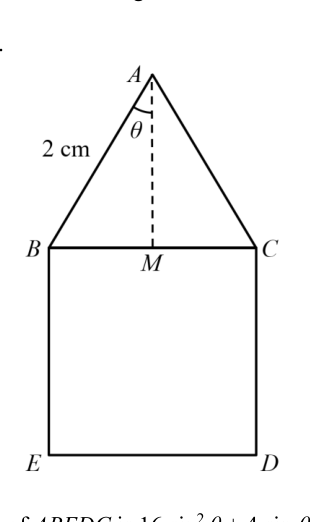
The diagram below shows an isosceles triangle ABCABC, where AB=AC=2 cmAB = AC = 2\text{ cm}, and a square BCDEBCDE. MM is the midpoint of BCBC. Angle BAM=θBAM = \theta and can vary.

  1. (a)

    Show that the total area of ABEDC is 16sin⁡2θ+4sin⁡θcos⁡θ cm216\sin^{2}\theta + 4\sin\theta\cos\theta\ \text{cm}^{2}.

  2. (b)

    Show that 16sin⁡2θ+4sin⁡θcos⁡θ=2sin⁡2θ−8cos⁡2θ+816\sin^{2}\theta + 4\sin\theta\cos\theta = 2\sin 2\theta - 8\cos 2\theta + 8.

  3. (c)

    Express 2sin⁡2θ−8cos⁡2θ2\sin 2\theta - 8\cos 2\theta in the form Rsin⁡(2θ−α)R\sin(2\theta - \alpha), where R>0R > 0 and 0∘<α<90∘0^\circ < \alpha < 90^\circ.

Work through it with AI →

It won't just hand you the answer — it asks where you're stuck.How the checker works

Worked solution

6(a)

1. Find the lengths of $BM$ and $AM$ in terms of $\theta$.

In right-angled △ABM\triangle ABM,
sin⁡θ=BMAB  ⟹  BM=2sin⁡θ\sin\theta = \frac{BM}{AB} \implies BM = 2\sin\theta
cos⁡θ=AMAB  ⟹  AM=2cos⁡θ\cos\theta = \frac{AM}{AB} \implies AM = 2\cos\theta

2. Find the length of $BC$ and the area of the square $BCDE$.

Since MM is the midpoint of BCBC,
BC=2BM=4sin⁡θBC = 2BM = 4\sin\theta
Area of square BCDE=BC2=(4sin⁡θ)2=16sin⁡2θBCDE = BC^2 = (4\sin\theta)^2 = 16\sin^2\theta

3. Find the area of $\triangle ABC$ and the total area.

Area of △ABC=12×BC×AM\triangle ABC = \frac{1}{2} \times BC \times AM
=12(4sin⁡θ)(2cos⁡θ)=4sin⁡θcos⁡θ= \frac{1}{2}(4\sin\theta)(2\cos\theta) = 4\sin\theta\cos\theta
Total area = Area of square + Area of △ABC\triangle ABC
=16sin⁡2θ+4sin⁡θcos⁡θ= 16\sin^2\theta + 4\sin\theta\cos\theta (shown)

Answer

16\sin^{2}\theta + 4\sin\theta\cos\theta

6(b)

1. Apply the double angle identity for sine to the term $4\sin\theta\cos\theta$.

4sin⁡θcos⁡θ=2(2sin⁡θcos⁡θ)=2sin⁡2θ4\sin\theta\cos\theta = 2(2\sin\theta\cos\theta) = 2\sin 2\theta

2. Apply the double angle identity for cosine to the term $16\sin^{2}\theta$.

cos⁡2θ=1−2sin⁡2θ  ⟹  2sin⁡2θ=1−cos⁡2θ\cos 2\theta = 1 - 2\sin^{2}\theta \implies 2\sin^{2}\theta = 1 - \cos 2\theta
16sin⁡2θ=8(2sin⁡2θ)=8(1−cos⁡2θ)=8−8cos⁡2θ16\sin^{2}\theta = 8(2\sin^{2}\theta) = 8(1 - \cos 2\theta) = 8 - 8\cos 2\theta

3. Combine the terms to show the final expression.

16sin⁡2θ+4sin⁡θcos⁡θ=(8−8cos⁡2θ)+2sin⁡2θ16\sin^{2}\theta + 4\sin\theta\cos\theta = (8 - 8\cos 2\theta) + 2\sin 2\theta
=2sin⁡2θ−8cos⁡2θ+8= 2\sin 2\theta - 8\cos 2\theta + 8 (shown)

Answer

16sin⁡2θ+4sin⁡θcos⁡θ=2sin⁡2θ−8cos⁡2θ+816\sin^{2}\theta + 4\sin\theta\cos\theta = 2\sin 2\theta - 8\cos 2\theta + 8 (shown)

6(c)

1. Expand the target form and compare coefficients to find equations for $R$ and $\alpha$

Rsin⁡(2θ−α)=Rsin⁡2θcos⁡α−Rcos⁡2θsin⁡αR\sin(2\theta - \alpha) = R\sin 2\theta \cos \alpha - R\cos 2\theta \sin \alpha
Comparing with 2sin⁡2θ−8cos⁡2θ2\sin 2\theta - 8\cos 2\theta:
Rcos⁡α=2R\cos \alpha = 2
Rsin⁡α=8R\sin \alpha = 8

2. Calculate the value of $R$

R=22+82=4+64=68R = \sqrt{2^2 + 8^2} = \sqrt{4 + 64} = \sqrt{68} (or 2172\sqrt{17})

3. Calculate the value of $\alpha$ and write the final expression

tan⁡α=82=4\tan \alpha = \frac{8}{2} = 4
α=tan⁡−1(4)≈75.964∘≈76.0∘\alpha = \tan^{-1}(4) \approx 75.964^\circ \approx 76.0^\circ (to 1 d.p.)
Expression is 68sin⁡(2θ−76.0∘)\sqrt{68}\sin(2\theta - 76.0^\circ)

Answer

68sin⁡(2θ−76.0∘)\sqrt{68}\sin(2\theta - 76.0^\circ)

AI analysis — may contain mistakes.

Worked this one out on paper? Snap your steps and Gigle's AI math checker will circle the step where it went wrong.

More questions on this topic

  1. 1Solve the equation 2cot⁡22x=1−5sin⁡2x2 \cot^2 2x = 1 - \frac{5}{\sin 2x} for −180∘≤x≤180∘-180^\circ \le x \le 180^\circ.
  2. 2已知sin⁡(α+π12)=55\sin (α+ \dfrac {π}{12} )= \dfrac { \sqrt {5}}{5},则sin⁡(π3−2α)=(    )\sin ( \dfrac {π}{3} -2α)= (\:\:\:\:) A. 45 \dfrac {4}{5}…
  3. 38.8.设△ABC\triangle ABC的内角AA,BB,CC所对的边分别为aa,bb,cc,若bcos⁡C+ccos⁡B=asin⁡Ab\cos C+c\cos B=a\sin A,则△ABC\triangle ABC的形状为…
  4. 4Prove that sin⁡3xsec⁡2x+sin⁡x=tan⁡xsec⁡x\sin^{3} x\sec^{2} x + \sin x = \tan x\sec x. Solve the equation sin⁡3xsec⁡2x+sin⁡x=5\sin^{3} x\sec^{2} x + \sin x = 5 for 0≤x≤360∘0 \le x \le 360^\circ…
  5. 5Given that cos⁡x=−45\cos x = -\frac{4}{5} and tan⁡x>0\tan x > 0, find sin⁡2x\sin 2x, cos⁡x2\cos \frac{x}{2}.