A cone of height 12 cm and base radius 5 cm is placed over a cylinder of radius cm and height cm. The cone is in contact with the cylinder along the cylinder's upper rim. The diagram shows a vertical cross-section of the cone and the cylinder.
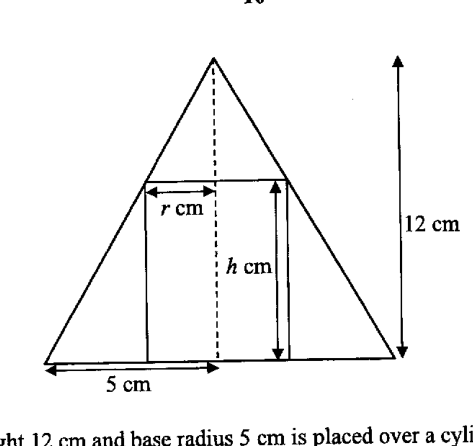
- (i)
Express in terms of .
- (ii)
Hence show that the volume, cm, of the cylinder is given by
- (iii)
Calculate the maximum value of .
It won't just hand you the answer — it asks where you're stuck.How the checker works
Worked solution
9(i)
1. Identify similar triangles from the vertical cross-section
Let the vertex of the cone be , the center of the base be , and a point on the base circumference be . The triangle is a right-angled triangle with height and base .
The cylinder's upper rim touches the cone. Let the point of contact be , and let the projection of onto the central axis be . The triangle is similar to triangle .
2. Set up the ratio of corresponding sides to find $h$ in terms of $r$
The height of the small triangle is , and its base is .
Since , the ratio of height to base is constant:
9(ii)
1. Find $h$ in terms of $r$ using similar triangles (from part i)
By similar triangles in the cross-section:
2. Substitute $h$ into the formula for the volume of a cylinder
The volume of the cylinder is .
Substituting :
3. Expand the expression to show the required result
(Shown)
(Shown)
9(iii)
1. Differentiate $V$ with respect to $r$
2. Equate the derivative to zero to find the stationary value of $r$
For maximum ,
Since ,
3. Verify that this value of $r$ gives a maximum volume
When ,
Since , is a maximum when .
4. Calculate the maximum value of $V$
Maximum
cm (to 3 s.f.)
or (to 3 s.f.)
AI analysis — may contain mistakes.
Worked this one out on paper? Snap your steps and Gigle's AI math checker will circle the step where it went wrong.
More questions on this topic
- 1The triangle ABC is such that its area is , the length of AB is …
- 2如果三角形的两条边分别为4和6,那么连结该三角形三边中点所得的周长可能是下列数据中的【 】 A. 6 B. 8 C. 10 D. 12
- 3In , , is a right angle, radians and is the…
- 4The diagram shows a quadrilateral whose vertices lie on the circumference of a circle. The point lies on the…
- 5The equation of a circle is . Find the radius of the circle and the coordinates of its ce…