Figure 1 shows a plate and Figure 2 shows two stacks of identical plates. There are 3 plates in a shorter stack and 7 plates in a taller stack. The height of the shorter stack is 20 cm and the height of the taller stack is 44 cm.
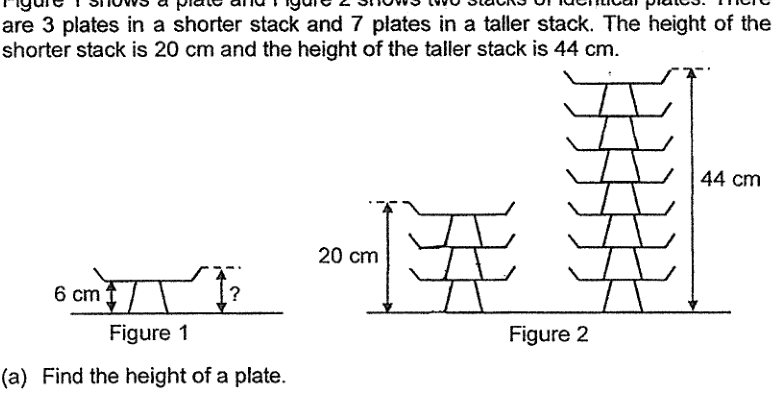
- (a)
Find the height of a plate.
- (b)
Matthew wants to pack the plates as a single stack into a box 1 m high. Figure 3 shows the 2 possible arrangement A and B. Which arrangement will allow Matthew to pack more plates? How many more?
It won't just hand you the answer — it asks where you're stuck.How the checker works
Worked solution
17(a)
1. Identify the difference in height and the difference in the number of plates between the two stacks.
Difference in height cm
Difference in number of plates plates
2. Calculate the height of one plate gap (the thickness added by each additional plate).
Height of 1 gap cm
3. Calculate the height of a single plate by subtracting the gaps from the total height of a stack.
Height of 3 plates stack cm
This stack consists of 1 base plate and 2 gaps.
Height of 2 gaps cm
Height of 1 plate cm
cm
17(b)
1. Find the height of a single plate and the height added by each subsequent plate in a normal stack.
From the given stacks:
Height of 7 plates = cm
Height of 3 plates = cm
Difference in height for 4 plates = cm
Height added by each additional plate in a stack = cm
Height of the first plate = cm
2. Calculate the maximum number of plates that can be packed in Arrangement A.
In Arrangement A, the plates are stacked normally.
Let be the number of plates.
Total height = cm
We need the height to be at most m = cm.
So, a maximum of plates can be packed in Arrangement A.
3. Calculate the maximum number of plates that can be packed in Arrangement B and find the difference.
In Arrangement B, the plates are in an alternating orientation (e.g., top-to-top, base-to-base), meaning they do not overlap and each plate contributes its full height of cm.
Number of plates in Arrangement B =
So, a maximum of plates can be packed in Arrangement B.
Difference =
Arrangement A allows Matthew to pack more plates.
Arrangement A, 4 more plates
AI analysis — may contain mistakes.
Worked this one out on paper? Snap your steps and Gigle's AI math checker will circle the step where it went wrong.
More questions on this topic
- 1Containers X and Y are rectangular containers. The base area of Container X is 30 cm^2 and the base area of Container Y…
- 2Andy had $5x. After buying apples at 60c each, he had $2x left. How many apples did Andy buy? Answer: ___
- 3n is a positive integer. Explain whether, for all n, is a multiple of 3. Answer ___
- 4A bag contains 4 black coins, 7 red coins and 11 white coins. Two coins are drawn from the bag at random, one after anot…
- 5给出下列判断:①单项式的系数为;②整式是二次三项式;③多项式的次数…