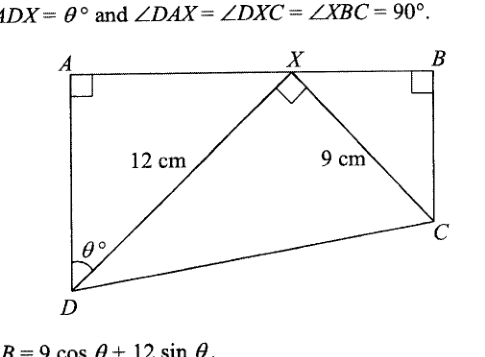
The diagram shows a trapezium ABCDABCD. The point XX lies on line ABAB such that DX=12 cmDX = 12\text{ cm} and CX=9 cmCX = 9\text{ cm}. ∠ADX=θ∘\angle ADX = \theta^\circ and ∠DAX=∠DXC=∠XBC=90∘\angle DAX = \angle DXC = \angle XBC = 90^\circ.

  1. (a)

    Show that AB=9cos⁡θ+12sin⁡θAB = 9 \cos \theta + 12 \sin \theta.

  2. (b)

    Express ABAB in the form Rcos⁡(θ−α)R \cos(\theta - \alpha), where RR and α\alpha are constants, and hence state the maximum length of ABAB and its corresponding value of θ\theta.

  3. (c)

    Find the value of θ\theta for which AB=11 cmAB = 11\text{ cm}.

Work through it with AI →

It won't just hand you the answer — it asks where you're stuck.How the checker works

Worked solution

9(a)

1. Find the length of $AX$ in terms of $\theta$

In △ADX\triangle ADX, ∠DAX=90∘\angle DAX = 90^\circ.
sin⁡θ=AXDX\sin \theta = \frac{AX}{DX}
AX=12sin⁡θAX = 12 \sin \theta

2. Find $\angle BXC$ in terms of $\theta$

In △ADX\triangle ADX, ∠AXD=180∘−90∘−θ=90∘−θ\angle AXD = 180^\circ - 90^\circ - \theta = 90^\circ - \theta.
Since A,X,BA, X, B lie on a straight line, the sum of angles at XX is 180∘180^\circ.
∠BXC=180∘−∠AXD−∠DXC\angle BXC = 180^\circ - \angle AXD - \angle DXC
∠BXC=180∘−(90∘−θ)−90∘=θ\angle BXC = 180^\circ - (90^\circ - \theta) - 90^\circ = \theta

3. Find the length of $XB$ and hence show the expression for $AB$

In △XBC\triangle XBC, ∠XBC=90∘\angle XBC = 90^\circ.
cos⁡∠BXC=XBCX\cos \angle BXC = \frac{XB}{CX}
XB=9cos⁡θXB = 9 \cos \theta
Since XX lies on ABAB, AB=AX+XBAB = AX + XB.
AB=12sin⁡θ+9cos⁡θAB = 12 \sin \theta + 9 \cos \theta
AB=9cos⁡θ+12sin⁡θAB = 9 \cos \theta + 12 \sin \theta (Shown)

Answer

AB=9cos⁡θ+12sin⁡θAB = 9 \cos \theta + 12 \sin \theta (Shown)

9(b)

1. Find the value of $R$

R=92+122=81+144=225=15R = \sqrt{9^2 + 12^2} = \sqrt{81 + 144} = \sqrt{225} = 15

2. Find the value of $\alpha$

tan⁡α=129=43\tan \alpha = \frac{12}{9} = \frac{4}{3}
α=tan⁡−1(43)≈53.130∘\alpha = \tan^{-1}\left(\frac{4}{3}\right) \approx 53.130^\circ

3. Express $AB$ in the required form

AB=15cos⁡(θ−53.1∘)AB = 15 \cos(\theta - 53.1^\circ)

4. State the maximum length of $AB$

Maximum length of AB=R=15 cmAB = R = 15\text{ cm}

5. Find the corresponding value of $\theta$

For maximum length, cos⁡(θ−53.130∘)=1\cos(\theta - 53.130^\circ) = 1
θ−53.130∘=0∘\theta - 53.130^\circ = 0^\circ
θ=53.1∘\theta = 53.1^\circ (to 1 d.p.)

Answer

AB=15cos⁡(θ−53.1∘)AB = 15 \cos(\theta - 53.1^\circ)
Maximum length = 15 cm15\text{ cm}
Corresponding θ=53.1∘\theta = 53.1^\circ

9(c)

1. Recall the $R$-formula expression for $AB$ from part (b)

From part (b), AB=15cos⁡(θ−53.13∘)AB = 15 \cos(\theta - 53.13^\circ).
We set this equal to 11:
15cos⁡(θ−53.13∘)=1115 \cos(\theta - 53.13^\circ) = 11

2. Solve for the basic angle

cos⁡(θ−53.13∘)=1115\cos(\theta - 53.13^\circ) = \frac{11}{15}
θ−53.13∘=cos⁡−1(1115)\theta - 53.13^\circ = \cos^{-1}\left(\frac{11}{15}\right)
θ−53.13∘=±42.83∘\theta - 53.13^\circ = \pm 42.83^\circ

3. Find the valid value of $\theta$ in the context of the geometric figure

Since θ\theta is an angle in the right-angled triangle ADXADX, 0∘<θ<90∘0^\circ < \theta < 90^\circ.
Taking the negative value:
θ=53.13∘−42.83∘=10.3∘ (to 1 d.p.)\theta = 53.13^\circ - 42.83^\circ = 10.3^\circ \text{ (to 1 d.p.)}
(Taking the positive value gives θ=95.96∘\theta = 95.96^\circ, which is rejected as it is obtuse).

Answer

10.3∘10.3^\circ

AI analysis — may contain mistakes.

Worked this one out on paper? Snap your steps and Gigle's AI math checker will circle the step where it went wrong.

More questions on this topic

  1. 1Solve the equation 2cot⁡22x=1−5sin⁡2x2 \cot^2 2x = 1 - \frac{5}{\sin 2x} for −180∘≤x≤180∘-180^\circ \le x \le 180^\circ.
  2. 2已知sin⁡(α+π12)=55\sin (α+ \dfrac {π}{12} )= \dfrac { \sqrt {5}}{5},则sin⁡(π3−2α)=(    )\sin ( \dfrac {π}{3} -2α)= (\:\:\:\:) A. 45 \dfrac {4}{5}…
  3. 38.8.设△ABC\triangle ABC的内角AA,BB,CC所对的边分别为aa,bb,cc,若bcos⁡C+ccos⁡B=asin⁡Ab\cos C+c\cos B=a\sin A,则△ABC\triangle ABC的形状为…
  4. 4Prove that sin⁡3xsec⁡2x+sin⁡x=tan⁡xsec⁡x\sin^{3} x\sec^{2} x + \sin x = \tan x\sec x. Solve the equation sin⁡3xsec⁡2x+sin⁡x=5\sin^{3} x\sec^{2} x + \sin x = 5 for 0≤x≤360∘0 \le x \le 360^\circ…
  5. 5Given that cos⁡x=−45\cos x = -\frac{4}{5} and tan⁡x>0\tan x > 0, find sin⁡2x\sin 2x, cos⁡x2\cos \frac{x}{2}.