In this question, you should state clearly all the distributions that you use, together with the values of the appropriate parameters.
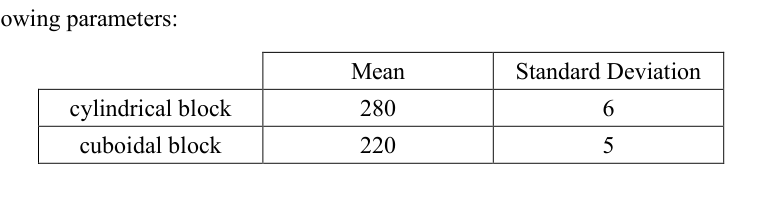
A toy designer creates weighted wooden blocks used in balance-based educational toys. There are two types of blocks: cylindrical blocks and cuboidal blocks. The mass, in grams, of each cylindrical block and cuboidal block follow a normal distribution with the following parameters:
Mean Standard Deviation cylindrical block 280 6 cuboidal block 220 5
To build a deluxe seesaw model, the designer uses:
- 2 cylindrical blocks,
- 3 cuboidal blocks,
- 7 screws,
- 1 wooden plank.
The blocks are drilled before assembly to fit screws:
- Each cylindrical block loses 5% of its mass after drilling.
- Each cuboidal block loses 3% of its mass after drilling.
The masses of the remaining components follow a normal distribution with the following parameters:
Mean Standard Deviation screw 8 1.2 wooden plank 540 8
When assembling the deluxe seesaw model, all of its components are chosen at random.
| Mean | Standard Deviation | |
|---|---|---|
| cylindrical block | 280 | 6 |
| cuboidal block | 220 | 5 |
| Mean | Standard Deviation | |
|---|---|---|
| screw | 8 | 1.2 |
| wooden plank | 540 | 8 |
- (a)
Find the probability that the mass of a randomly selected cylindrical block exceeds the mass of a randomly selected cuboidal block by more than 65 grams.
- (b)
The probability that the total of twice the mass of a cylindrical block and thrice the mass of a cuboidal block being less than g is 0.355. Find the value of , giving your answer to the nearest integer.
- (c)
Find the probability that the total mass of all the modified components in a deluxe seesaw model is more than 1785 g.
It won't just hand you the answer — it asks where you're stuck.How the checker works
Worked solution
9(a)
1. Define the random variables and their initial distributions.
Let be the mass of a cylindrical block and be the mass of a cuboidal block.
2. Determine the expectation and variance of the difference $X - Y$.
3. State the distribution of $X - Y$ and calculate the required probability.
Since and are independent normal variables,
(to 3 s.f.)
9(b)
1. Formulate the random variable for the linear combination and calculate its expected value.
Let be the mass of a cylindrical block and be the mass of a cuboidal block.
and .
Let be the total of twice the mass of a cylindrical block and thrice the mass of a cuboidal block. Then .
2. Calculate the variance of the linear combination.
Since the masses of the blocks are randomly selected and thus independent, the variance of is:
3. State the resulting normal distribution and use the inverse normal method to find $M$.
Since and are normally distributed, their linear combination is also normally distributed:
We are given .
Using the inverse normal function on a graphing calculator:
Rounding to the nearest integer:
9(c)
1. Define the random variable for the total mass of the assembled seesaw model.
Let , , , and be the masses of a cylindrical block, cuboidal block, screw, and wooden plank respectively.
Let be the total mass of the deluxe seesaw model.
2. Calculate the expected value of $T$.
3. Calculate the variance of $T$ and state its distribution.
Hence, .
4. Calculate the probability that the total mass exceeds 1785 g.
AI analysis — may contain mistakes.
Worked this one out on paper? Snap your steps and Gigle's AI math checker will circle the step where it went wrong.
More questions on this topic
- 1Section B: Statistics [60 marks] A manager claims that the time spent by each customer at his supermarket follows a norm…
- 2In this question you should state the parameters of any distributions that you use. Crispy Cream Donut Shop sells 2 type…
- 3 is a normal random variable with mean 1 and variance 1, and is also a normal random variable with mean and…
- 4A credit card company has a special 24-hour telephone hotline for customers to either report a lost credit card or to re…
- 5Fishing Company A has two types of fishing vessels, the "Standard" vessel and the "Large" vessel. The amount of fish cau…