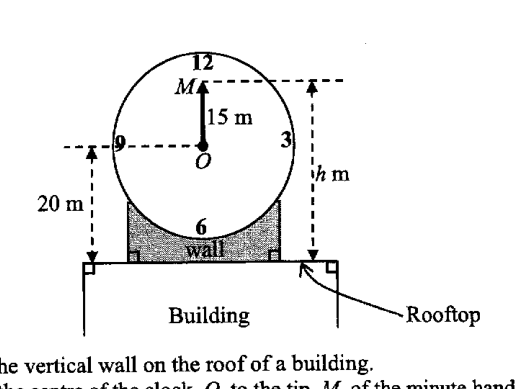
A clock is set on the vertical wall on the roof of a building.
The distance from the centre of the clock, , to the tip, , of the minute hand is 15 m.
The height, m, of above the rooftop is given by , where is the time in minutes past the hour. is 20 m above the rooftop. The rooftop is taken to be horizontal.
- (a)
Write down the value of and explain why .
- (b)
Explain why the value of is .
- (c)
Sketch the graph of for .
- (d)
Find the two timings in the first hour for which the height of is 10 m.
It won't just hand you the answer — it asks where you're stuck.How the checker works
Worked solution
12(a)
1. State the value of $a$ by relating it to the amplitude of the model.
The amplitude corresponds to the length of the minute hand.
2. Explain the value of $b$ by relating it to the vertical shift of the model.
The parameter is the vertical shift (or mean value) of the cosine function. Physically, this is the height of the centre of the clock above the rooftop.
When the minute hand is horizontal, , so . Since the centre is given to be 20 m above the rooftop, .
represents the mean height of the tip , which corresponds to the height of the centre of the clock above the rooftop. When the minute hand is horizontal, and . Since is 20 m above the rooftop, .
12(b)
1. Identify the period of the minute hand's motion
A minute hand completes one full revolution in 60 minutes. Therefore, the period of the height function is 60 minutes.
2. Equate the period to the formula for the period of a cosine function to find $k$
The period of is given by .
The minute hand completes one full revolution in 60 minutes, so the period is 60. Since the period of is , we have , which gives .
12(c)
1. State the full equation of the height function using results from previous parts
From parts (a) and (b), , , and .
2. Determine the coordinates of key points (maximum, minimum, and midline intersections) for the given domain
The period is minutes.
At , (maximum).
At , (midline).
At , (minimum).
At , (midline).
3. Sketch the graph
Draw a smooth curve passing through , , , and on a set of axes with on the horizontal axis and on the vertical axis.
A smooth cosine curve starting at , passing through , reaching a minimum at , and ending at .
12(d)
1. Set up the equation for the height of $M$ using the parameters from earlier parts.
From parts (a) and (b), .
We are given , so:
2. Isolate the trigonometric function.
3. Find the basic angle and the possible values for the argument in the required interval.
Basic angle rad.
Since cosine is negative, the angle lies in the 2nd and 3rd quadrants.
For the first hour, , so .
4. Solve for $t$.
and
AI analysis — may contain mistakes.
Worked this one out on paper? Snap your steps and Gigle's AI math checker will circle the step where it went wrong.
More questions on this topic
- 1State the range of principal values of . The curve is shown below for …
- 2The diagram below shows a portion a plastic fibre cable, which allows light waves to pass through. The path of the light…
- 3The diagram shows a wind turbine with blade in length. The centre of the wind turbine is fro…
- 4The diagram shows the curve for radians. A minimum point …
- 5The function f is defined by for . State the amplitude and the period of . State t…