A farmer uses 160 m of fencing to enclose a plot of his land in a shape that comprises an isosceles triangle and a rectangle, with the dimensions shown.
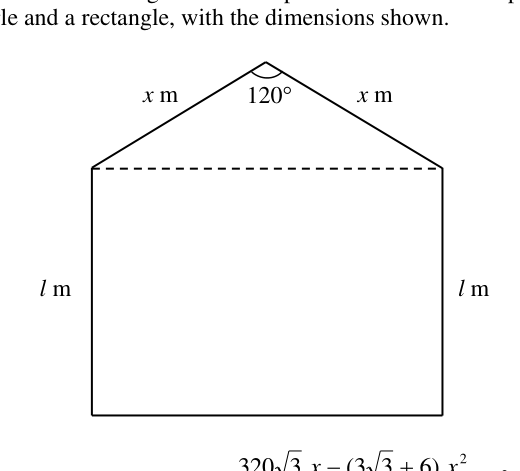
  1. (i)

    Show that the area of the plot is 3203 x−(33+6) x24 m2.\dfrac{320\sqrt{3}\,x - (3\sqrt{3} + 6)\,x^2}{4}\ \text{m}^2.

  2. (ii)

    Given that xx can vary, find the value of xx for which the area of the plot is stationary.

  3. (iii)

    Explain why this value of xx gives the farmer the largest possible area for the plot. Find this area and give your answer correct to the nearest square metre.

Work through it with AI →

It won't just hand you the answer — it asks where you're stuck.How the checker works

Worked solution

11(i)

1. Find the length of the base of the isosceles triangle (which is also the top width of the rectangle).

Let the base of the triangle be ww.
Using the cosine rule on the triangle:
w2=x2+x2−2(x)(x)cos⁡120∘w^2 = x^2 + x^2 - 2(x)(x)\cos 120^\circ
w2=2x2−2x2(−12)=3x2w^2 = 2x^2 - 2x^2(-\frac{1}{2}) = 3x^2
w=3xw = \sqrt{3}x

2. Express the perimeter of the plot in terms of $x$ and $l$, and solve for $l$.

The perimeter consists of the two sloping sides of the triangle, the two vertical sides of the rectangle, and the bottom horizontal side of the rectangle.
Perimeter =x+x+l+l+w=2x+2l+3x= x + x + l + l + w = 2x + 2l + \sqrt{3}x
Given perimeter is 160 m:
2x+2l+3x=1602x + 2l + \sqrt{3}x = 160
2l=160−(2+3)x2l = 160 - (2 + \sqrt{3})x
l=80−2+32xl = 80 - \frac{2 + \sqrt{3}}{2}x

3. Find the area of the isosceles triangle.

Area of triangle =12(x)(x)sin⁡120∘= \frac{1}{2}(x)(x)\sin 120^\circ
=12x2(32)=34x2= \frac{1}{2}x^2 \left(\frac{\sqrt{3}}{2}\right) = \frac{\sqrt{3}}{4}x^2

4. Find the area of the rectangle and the total area, then simplify to the required form.

Area of rectangle =w×l=3x(80−2+32x)= w \times l = \sqrt{3}x \left(80 - \frac{2 + \sqrt{3}}{2}x\right)
=803x−23+32x2= 80\sqrt{3}x - \frac{2\sqrt{3} + 3}{2}x^2
Total Area A=Area of triangle+Area of rectangleA = \text{Area of triangle} + \text{Area of rectangle}
A=34x2+803x−23+32x2A = \frac{\sqrt{3}}{4}x^2 + 80\sqrt{3}x - \frac{2\sqrt{3} + 3}{2}x^2
A=803x+(34−43+64)x2A = 80\sqrt{3}x + \left(\frac{\sqrt{3}}{4} - \frac{4\sqrt{3} + 6}{4}\right)x^2
A=803x−33+64x2A = 80\sqrt{3}x - \frac{3\sqrt{3} + 6}{4}x^2
A=3203x−(33+6)x24A = \frac{320\sqrt{3}x - (3\sqrt{3} + 6)x^2}{4} (Shown)

Answer

Shown.

11(ii)

1. Differentiate the area function with respect to $x$

Let A=3203 x−(33+6) x24=803 x−33+64 x2A = \frac{320\sqrt{3}\,x - (3\sqrt{3} + 6)\,x^2}{4} = 80\sqrt{3}\,x - \frac{3\sqrt{3} + 6}{4}\,x^2.

dAdx=803−33+62 x\frac{dA}{dx} = 80\sqrt{3} - \frac{3\sqrt{3} + 6}{2}\,x

2. Set the derivative to zero to find the stationary point

For a stationary value, dAdx=0\frac{dA}{dx} = 0.

803−33+62 x=080\sqrt{3} - \frac{3\sqrt{3} + 6}{2}\,x = 0

33+62 x=803\frac{3\sqrt{3} + 6}{2}\,x = 80\sqrt{3}

3. Solve for $x$

x=160333+6x = \frac{160\sqrt{3}}{3\sqrt{3} + 6}

x≈24.742≈24.7x \approx 24.742 \approx 24.7 (to 3 s.f.)

Answer

x=160333+6x = \frac{160\sqrt{3}}{3\sqrt{3} + 6} or x≈24.7x \approx 24.7

11(iii)

1. Find the second derivative of the area function to determine the nature of the stationary point.

From (i), A=32034x−33+64x2=803x−33+64x2A = \frac{320\sqrt{3}}{4}x - \frac{3\sqrt{3} + 6}{4}x^2 = 80\sqrt{3}x - \frac{3\sqrt{3} + 6}{4}x^2.
dAdx=803−33+62x\frac{dA}{dx} = 80\sqrt{3} - \frac{3\sqrt{3} + 6}{2}x.
d2Adx2=−33+62\frac{d^2A}{dx^2} = -\frac{3\sqrt{3} + 6}{2}.

2. Explain why the area is a maximum.

Since d2Adx2=−33+62<0\frac{d^2A}{dx^2} = -\frac{3\sqrt{3} + 6}{2} < 0 for all xx, the stationary point is a maximum. Thus, this value of xx gives the largest possible area.

3. Calculate the maximum area using the value of $x$ from (ii).

From (ii), dAdx=0  ⟹  x=160333+6≈24.7436\frac{dA}{dx} = 0 \implies x = \frac{160\sqrt{3}}{3\sqrt{3} + 6} \approx 24.7436.
Substitute x=160333+6x = \frac{160\sqrt{3}}{3\sqrt{3} + 6} into AA:
A=803(160333+6)−33+64(160333+6)2A = 80\sqrt{3}\left(\frac{160\sqrt{3}}{3\sqrt{3} + 6}\right) - \frac{3\sqrt{3} + 6}{4}\left(\frac{160\sqrt{3}}{3\sqrt{3} + 6}\right)^2
A=3840033+6−1920033+6=1920033+6≈1140.39A = \frac{38400}{3\sqrt{3} + 6} - \frac{19200}{3\sqrt{3} + 6} = \frac{19200}{3\sqrt{3} + 6} \approx 1140.39
A≈1140 m2A \approx 1140\text{ m}^2 (to the nearest square metre).

Answer

The second derivative is negative, hence the area is a maximum. The maximum area is 1140 m21140\text{ m}^2.

AI analysis — may contain mistakes.

Worked this one out on paper? Snap your steps and Gigle's AI math checker will circle the step where it went wrong.

More questions on this topic

  1. 1The diagram shows a greenhouse built on a rectangular base. 140 m2140\text{ m}^2 of polyethene is used to build the curved r…
  2. 2In the triangle ABCABC, AB=x cmAB = x\ \text{cm}, AC=3x cmAC = 3x\ \text{cm} and angle BAC=2π3BAC = \dfrac{2\pi}{3}. If xx is increasing…
  3. 3A curve has the equation y=2x−33x+4y = \frac{2x - 3}{3x + 4}, where x≠−43x \ne -\frac{4}{3}. The normal to the point PP on the cur…
  4. 4Find the gradient function of the curve y=2x2−ln⁡x+cy = 2x^2 - \ln x + c. The curve touches the positive xx-axis at point TT. Fi…
  5. 5The normal to the curve y=2tan⁡3x−1y = 2\tan 3x - 1 at point P(π3,−1)P\left(\frac{\pi}{3}, -1\right) crosses the yy-axis at point AA…