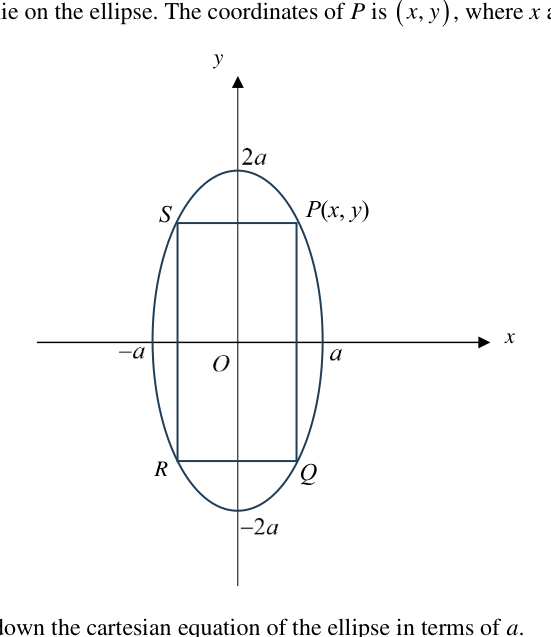
The diagram shows an ellipse, centred at the origin with semi-minor axis and semi-major axis , where . The rectangle is inscribed in the ellipse such that its four vertices , , and lie on the ellipse. The coordinates of is , where and are positive.
- (i)
Write down the cartesian equation of the ellipse in terms of .
- (ii)
By considering the coordinates of , show that , the area of rectangle , is .
- (iii)
Using differentiation, find, in terms of , the value of when is a maximum. You do not need to prove that is a maximum.
- (iv)
Find the value of if the maximum value of is 100.
It won't just hand you the answer — it asks where you're stuck.How the checker works
Worked solution
6(i)
1. State the standard equation using the given intercepts
The ellipse is centred at the origin with a horizontal semi-axis of and a vertical semi-axis of . Substituting these into the standard ellipse equation gives:
6(ii)
1. Re-derive the Cartesian equation of the ellipse (from part i) to use in this part.
The ellipse is centred at the origin with x-intercepts and y-intercepts .
Its Cartesian equation is:
2. Express the area of rectangle $PQRS$ in terms of $x$ and $y$.
Since is in the first quadrant and the inscribed rectangle has vertices on the ellipse, it is symmetric about both coordinate axes.
The width of the rectangle is and its height is .
The area is given by:
3. Express $y$ in terms of $x$ and substitute it into the area equation to show the required result.
From the equation of the ellipse:
Since lies in the first quadrant, , so we take the positive square root:
Substitute into the area equation:
6(iii)
1. Differentiate the area function $A$ with respect to $x$.
Given .
Using the product rule and chain rule:
2. Equate the derivative to zero and solve for $x$ in terms of $a$.
For to be a maximum, set :
Multiply throughout by (since and the denominator is non-zero):
Since it is given that and are positive,
6(iv)
1. Find the value of $x$ that maximizes the area $A$ (as required from part iii).
From part (iii), to find when is a maximum, we set :
2. Substitute $x = \frac{a}{\sqrt{2}}$ into the area expression to find the maximum area in terms of $a$.
Substitute into :
3. Equate the maximum area to 100 and solve for $a$.
Given that the maximum value of is 100:
Since , we reject the negative root:
AI analysis — may contain mistakes.
Worked this one out on paper? Snap your steps and Gigle's AI math checker will circle the step where it went wrong.
More questions on this topic
- 1The curve has equation . Without using a calculator, find the set of values that …
- 2The functions and are defined by …
- 3By expressing the equation of the curve in the form , where …
- 45 (a) Solve the following integral. …
- 5A curve has the equation where . Sketch , stating the coordinates of any points o…