Tank A and Tank B shown below are empty at first. Tank A has a base area of 441 cm^2. When water was poured into Tank A, some of the water flowed into Tank B through the hole which was just above Tank B. Tank B was filled and the total amount of water in both tanks became 5324 cm^3.
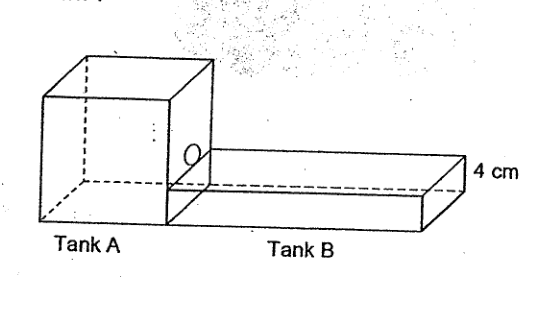
- (a)
Find the amount of water in Tank A.
- (b)
What is the capacity of Tank B?
It won't just hand you the answer — it asks where you're stuck.How the checker works
Worked solution
14(a)
1. Determine the final height of the water in Tank A
Since water flowed into Tank B but Tank B was only filled, the water in Tank A must have stopped overflowing. This means the final water level in Tank A is exactly at the level of the hole. The hole is just above Tank B, so its height is equal to the height of Tank B, which is .
2. Calculate the volume of water in Tank A
14(b)
1. Find the volume of water in Tank A (result from part a)
Since the hole is just above Tank B, the water level in Tank A is at the height of Tank B, which is .
Volume of water in Tank A
2. Find the volume of water in Tank B
Volume of water in Tank B
3. Find the total capacity of Tank B
Tank B is filled, so units represent .
unit
Capacity of Tank B ( units)
AI analysis — may contain mistakes.
Worked this one out on paper? Snap your steps and Gigle's AI math checker will circle the step where it went wrong.
More questions on this topic
- 1The figure below is made up of 2 squares, ABCD and DEFG. X is a point on GD and Y is a point on DE. BC = 7 cm, FE = 6 cm…
- 2Find the value of . Ans: ___
- 3In a camp, the number of children is of the number of adults. of the children are boys and t…
- 4A can of mushroom soup costs $3.20 and a bundle of 3 cans of mushroom soup costs $8. Diane wants to buy 20 cans of mus…
- 5A group of singers are arranged in 5 rows. There are 7 singers in the second row. Each row has more singers than the…