Here is some information about a grain storage bin.
Grain Storage Bin
Item Value Height (h) 6880 mm Diameter (d) 4550 mm Mass 1100 kg
Safety information: The bin can be filled to a maximum of 85% of its total volume.
In this question, the grain storage bin can be modelled as a right cylinder with a right conical top. The height of the conical top is half the radius of the bin.
| Item | Value |
|---|---|
| Height (h) | 6880 mm |
| Diameter (d) | 4550 mm |
| Mass | 1100 kg |
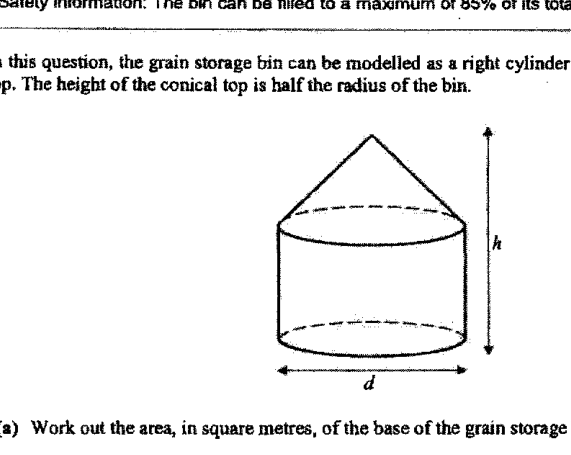
- ((a))
Work out the area, in square metres, of the base of the grain storage bin.
Answer ... m^2
- ((b))
Work out the volume, in cubic metres, of the grain storage bin.
Answer ... m^3
- ((c))
The storage bin is never filled to more than its safe volume.
It will need a special load-bearing support structure if its total weight per square metre, on the ground beneath, is greater than 20 kN/m^2.
Given that the model is an underestimation of the actual storage capacity of the bin, does the bin need a special load-bearing support structure? Justify your decision with calculations.
Answer
It won't just hand you the answer — it asks where you're stuck.How the checker works
Worked solution
11((a))
1. Find the base area using the radius in metres
Diameter
Radius
Area of base
11((b))
1. Find the radius and the separate heights of the cone and cylinder in metres
Cone height
Cylinder height
2. Calculate the volume of the cylindrical part
Volume of cylinder
3. Calculate the volume of the conical top and add it to the cylinder volume
Volume of cone
Total volume
11((c))
1. Find the safe volume of grain using the 85% fill limit
From part (b), the modelled volume of the bin is .
2. Find the mass of grain at the safe volume
Density of grain .
3. Add the mass of the empty bin to get the total mass
Mass of empty bin .
4. Convert the total mass to weight in kN
Given that is equivalent to ,
5. Find the total weight per square metre on the ground
From part (a), the base area is .
6. Compare with the limit and justify using the underestimation statement
The calculated value is already greater than the limit. Also, the model is an underestimation of the actual storage capacity, so the actual maximum grain weight would be greater than this calculated value.
Yes. The calculated total weight per square metre is about , which is already greater than . Since the model underestimates the actual storage capacity, the actual value would be even greater, so the bin needs a special load-bearing support structure.
AI analysis — may contain mistakes.
Worked this one out on paper? Snap your steps and Gigle's AI math checker will circle the step where it went wrong.
More questions on this topic
- 1A cuboid has a volume of 250 cm^3, correct to the nearest cubic centimetre. The height of the cuboid is 8.4 cm, correct…
- 2The diagram (not drawn to scale) shows the speed-time graph of a vehicle. The vehicle starts from rest and accelerates u…
- 3The diagram below shows the speed-time graph of a bus journey. The bus accelerated from rest at 1.25 m/s^2 to a speed of…
- 4In the diagram, POR is a quadrant of a circle with radius 6 cm. OR and PQ are parallel. QR is an arc of a circle with ce…
- 5Four squares of side length , , , and units are arranged in increasing size order so that their left edges…