The diagram shows a cuboid with height x cm.
The width of the cuboid is 6 cm more than its height.
The length of the cuboid is twice its width.
The length of the diagonal, AG, of the cuboid is 24 cm.
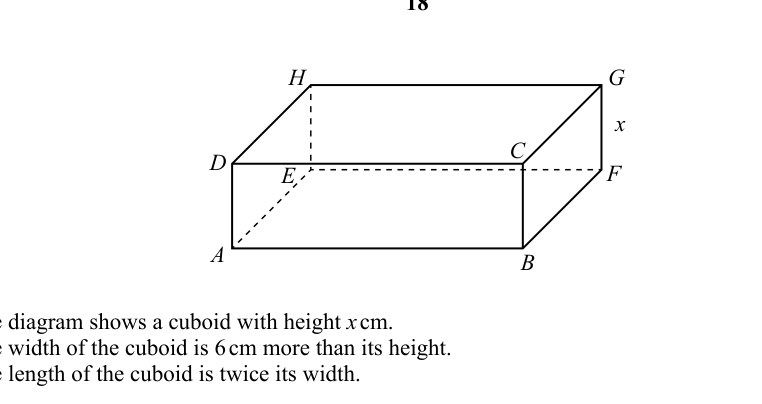
- (a)
Form an equation, in terms of x, to represent this information and show that it simplifies to
- (b)
Solve the equation . Give your solutions correct to two decimal places.
Answer x = ... or x = ...
- (c)
Calculate angle GAF.
Answer ...
It won't just hand you the answer — it asks where you're stuck.How the checker works
Worked solution
8(a)
1. Express all three dimensions of the cuboid in terms of $x$.
Height
Width
Length
2. Form the equation using the space diagonal of the cuboid.
By Pythagoras' theorem in 3 dimensions,
Since ,
3. Expand the squares and simplify the equation.
4. Rearrange to show the required quadratic equation.
Divide by :
8(b)
1. Identify the coefficients and substitute them into the quadratic formula.
For , , , .
Using
2. Simplify the discriminant and the exact expression for the two roots.
3. Calculate both numerical solutions.
4. Round both solutions to two decimal places.
Correct to two decimal places,
8(c)
1. Use the physically valid value of $x$ and find the side opposite angle $GAF$.
From part (b), take the positive value
since the height of a cuboid cannot be negative.
The width is
In triangle , is the width of the cuboid, so
2. Apply a trigonometric ratio in right-angled triangle $AFG$ to find angle $GAF$.
In right-angled triangle , the hypotenuse is
For angle ,
Hence
AI analysis — may contain mistakes.
Worked this one out on paper? Snap your steps and Gigle's AI math checker will circle the step where it went wrong.
More questions on this topic
- 1In the diagram, there are two right-angled triangles ΔABD and ΔCEB such that AD = 12 cm, BD = 15 cm and BE = 20 cm. Find…
- 2In triangle ABC, , and . Express as a fraction in its…
- 3In the diagram, POR is a quadrant of a circle with radius 6 cm. OR and PQ are parallel. QR is an arc of a circle with ce…
- 4Triangle ABC is a right-angled triangle. Given that two of its lengths are 11 cm and 5 cm, find two possible lengths for…
- 5The diagram below shows a gift souvenir formed by joining the plane face of a solid hemisphere of radius 3 cm and a soli…