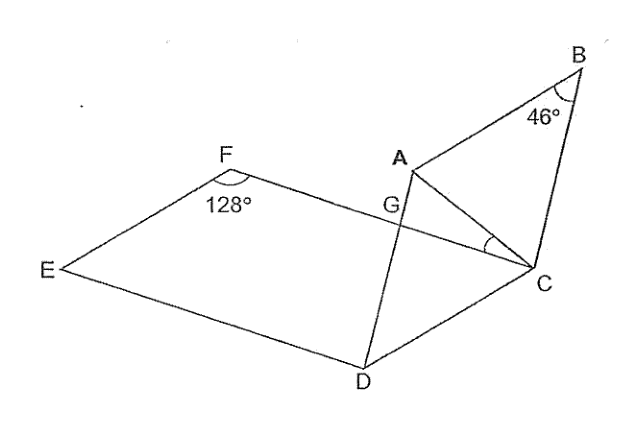
ABCD is a rhombus and CDEF is a parallelogram.
Find .
It won't just hand you the answer — it asks where you're stuck.How the checker works
Worked solution
10
1. Find the angle $\angle ACD$ in the rhombus $ABCD$.
In rhombus , the adjacent angles sum to , so .
The diagonal bisects , so:
2. Find the angle $\angle FCD$ in the parallelogram $CDEF$.
In parallelogram , adjacent angles sum to . Assuming the given angle refers to the interior angle (or ), the adjacent angle is:
3. Calculate $\angle ACG$.
Since are collinear and lies on , the angle is the same as .
From the figure, .
Answer
AI analysis — may contain mistakes.
Worked this one out on paper? Snap your steps and Gigle's AI math checker will circle the step where it went wrong.
More questions on this topic
- 1The figure below is made up of 2 squares, ABCD and DEFG. X is a point on GD and Y is a point on DE. BC = 7 cm, FE = 6 cm…
- 2The net drawn for the solid shown below is incorrect. Name the solid. Ans: (a)___ Shade a triangular face on the net tha…
- 3In the figure below, ABCD is a trapezium and AD = BC. Each of the statements is either true, false or not possible to te…
- 4In the figure, WXYZ is a trapezium and AXYB is a rhombus. XBC and XAZ are straight lines. WX // ZY, BC = BY, …
- 5The figure below shows 12 identical squares. What is the least number of such squares that must be added to the figure s…