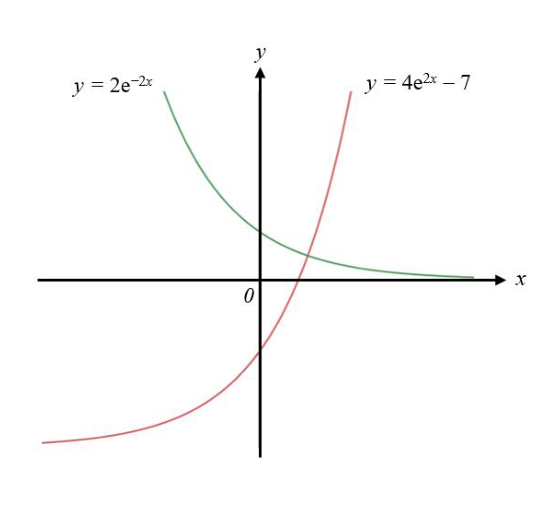
The diagram below shows the curve and the curve .
- (a)
Using the diagram above, determine with explanation, the number of solutions for the equation .
- (b)
Solve the equation .
It won't just hand you the answer — it asks where you're stuck.How the checker works
Worked solution
1(a)
1. Rearrange the given equation to match the equations of the curves in the diagram
The equation can be rearranged as:
2. Relate the equation to the intersection of the curves and state the number of solutions
The solutions to correspond to the points of intersection of the curves and .
From the diagram, the two curves intersect at exactly one point. Therefore, there is 1 solution.
1 solution
1(b)
1. Transform the equation into a quadratic equation in terms of $e^{2x}$
Let . Then .
2. Solve the quadratic equation for $u$
3. Substitute back $e^{2x}$ and reject the invalid solution
Since for all real , has no real solution.
4. Solve for $x$ using natural logarithms
or
AI analysis — may contain mistakes.
Worked this one out on paper? Snap your steps and Gigle's AI math checker will circle the step where it went wrong.
More questions on this topic
- 1Mr Phua bought a new car. After months, its value is given by , where is a constant. The…
- 2Find the gradient function of the curve . The curve touches the positive -axis at point . Fi…
- 3The point lies on the curve for . The normal to the curve at is par…
- 4The figure shows part of the curve . and are two points on the curve. Given that …
- 5函数则…