The figure ABCD is formed by two different squares and two identical rectangles. The area of the small square is 1/4 the area of the big square.
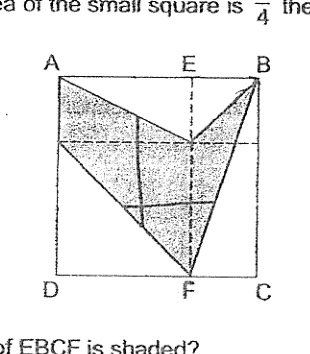
- (a)
What fraction of EBCF is shaded?
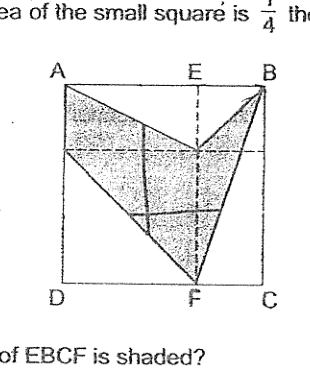
- (b)
What fraction of ABCD is shaded?
It won't just hand you the answer — it asks where you're stuck.How the checker works
Worked solution
No solution to show yet.
Worked this one out on paper? Snap your steps and Gigle's AI math checker will circle the step where it went wrong.
More questions on this topic
- 1The normal to the curve at point crosses the -axis at point …
- 2The point lies on the curve for . The normal to the curve at is par…
- 3The figure shows part of the curve . and are two points on the curve. Given that …
- 4The diagram shows part of the curve which crosses the -axis at and the -axis at …
- 5The triangle ABC is such that its area is , the length of AB is …